




Uninsured Motorist Coverage: What Every Driver Needs

Updated: Jul 30

Uninsured motorist coverage (UM/UIM) pays your medical bills, lost wages, pain and suffering, and sometimes vehicle damage when the driver who hit you has no insurance or not enough to cover what you’ve lost. A significant share of U.S. drivers were uninsured in the most recent reporting year, and underinsured drivers push that exposure even higher in many states. The practical upshot: if you’re in a serious crash, there’s a real chance the other driver can’t fully pay for your recovery.
Here’s what UM/UIM protects you from, at a glance:
Uninsured driver: The at-fault driver has no liability insurance at all.
Hit-and-run: The driver flees the scene (subject to state corroboration rules).
Underinsured driver: The at-fault driver has insurance, but limits are too low to cover your damages.
Insurer insolvency: The at-fault driver’s carrier goes bankrupt or denies the claim.
One immediate action: Pull out your declarations page and check whether you have both UM and UIM listed, and at what limits. If those limits are below 100/300 (meaning $100,000 per person, $300,000 per accident), or below your personal asset exposure, call a licensed agent before your next renewal.
Table of Contents
What UM and UIM actually mean and when each one applies
The two coverages sound similar but respond to different situations.

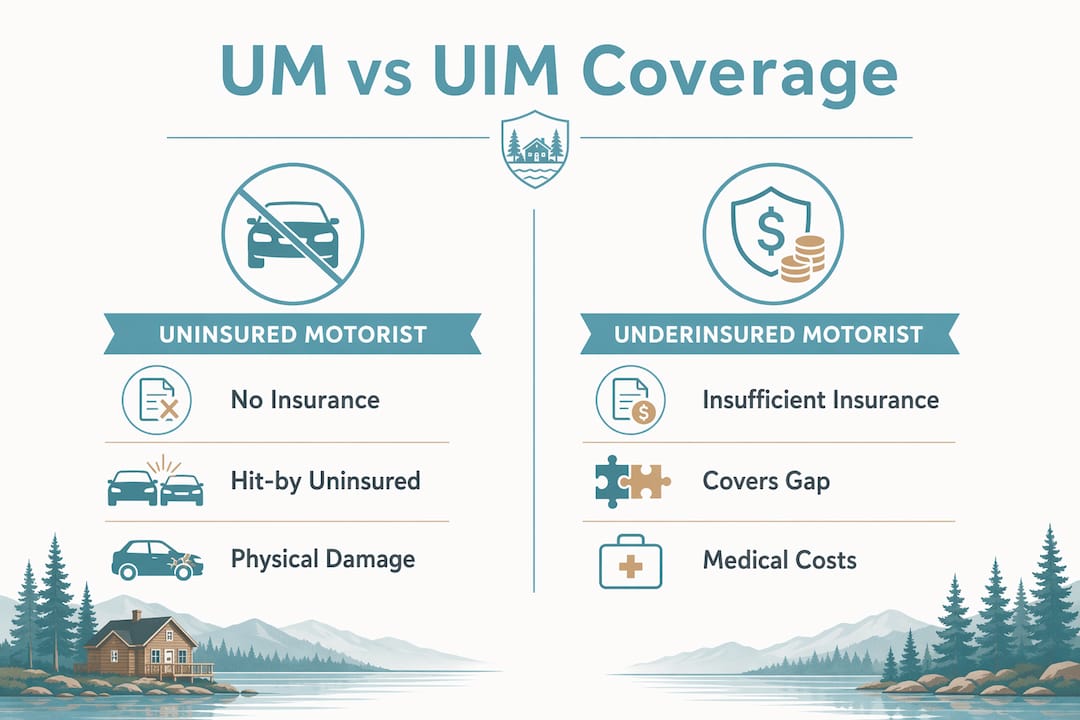
Uninsured Motorist (UM) kicks in when the at-fault driver has no valid liability insurance. That includes drivers who let their policy lapse, drivers who give you a fake insurance card, and in most states, hit-and-run drivers who flee before you can get their information. Some states also trigger UM when the at-fault driver’s insurer becomes insolvent or formally denies the claim.
Underinsured Motorist (UIM) applies when the other driver has insurance, but their liability limits aren’t enough to cover your actual damages. Say the driver who rear-ended you carries the state minimum of $25,000 per person. Your ER visit, surgery, and six weeks of missed work add up to $120,000. Their policy pays $25,000. Your UIM coverage is designed to bridge that gap, up to your own UIM limit.
Three quick scenarios that illustrate the difference:
A driver runs a red light and hits you, then drives away. No plate, no contact info. UM responds (if your state’s corroboration rules are met).
A driver with $25,000 in liability coverage causes $90,000 in injuries. Their policy pays first; your UIM covers the remaining gap up to your limit.
The at-fault driver’s insurer goes under before paying. UM may treat that driver as effectively uninsured.
Some states combine UM and UIM into a single coverage; others require both separately or allow you to reject them in writing. State insurance department guidance is the authoritative source for your state’s specific rules.
What UM/UIM typically covers and what it doesn’t
What’s usually covered
UM Bodily Injury (UMBI) is the core protection. It can pay for:
Emergency room bills, surgery, hospitalization, and rehabilitation
Lost wages while you recover
Pain and suffering (non-economic damages)
Funeral expenses in fatal crashes
In some states, diminished vehicle value or other intangible losses
UM Property Damage (UMPD) covers your vehicle when an uninsured driver damages it, but availability varies by state. Some states don’t offer UMPD at all; others require a separate deductible. UIM gap payments cover the difference between the at-fault driver’s liability payout and your actual losses, up to your UIM limit.
Passengers in your car are generally covered too. UM follows the vehicle in most states, so anyone riding with you at the time of the crash can claim up to your per-person UM limit.
Common exclusions
Accidents you caused yourself
Damage covered by your collision policy (though hit-and-run rules vary)
Intentional acts
Business-use situations if your personal policy excludes commercial driving
How UM/UIM interacts with other coverage
Health insurance and Personal Injury Protection (PIP) or MedPay typically pay first for medical bills. UM/UIM then covers remaining losses, including wages and pain and suffering that health insurance won’t touch. Collision coverage handles vehicle damage regardless of fault, but usually comes with a deductible. If you collect from both health insurance and UM/UIM for the same bills, your insurer may pursue subrogation to recover what it paid.

Pro Tip: Confirm with your agent whether your policy stacks UM limits across multiple vehicles and whether your state allows UMPD for hit-and-run claims. These two details can significantly change your total recovery in a serious crash.
Which states require UM/UIM and how state rules change your coverage
State law determines whether UM/UIM is mandatory, optional, or something you must actively reject in writing. The rules also govern stacking and hit-and-run claim requirements.
Three categories of state rules
Rule Type | What It Means | Examples |
Mandatory UM/UIM | State law requires both coverages; you can’t waive them | Virginia, New York, North Carolina |
Must-offer (written rejection) | Insurer must offer UM/UIM; you can reject in writing | Texas, California, Florida |
Optional | No statutory offer requirement; you must ask for it | Varies; check your state DOI |
Stacking vs. de-stacking
Many states allow some form of stacking, which means you can combine UM limits across multiple vehicles on your policy. If you have three cars each with $100,000 UM per person, stacking gives you up to $300,000 per person for a single claim. In de-stacking (setoff) states, you’re limited to the highest single-vehicle limit regardless of how many cars you insure.
Insurers sometimes de-stack coverage at renewal without notice. If you’re in a stacking state and want that benefit preserved, explicitly request it in writing when you renew.
Hit-and-run rules
Most states require either physical contact between the hit-and-run vehicle and your car, or independent corroboration (a witness, traffic camera footage, or police report) to file a UM claim for a phantom driver. Prompt police reporting, typically within 24–72 hours, is usually required. Skipping the police report can sink an otherwise valid claim.
How setoff math works in practice
In a setoff (gap) state: the at-fault driver carries $25,000 in liability. Your damages total $100,000. Your UIM limit is $100,000. The insurer pays $25,000 from the at-fault policy, then your UIM pays the $75,000 gap. In an add-on state, your UIM pays the full $100,000 on top of the at-fault payment, up to your limit. The difference between these two regimes can be tens of thousands of dollars.
How to file a UM/UIM claim after an accident
At the scene
Do these things immediately, because they directly affect your claim:
Move to safety and call 911, even for minor injuries.
Get the other driver’s license plate, insurance card, and contact info if they stay.
Photograph the scene, vehicle positions, damage, and any visible injuries.
Get names and contact info for any witnesses.
Seek medical attention the same day, even if you feel okay. Delayed treatment is a common reason insurers dispute injury severity.
Filing with your own insurer
For UM/UIM, you file with your own insurance company, not the other driver’s. Notify your insurer promptly. Many policies have notice deadlines of one to two years, and some states have shorter statutory windows. Missing a deadline can result in a denied claim regardless of fault.
Pro Tip: Request written confirmation of your claim’s filing date and ask your adjuster to specify any deadlines for submitting medical records, wage documentation, or a proof-of-loss form. Keep every receipt, every medical bill, and every piece of correspondence in one folder.
Typical claim timeline
Stage | What Happens | Typical Timeframe |
Report and notice | You notify your insurer; claim number assigned | Day 1–3 |
Investigation | Insurer reviews police report, medical records, liability | 2 weeks |
At-fault carrier payment | Other driver’s insurer pays up to their limit | 4 weeks |
UIM gap evaluation | Your insurer calculates remaining damages vs. UIM limit | 2 weeks after above |
Settlement or arbitration | Agreement reached or dispute goes to arbitration | Varies widely |
Arbitration clauses are common in UM/UIM policies. They shift dispute resolution away from a jury trial, which can affect your leverage and the final payout. Review your policy’s arbitration language before a claim happens, not after.
How much UM/UIM coverage should you actually buy?
The standard recommendation from insurance analysts is straightforward: match your UM/UIM bodily injury limits to your liability limits. If you carry 100/300 liability, buy 100/300 UM/UIM. The logic is simple — your assets deserve the same protection from an underinsured driver as they do from a lawsuit if you were the one at fault.
Why state minimums fall short fast
State minimum liability limits are often $25,000 per person or less. A single emergency room visit for a broken femur can run $30,000–$50,000 before surgery, physical therapy, or lost wages enter the picture. A serious spinal injury can generate settlement factors — future care costs, lost earning capacity, permanent impairment — that push well past $500,000. Minimum UM limits evaporate in those situations.
Practical limit recommendations
Minimum floor: 50/100 UM/UIM if budget is tight, but only as a short-term position.
Standard recommendation: 100/300 UM/UIM, matching your liability limits.
Asset-protection level: 250/500 if you have significant home equity, savings, or future earnings at risk.
Stacking example
You have three vehicles, each with $100,000 UM per person, in a stacking state. You’re seriously injured by an uninsured driver. Stacked, your UM pays up to $300,000. De-stacked, you’re capped at $100,000. That $200,000 difference is the reason stacking status matters when you’re choosing limits.
Pro Tip: If you’re unsure whether your state allows stacking, ask your agent to confirm in writing and note it on your declarations page. Don’t assume it’s active just because you have multiple vehicles on the policy.
What UM/UIM typically costs and what drives the price
The premium increase to raise UM/UIM limits to match liability limits is often modest, frequently in the range of $20–$40 per six-month policy term in many markets. That’s roughly the cost of a tank of gas to add protection against a scenario that affects about 1 in 8 drivers on the road.
Factors that affect your UM/UIM premium
State: States with high uninsured driver rates charge more for UM/UIM because the risk pool is larger.
Driving record: At-fault accidents and violations raise your overall premium, including UM/UIM.
Vehicle type: Higher-value vehicles cost more to insure across all coverages.
Household drivers: Adding young or high-risk drivers to the policy increases UM/UIM costs.
Limits chosen: Moving from 25/50 to 100/300 costs more than a token amount, but the jump from 100/300 to 250/500 is usually smaller than drivers expect.
Bundling: Combining auto with home or renters insurance typically earns a multi-policy discount that partially offsets higher UM/UIM limits.
The value comparison
Consider this: a $30 per six-month increase in premium buys you an additional $75,000 in UM/UIM protection per person. Against the backdrop of a serious crash, that math is hard to argue with. The real cost of underinsurance isn’t the premium you saved. It’s the gap between what the other driver’s policy pays and what your recovery actually costs.
Hit-and-run, phantom drivers, and other edge cases
Physical contact and corroboration rules
Most states require physical contact between the hit-and-run vehicle and your car before UM coverage applies. A phantom vehicle that forces you off the road without touching your car often doesn’t qualify under a strict physical-contact rule. Some states allow independent corroboration instead, meaning a credible witness or traffic camera footage can substitute for contact. Know your state’s rule before you assume a hit-and-run qualifies.
What helps your claim
A police report filed within 24–72 hours of the incident
Witness statements or contact information collected at the scene
Traffic or dashcam footage showing the other vehicle
Consistent medical records documenting injuries from the date of the crash
When UM treats an insured driver as uninsured
UM can respond when the at-fault driver’s insurer formally denies the claim or becomes insolvent. If you receive a denial letter from the other driver’s carrier, preserve it. It may be the document that triggers your own UM coverage. Insurer insolvency is rarer but does happen; your state guaranty fund may also provide some protection in those cases.
Common reader questions about UM/UIM
Will filing a UM claim raise my premium? In most states, a UM claim you didn’t cause cannot be used to surcharge your premium. Confirm this with your agent, as state rules vary.
Are my passengers covered? Yes, in most states. UM follows the vehicle, so passengers injured in your car are covered up to your per-person UM limit.
Does UM cover me as a pedestrian? Often yes. Many UM policies cover you if you’re struck by an uninsured driver while walking or cycling, but confirm the language in your specific policy.
What if the other driver gave me fake insurance info? If the policy turns out to be invalid or lapsed, UM treats that driver as uninsured.
How to add or update your UM/UIM coverage
Step-by-step
Pull your current declarations page and locate the UM and UIM lines. Note the limits and whether they’re listed separately or combined.
Decide your target limits. If you carry 100/300 liability, aim for 100/300 UM/UIM at minimum.
Contact your agent or request an online quote. Ask for side-by-side pricing at your current limits versus 100/300 and 250/500.
Before signing, confirm stacking status, UMPD availability, and whether the policy includes an arbitration clause.
Get the updated declarations page in writing and verify the new limits appear correctly.
Questions to ask your agent
Are UM and UIM both present on my policy, and at what limits?
Are my limits stacked or de-stacked across my vehicles?
Does my policy include UMPD, and is there a separate deductible?
Does the policy contain an arbitration clause for UM/UIM disputes?
Are there any consent-to-settle requirements that could affect a UIM claim?
What to compare beyond the price
Two policies at the same limit can pay out very differently depending on whether UIM operates as a gap (setoff) or add-on coverage, whether stacking is included, and how the arbitration clause is written. A licensed agent who shops multiple carriers can flag these differences before you buy, not after a claim.
Why experts consider UIM the more critical protection
UIM is often the more important of the two coverages, and the reason is straightforward: underinsured drivers are far more common than completely uninsured ones. State-minimum liability limits haven’t kept pace with the actual cost of serious injuries. A driver following the law in a state with $25,000 per-person minimums is still dangerously underinsured by any realistic measure of crash costs.
The “risk pool symmetry” argument makes this concrete. You buy $300,000 in liability coverage to protect your assets if you cause a serious crash. The same logic applies in reverse: an underinsured driver who causes a serious crash can expose your savings, your home equity, and your future earnings to the same financial hit. Matching UM/UIM to liability limits closes that asymmetry.
Consider a real-world gap scenario. A driver with $50,000 in liability coverage causes $200,000 in injuries. Their policy pays $50,000. Without UIM, you absorb the $150,000 difference. With 250/500 UIM, your insurer covers the gap. The damages recovered in serious crashes routinely exceed state-minimum liability limits by a wide margin, which is exactly why UIM exists.
UIM and UM are complementary but distinct protections. UIM is often the more critical of the two because underinsured drivers are more common, and state-minimum liability frequently leaves large gaps in real-world crash costs. Raising UIM limits to match your liability limits is the single most cost-effective step most drivers can take to protect their financial recovery after a serious accident.
Key Takeaways
Uninsured motorist coverage is one of the most cost-effective protections on your auto policy because the premium increase to raise limits is often modest while the financial gap it closes can be enormous.
Point | Details |
Match limits to liability | Set UM/UIM bodily injury limits equal to your liability limits (e.g., 100/300 or 250/500). |
Stacking requires action | In stacking states, explicitly request stacked UM in writing at each renewal or it may lapse. |
File promptly after a crash | Notice deadlines are often one to two years; missing them can void an otherwise valid claim. |
UIM is often the priority | Underinsured drivers are more common than uninsured ones; UIM closes the gap state minimums leave. |
South Lake Agency Insurance Brokers shops 20+ carriers | South Lake Agency compares UM/UIM wording and limits across carriers at no broker fee to you. |
Why carrying both UM and UIM is the right call for most drivers
The conventional wisdom on auto insurance tends to focus on liability limits because that’s what protects you from lawsuits. What gets underweighted is the mirror image: the financial exposure you face when someone else hits you and can’t pay. State minimums were set decades ago and haven’t kept pace with the actual cost of emergency care, surgery, or months of lost income.
The case for carrying both UM and UIM at matched limits isn’t complicated. A sizable share of drivers on the road are uninsured, and an even larger share are underinsured relative to the cost of a serious crash. The premium difference between bare-minimum UM and a matched UM/UIM package is often smaller than the cost of a single copay. South Lake Agency’s approach as an independent brokerage, shopping across 20+ carriers and reviewing policy wording rather than just price, is exactly the kind of check that catches setoff clauses, missing UMPD, or de-stacked limits before a claim makes those details matter. The 97.3% client renewal rate reflects what happens when coverage is set up correctly from the start.
South Lake Agency can review your UM/UIM limits at no cost to you
Most drivers don’t know whether their UM and UIM limits are stacked, whether they have UMPD, or whether their policy contains an arbitration clause that limits their options after a crash. Those details live in the fine print, and they can change your recovery by tens of thousands of dollars.

South Lake Agency is an independent brokerage that shops 20+ top-rated carriers to find you the right UM/UIM coverage at the right price, with no broker fees added to your cost. Licensed agents review your current declarations page, compare carrier wording side by side, confirm stacking and arbitration language, and help you set limits that actually match your exposure. Clients save an average of $2,246 per year, and the 97.3% renewal rate reflects coverage that holds up when it’s needed.
Useful sources for verifying UM/UIM rules in your state
The rules governing uninsured and underinsured motorist coverage vary significantly by state. These sources are the most reliable starting points for confirming statutory language, offer/rejection requirements, and hit-and-run rules that apply where you live.
Maryland Insurance Administration — UM Claims Consumer Advisory: A plain-language PDF covering what UM claims require, how to file, and what documentation to preserve. Useful as a general reference even outside Maryland.
Oklahoma Insurance Department — Uninsured Motorist: State-specific guidance on UM requirements, offer rules, and claim procedures in Oklahoma.
Texas Department of Insurance — UM Coverage Tips: Covers what UM/UIM pays, how to file, and what Texas law requires carriers to offer.
Your state’s Department of Insurance website: Search “[your state] department of insurance uninsured motorist” to find the statutory language on stacking, hit-and-run corroboration, and mandatory offer rules. These pages are the authoritative source for your specific situation.
When you’re updating coverage or in the middle of a claim, use these links to verify the exact rules rather than relying on general summaries. State law changes, and a detail that was accurate two years ago may not reflect current requirements.
This article is general information, not legal or insurance advice. Confirm current rules with your state’s Department of Insurance or a licensed insurance professional for your specific situation.
Recommended
Comments