




Avoid Permit Denials and Winter Claims: Minnesota STR Insurance

If you rent out a property on Airbnb or VRBO in Minnesota, you need a dedicated short-term rental policy or a landlord policy with a short-term rental endorsement. A standard homeowners policy will not cover the three risks that matter most: property damage from paying guests, liability if someone gets hurt on your property, and lost income if the place is unrentable after a claim. Minnesota’s winters and a patchwork of city permit rules make the gap between “what you have” and “what you need” wider than most owners realize.
TL;DR:
Standard homeowners and landlord policies neglect key risks such as property damage from guests, liability, and lost income during repairs, requiring dedicated short-term rental coverage.
Insurance premiums for Minnesota short-term rentals are typically 15% to 25% higher than long-term rentals, influenced mainly by guest turnover, property value, and safety features.
Local city regulations vary widely, with many requiring permits and proof of adequate insurance coverage; failure to comply risks denied claims and permit rejections.
Exclusions including ordinance, wear-and-tear, and long-term water damage can catch hosts off guard, making close review of policy language essential before claims.
An independent broker can help hosts find tailored policies, verify coverage meets local requirements, and streamline the process, especially for multiple properties or complex amenities.
Table of Contents
What Does Short-Term Rental Insurance Cover in Minnesota?
Short-term rental insurance is built around three pillars: the structure itself, your liability to guests, and the income the property generates. Each works differently than the equivalent line in a homeowners policy, and the differences show up fastest when you actually file a claim.
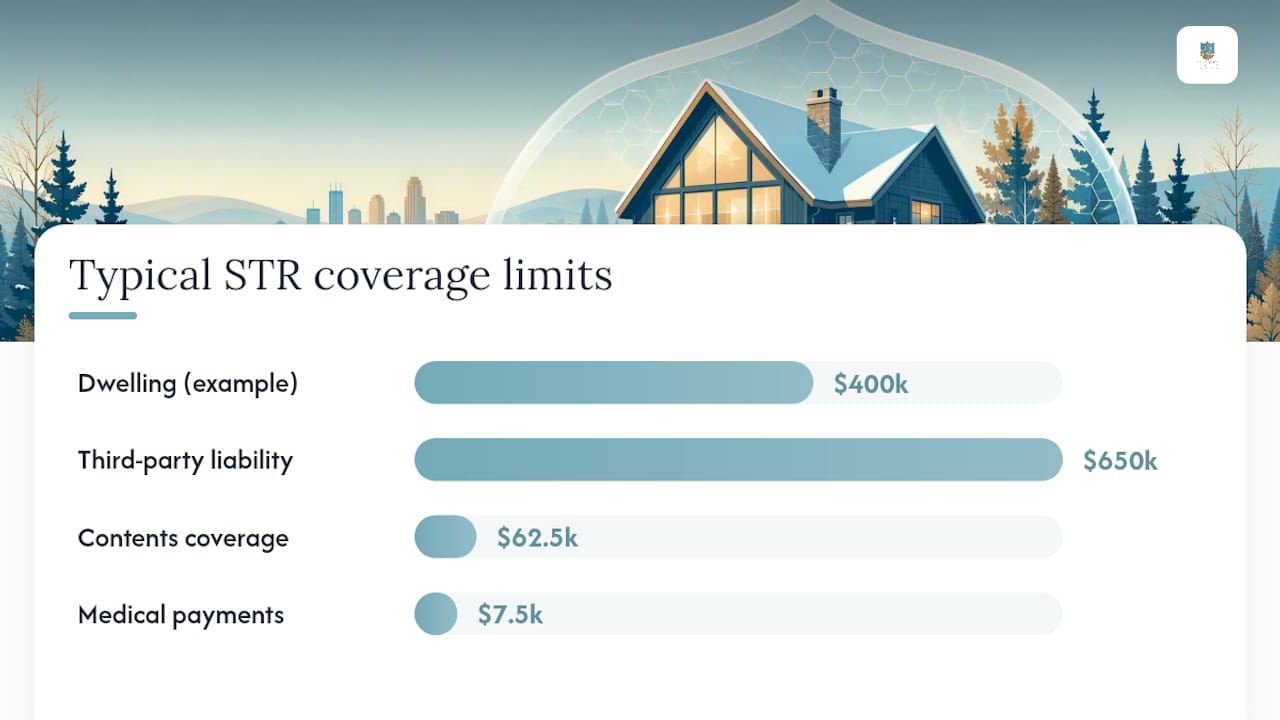
Dwelling and contents. Most STR policies price the dwelling on a replacement-cost basis, meaning a damaged roof or a flooded basement gets rebuilt to current standards, not reimbursed at depreciated value. Contents coverage, which pays for furniture, mattresses, small appliances, and the kitchen gear you stock for guests, usually runs on a separate limit inside the policy. A host with a $400,000 lake cabin might carry $50,000 to $75,000 in contents coverage if the place is fully furnished for turnover guests, well above what a typical owner-occupied policy assumes.
Guest liability. This splits into two pieces. Medical payments’ coverage pays small guest injury claims (a slip on an icy deck step, a burn from the fire pit) regardless of fault, usually up to $5,000 or $10,000, without a lawsuit. Third-party liability kicks in for larger claims where you’re found responsible, and typical per-occurrence limits run $300,000 to $1,000,000, with a separate aggregate limit capping total payouts for the policy period.
Loss of rental income. This is the coverage most new hosts skip and most experienced hosts insist on. If a covered event, say a frozen pipe bursts and floods the unit, makes the property uninhabitable, this coverage reimburses the income you’d have earned from confirmed or historically typical bookings during repairs. Insurers generally want proof: a booking calendar, past income statements, or a platform payout history, and coverage typically caps out at a set number of months rather than running indefinitely.
Beyond the core three, STR policies typically address:
Guest-caused damage, theft, and vandalism to furniture, fixtures, and electronics left in the unit.
Amenity liability for pools, hot tubs, docks, and watercraft, which many standard policies flatly exclude.
Liquor liability, relevant if you host events or leave wine or a stocked bar for guests.
Bed bug and pest coverage, an unusual add-on but one insurers increasingly offer given how expensive professional remediation gets.
Squatter protection, covering legal costs and lost income if a “guest” refuses to leave after checkout.
Short-term rental insurance exists specifically to close the gaps that homeowners and landlord policies leave open once you start charging strangers to stay overnight.
STR Insurance vs. Homeowners, Landlord, and Platform Coverage
Homeowners insurance is written for owner-occupied living, not paid stays. The moment you accept payment from a guest, most carriers classify that as business use, and business use is one of the most common triggers for a denied claim under a standard homeowners policy. Some insurers will tolerate occasional rentals, but frequent turnover on Airbnb or VRBO almost always crosses the line into excluded territory.
Landlord insurance gets you closer but still misses the mark. It’s priced for long-term tenants who sign a lease and stay for a year, not for guests who cycle through every three to five nights. That turnover changes your risk profile substantially, and landlord policies frequently exclude the amenity liability exposure, hot tub, pool, dock, that vacation rentals depend on to attract bookings.
Platform host protections, like Airbnb’s AirCover, cover a real gap but not the entire gap. These programs are supplemental by design, not a replacement for a standalone policy. They typically come with coverage caps well below what a serious liability claim could cost, carve out exclusions for certain property types or damage causes, and route claims through a company process rather than a licensed adjuster working on your behalf. If a guest sues you personally, rather than filing a platform damage claim, you may find yourself without representation at all.
Homeowners policy: excludes business use once you charge guests regularly.
Landlord policy: underpriced for turnover risk, often excludes amenity liability.
Platform protection: capped limits, exclusions, and no dedicated claims advocate.
STR policy or endorsement: built for exactly this exposure from the ground up.
Pro Tip: Ask your current insurer directly whether your policy has a short-term rental exclusion clause. Many hosts don’t find out until after a claim gets denied.
An endorsement added to an existing landlord policy can work for a single occasional rental unit. Once you’re running multiple properties, hosting frequent events, or operating amenities like a pool or dock, a standalone STR policy is the safer route.
How Much Does Short-Term Rental Insurance Cost in Minnesota?
Expect to pay more than you would for a comparable long-term rental. Short-term rental coverage in Minnesota runs roughly 15% to 25% higher than long-term rental insurance for a similar property, driven by guest turnover and the liability exposure that comes with strangers cycling through every few days.
Minnesota’s median landlord insurance premium sits around $1,469 per year, and short-term rental surcharges push many STR policies above that baseline once turnover and amenity risk are factored in.
Several variables move your premium up or down more than any other single factor:
Rebuild cost. A lake home with custom finishes costs more to rebuild than a comparable square footage in a standard subdivision, and premiums track that gap.
Occupancy and turnover. Insurers commonly underwrite on nights booked per year, so a property booked 200 nights annually carries a different risk profile than one rented occasionally.
Claims history. Prior water damage or liability claims on the property or your own record raise quoted rates.
Deductible choice. A higher deductible lowers the premium but increases your out-of-pocket exposure on smaller claims.
Location. Resort-area properties near lakes often carry different pricing than urban units, partly due to amenity exposure and partly due to seasonal claim patterns.
Safety devices. Smoke detectors, water leak sensors, and monitored security systems can shave points off your quote.
Winter adds its own line item; a risk-management perspective on property investment offers useful background on risk mitigation practices that can help hosts understand how to minimise their insurance exposures How to Minimise Risks in Property Investment | Invision Property. Ice dams, frozen and burst pipes, and heavy roof snow loads are common Minnesota claims, and insurers price for that risk. Mitigation, insulating exposed pipes, keeping the attic properly ventilated, and staying current on roof maintenance, reduces claim frequency and can help hold your rate down over time. Bundling your STR policy with auto or umbrella coverage, raising your deductible if you can absorb a small loss, and documenting safety upgrades are the most reliable ways to manage cost without cutting coverage you’ll actually need. A closer look at what drives home insurance costs in Minnesota breaks down how these same factors play out for standard homeowners policies too.
Minnesota’s Patchwork of Short-Term Rental Rules
Minnesota has no single statewide short-term rental law. Cities set their own registration, permitting, and tax requirements, which means the rules that apply in Minneapolis may look nothing like the rules in a lake town two hours north. Some cities require a rental license and periodic inspections. Others cap the number of nights you can rent annually, or require you to live on-site for part of the year. A growing number now ask hosts to show proof of insurance, sometimes with a specific minimum liability limit, before they’ll issue a permit.
Here’s how to find out what applies to you:
Search your city’s website for “short-term rental ordinance” or “vacation rental license.” Most municipalities that regulate STRs publish the rules in their municipal code.
Check for a lodging tax requirement. Many Minnesota cities charge a local lodging tax on top of state sales tax, collected either by you or automatically by the platform, depending on local agreements.
Call or email the city planning or licensing department if the ordinance is unclear. Zoning language written before Airbnb existed often doesn’t map cleanly onto vacation rentals.
Ask your county if you’re outside city limits. Unincorporated areas sometimes fall under county rules instead of a municipal code.
Loop in your insurance broker once you know the permit requirements. A broker can confirm your policy’s liability limit actually meets or exceeds what the city demands before you submit your application.
Skipping this step is one of the more expensive mistakes a new host can make. A denied permit application after you’ve already bought furniture and photographed the listing costs real money and real time.
Exclusions That Catch Minnesota Hosts Off Guard
Every policy has exclusions, and STR policies are no exception. The ones that surprise hosts most often involve wording they never read closely until a claim gets denied.
Ordinance or law exclusions, which limit payouts for the added cost of rebuilding to current building code after a covered loss.
Wear-and-tear exclusions, which deny claims for gradual deterioration rather than sudden damage, a distinction that matters a lot for older Minnesota lake properties.
Specific water-damage carve-outs, since not every water loss is treated the same. Sudden pipe bursts are often covered; long-term seepage or sump pump failure sometimes isn’t unless you’ve added that endorsement.
Pest exclusions, which is exactly why bed bug and flea coverage exists as a separate add-on rather than a standard inclusion.
Intentional damage exclusions, which won’t help if a guest deliberately trashes the unit, though guest-caused accidental damage is typically covered.
Read the occupancy and vacancy clauses carefully too. Some policies reduce or void coverage if the property sits vacant beyond a set number of consecutive days, a real risk for seasonal cabins that only book heavily in summer.
Endorsements worth asking about directly include sewer backup coverage (a real threat with Minnesota’s freeze-thaw cycles), bed bug and flea protection, amenity liability for pools and hot tubs, liquor liability if you allow or provide alcohol, and off-premises coverage for amenities like a shared dock or storage shed.
Pro Tip: Bring a printed list of your amenities, pool, hot tub, dock, fire pit, to your insurance conversation. Agents can only recommend the right endorsement if they know exactly what’s on the property.
Ask your agent directly: “What water damage causes are excluded?” and “Can you show me a real claim example where this exclusion applied?” A good agent will have a concrete answer, not a vague reassurance.
A Buying Checklist for Minnesota STR Insurance
Shopping for a policy gets easier once you know exactly what to confirm before you commit.
Confirm the policy explicitly permits short-term rental use. Get this in writing, not verbally, since business-use language buried in fine print is what causes denied claims later.
Verify the dwelling limit reflects true replacement cost, not the price you paid for the property, which can be well below current rebuild cost in a tight construction market.
Check liability limits against your city’s permit requirements and against your actual exposure if you have a pool, dock, or hot tub on-site.
Read the loss-of-rental-income wording closely. Ask how the insurer calculates your payout and what documentation they’ll require.
Ask specifically how guest-caused damage is handled, including whether there’s a separate deductible for guest claims versus your own accidental damage.
Gather your documents before requesting quotes: your city permit or license, any lender or mortgage insurance requirements, recent photos of the property, and receipts for safety devices like leak sensors or monitored alarms.
Ask whether you need an umbrella policy. If you host frequently or have higher-value amenities, raising your liability ceiling with an umbrella policy is often cheaper than it sounds relative to the added protection.
Talk to a broker if you’re running the STR as a registered business entity. A dedicated business insurance policy may fit better than a personal-lines rental policy once you cross that threshold.
Bring this list to your first conversation with an agent. It turns a vague “what do I need?” call into a specific, efficient quoting conversation.
How South Lake Agency Helps Minnesota STR Owners
Shopping short-term rental insurance alone means calling carrier after carrier and comparing fine print by hand. South Lake Agency Insurance Brokers does that comparison work for you, checking quotes across more than 20 carriers to find coverage that actually matches your property’s risk instead of a generic policy that happens to be available.
That comparison shopping is also where the savings tend to show up.
For an STR owner specifically, a broker’s value shows up in the details: finding a carrier that writes amenity or liquor liability endorsements, confirming your liability limit actually meets what your city’s permit office requires, and coordinating directly with your mortgage lender if the property carries a loan. When a claim happens, that same broker relationship means you have someone who already knows your policy, not a call center reading from a script.
If you’re ready to see what a tailored quote looks like, comparing homeowners and rental insurance options is the fastest way to start the conversation.
An Editorial Take on Minnesota’s Short-Term Rental Risk
The conventional advice online treats short-term rental insurance as a single national product with a single price tag. That’s misleading for a Minnesota host. Your winter exposure, ice dams, burst pipes, roof snow load, is a bigger driver of both your claim risk and your premium than most generic guides admit, and it deserves more attention than the standard liability talking points.
The permit patchwork is the other piece conventional advice glosses over. A host in a lake town two hours from the Twin Cities faces a completely different registration process than someone renting a duplex in Minneapolis, and no article can tell you the exact rule for your address. What I’d prioritize first, before comparing premiums, is calling your city’s licensing office and reading your current policy’s occupancy clause line by line. Most denied claims trace back to one of those two things being wrong, not to picking the “wrong” insurance company. Get the permit and the policy language right first. The price comparison matters, but it matters less than making sure the coverage actually applies when you need it.
— Andrew
Get a Minnesota Short-Term Rental Quote
An independent insurance brokerage can be an alternative to calling carrier after carrier yourself, shopping the market on your behalf, and lining up options built for guest turnover, amenity liability, and Minnesota’s winter risk profile instead of a one-size-fits-all landlord policy.

If you’re coordinating with a mortgage lender on a new purchase, South Lake Agency also handles that communication directly, one less call for you to make during an already busy closing process.
Start by comparing homeowners and rental insurance quotes for your property, and mention that it’s used as a short-term rental so the quote reflects the coverage you actually need.
This article is general information, not a substitute for advice from a qualified financial advisor. Consult a qualified financial professional about your own circumstances before acting on anything here.
Sources
FAQ
What insurance do I need for a short-term rental in Minnesota?
You need either a standalone short-term rental policy or a landlord policy with a short-term rental endorsement covering property damage, guest liability, and loss of rental income. A standard homeowners policy typically excludes business use once you start charging guests, which creates a real coverage gap if you don’t upgrade.
What are the legal requirements for short-term rentals in Minnesota?
There’s no single statewide law. Individual cities set their own registration, permitting, and lodging tax rules, so requirements in Minneapolis can differ significantly from a lake town’s ordinance. Check your city’s municipal code or licensing department directly before listing your property.
How much does short-term rental insurance cost in Minnesota?
Short-term rental coverage typically runs 15% to 25% more than comparable long-term rental insurance, reflecting higher guest turnover and liability exposure. Minnesota’s median landlord insurance premium is around $1,469 per year, with winter-related claims pushing many STR premiums higher still.
What does Dave Ramsey say about renters insurance?
Dave Ramsey generally advises renters to carry renters insurance because it’s inexpensive relative to the protection it provides for personal belongings and liability. That guidance applies to tenants renting long-term, not to owners hosting paying guests, whose exposure and coverage needs are substantially different.
Is a landlord policy endorsement enough, or do I need a full STR policy?
An endorsement can work if you rent occasionally and don’t offer amenities like a pool or hot tub. Once you host frequently, run multiple units, or have amenity exposure, a standalone policy built specifically for short-term rentals is the safer choice, and a broker like South Lake Agency Insurance Brokers can help you compare both options against your actual carrier quotes.
Recommended
Comments