




Spot Hidden Incentives: How Insurance Brokers Are Paid and What to Ask


Most insurance brokers are paid by the insurer through commissions built into your premium, though some situations call for a direct broker fee. That commission usually runs from lower single-digit percentages up to the high teens depending on the policy, with renewals paying less than the first year. On top of that, some brokers earn contingent bonuses tied to how well their book of business performs, and nearly all face chargebacks if a client cancels early.
TL;DR:
Carriers typically pay brokers through commissions included in the premium, averaging mid-teens for personal auto and home policies, with lower renewal rates.
Life insurance commissions can reach 60% to 80% on the first year, then sharply decline to a small trail commission in subsequent years.
Contingent bonuses depend on loss ratios, retention, and volume, paid annually, while chargebacks occur if a client cancels early, affecting broker income.
Broker fees are only legitimate if disclosed in writing beforehand, especially for large commercial placements, consulting, or administrative-heavy accounts.
Working with a broker who is appointed to many carriers and does not charge unnecessary fees helps ensure unbiased advice and better risk shopping.
Table of Contents
How Insurance Brokers Get Paid: Commissions vs. Fees
The two payment streams work differently, and mixing them up is where most confusion starts. Carrier-paid commission is the default. It gets folded into the premium calculation before you ever see a quote, so you are not writing a separate check for your broker’s cut. This is how brokers get paid on the vast majority of personal auto, home, and standard business policies.
Direct fees show up in narrower circumstances: non-commissionable products, standalone risk consulting, or complex commercial accounts where the broker’s workload goes well beyond placing a policy — see this small-business insurance alternative checklist for more on alternatives and considerations. South Lake Agency Insurance Brokers structures its personal and business lines around the commission-only model, so clients working with a broker under that approach never see broker fees added to their bill.
Dual compensation, meaning a broker collects both a carrier commission and a client fee on the same transaction, is legal in most states but typically requires disclosure. Here is when each fee type tends to appear:
Placement or consulting fees: large commercial accounts requiring custom risk analysis
Hourly advisory fees: standalone coverage reviews with no policy sale attached
Certificate or administrative fees: high-volume certificate issuance for contractors or landlords
Flat service fees: low-commission or non-commissionable specialty products
If you never see a line-item fee on your statement, the broker is almost certainly working entirely off commission.
Commission Ranges by Insurance Type

Commission percentages swing widely depending on what you are insuring, and the gap between first-year and renewal pay is often the biggest surprise for people new to how this works. On personal auto and home policies, new-business commissions typically land in the mid-teens percentage range, with renewal commissions dropping several points lower once the account is established. Commercial P&C follows a similar pattern, though larger accounts sometimes negotiate different terms entirely.
Life insurance runs on its own logic. First-year commissions on certain permanent products can reach 60% to 80% of the first year’s premium, then fall off sharply to a small trail commission, often in the low single digits, for every year after. Group health and employee benefits usually pay either a modest percentage of premium or a flat per-member-per-month fee, which gives brokers steadier but smaller cash flow than a life sale does.
Personal P&C: roughly mid-teens percent new business, lower on renewal
Life insurance: high first-year percentage, thin renewal trail
Group health: percentage of premium or per-member-per-month
Statistic to know: Producer splits also matter here. Depending on the agency model, the actual salesperson often keeps 60% to 90% of the commission the agency collects from the carrier, with the rest going to the agency itself. Two brokers quoting the same “15% commission” line can end up with very different take-home pay once their internal split is factored in.
What Are Contingent Commissions and Chargebacks?
Contingent commissions, sometimes called overrides or bonus commissions, are extra payments carriers make to brokers whose book of business performs well. Triggers usually include loss ratio, client retention, and total volume placed with that carrier over the year. These bonuses typically pay out annually, often as a lump sum well after the underlying policies were sold, which is why they can create an incentive to favor certain carriers over others.
Chargebacks work in the opposite direction. If a client cancels a policy early, the carrier can claw back the commission it already paid the broker.
Contingent bonuses: based on loss ratio, retention, and volume; paid annually
Chargebacks: triggered by early cancellation; exact windows vary by carrier and product
Clawback windows differ by product, and some permanent life products extend that exposure well past the first year.
When Do Brokers Charge Fees Directly?
Direct billing is legitimate when it is disclosed in writing before the work begins. Watch for these patterns:
Large commercial placements where the broker performs extensive risk analysis beyond standard quoting.
Standalone consulting with no policy sale, billed hourly or as a flat project fee.
Certificate-heavy accounts, like contractors, that generate frequent administrative work.
Most states follow NAIC-style disclosure guidance requiring brokers to put fee agreements in writing and disclose commission arrangements on request.
Pro Tip: Ask directly: “Do you earn a commission on this policy in addition to the fee you’re charging me?” A broker who hesitates or dodges that question is a red flag worth taking seriously.
Questions to Ask Before Choosing a Broker
A short interview tells you almost everything about how a broker gets compensated and whether their incentives line up with yours. Ask what commission range applies to your specific policy type, whether they receive contingent bonuses from any carrier on your shortlist, and whether they charge any fee beyond what the carrier pays them.
Request three documents if a fee is involved: a written fee agreement, a summary of prior-year compensation, and confirmation of which carriers they are actually appointed to represent.
Access to multiple carriers, not just one preferred insurer
A documented process for claims support after the sale
Willingness to put fee and commission disclosure in writing
Pro Tip: A broker who works with 20 or more carriers has more room to shop your risk honestly than one appointed with just two or three insurers.
Are Broker Fees and Commissions Tax Deductible?
For businesses, broker fees and the commission embedded in commercial premiums are generally deductible as ordinary business expenses, the same as any other cost of running the business. Personal insurance premiums, including auto and homeowners policies, and any associated broker fees are typically not deductible on an individual tax return.
Mixed-use situations, like a home office or a vehicle used for both business and personal purposes, get complicated fast. Talk to a tax professional before assuming either rule applies cleanly to your situation.
How South Lake Agency Handles Broker Compensation
South Lake Agency Insurance Brokers compares clients against 20-plus carriers and does not charge broker fees on the personal and business lines it places, relying instead on the standard carrier-paid commission most of this article describes.
Clients who reach out get a multi-carrier quote comparison, and for home purchases, direct coordination with mortgage and title companies so closing timelines stay on track.
The Real Gap in How Brokers Explain Their Pay
Most explainers on broker compensation stop at “commissions are built into your premium” and call it a day. That is technically true and mostly useless, because it tells you nothing about whether your broker has a reason to steer you toward one carrier over another. The honest answer is that contingent bonuses and producer splits create real incentive gaps, and pretending otherwise does readers a disservice.
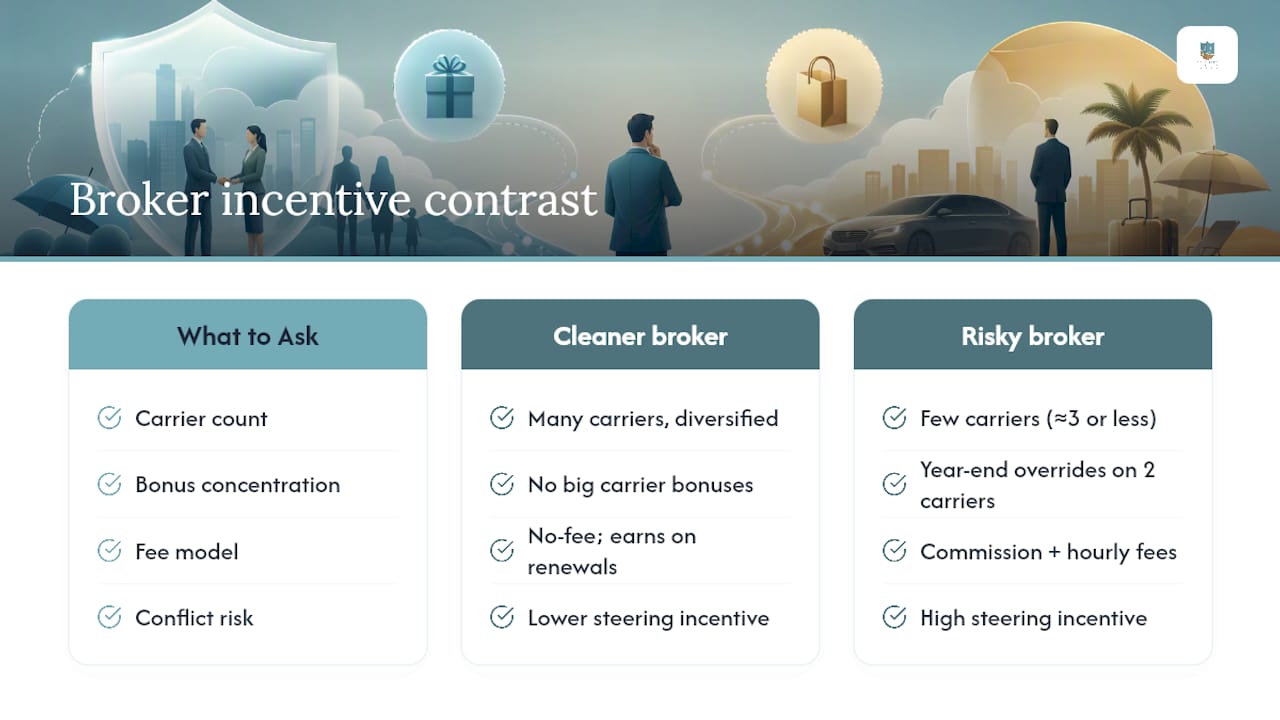
Here is what I’d prioritize differently than most guides: stop asking “how much commission do you make” and start asking “which carriers pay you a bonus for volume.” The first question gets you a percentage. The second gets you the actual conflict of interest, if one exists. A broker with 20 carrier relationships and no bonus concentrated in one or two insurers has structurally less reason to steer you wrong than one appointed with three carriers and a fat year-end override on two of them.
The no-fee model gets treated as a minor perk in most coverage. It is not. When a broker’s entire income depends on placing your policy well and keeping you as a renewing client, that is a cleaner incentive structure than one layered with hourly fees on top of commission.
— Andrew
Get a Broker-Fee-Free Quote Comparison
South Lake Agency Insurance Brokers runs on the model this whole article just walked through: carrier-paid commission, no broker fees tacked onto your bill, and access to multiple carriers instead of whatever one insurer happens to offer. That structure means the incentive to shop your risk honestly is built in, not bolted on.

If you are buying or renewing a policy, start with a quote comparison rather than a single-carrier quote. Homeowners and new homebuyers can compare homeowners insurance quotes, drivers can compare auto insurance quotes, and business owners can compare business insurance quotes across carriers in one conversation. Families weighing coverage gaps can also look at life insurance options. Reach out for a quote and ask directly about commission and fee structure. Given the no-fee model, the answer will already match what this article recommends you look for.
This article is general information, not a substitute for advice from a qualified financial advisor. Consult a qualified financial professional about your own circumstances before acting on anything here.
Sources
FAQ
How Does My Insurance Broker Get Paid?
Your broker is almost always paid by the insurance carrier through a commission already built into your premium, not through a separate charge from you. Commission rates vary by product, with personal P&C typically in the mid-teens percent on new business and lower on renewals. Some brokers also earn contingent bonuses from carriers based on volume and retention.
What Is the Downside of Using an Insurance Broker?
The main downside is a potential incentive conflict: contingent commissions and bonus programs can theoretically push a broker toward carriers that pay better rather than ones that fit you best. Asking directly about bonus arrangements and working with a broker who represents 20 or more carriers, rather than two or three, helps minimize that risk.
Can Insurance Brokers Make a Lot of Money?
Top-producing brokers can earn substantial income, largely because renewal commissions compound over years of client retention rather than requiring a new sale each time. Life insurance producers in particular can see large first-year payouts, sometimes 60% to 80% of first-year premium on certain permanent products, though most of that income depends on consistently writing new, profitable business.
Is Being an Insurance Broker a Stressful Job?
The job carries real financial pressure because much of a broker’s income depends on retention, and chargebacks can claw back commission if a client cancels early. That pressure is one reason brokers who avoid charging clients direct fees, relying instead on carrier commission and strong renewal rates, tend to build steadier, less adversarial client relationships over time.
Recommended
Comments