




Avoid Gaps: E&O Coverage, Retroactive Dates for Small Firms


Errors and omissions insurance pays your legal defense costs and any settlement or judgment when a client claims your professional advice or service caused them financial loss. It exists to cover mistakes, not accidents. Most policies exclude bodily injury, property damage, and cyber incidents, and nearly all of them work on a claims-made basis, which means timing determines whether a claim gets paid at all.
TL;DR:
Most policies exclude bodily injury, property damage, and cyber incidents, which require separate coverage like general liability or cyber liability insurance.
Defense costs are deducted from the same policy limit as settlements, so long legal battles can reduce the money available for client claims.
Premiums for small businesses typically range from $600 to $1,200 annually, with higher limits or riskier professions pushing costs higher.
Claims-made policies require ongoing coverage and careful management of retroactive and tail coverage to ensure past work remains protected.
Businesses providing advice or specialized services, especially those with large contracts, must tailor limits and review endorsements to close coverage gaps.
Table of Contents
What E&O Insurance Covers: Claim Types and Examples
E&O insurance coverage responds to a narrow but expensive category of risk: financial harm caused by professional mistakes, not physical injury or property damage. The core claim types are negligence, errors, omissions, misrepresentation, and breach of professional duty. If a client argues that your advice was wrong, your work was incomplete, or you promised something you didn’t deliver, this is the policy that answers the call.
Defense costs and settlements typically draw from the same pool of money as your policy limit, which is a detail buyers often miss. A $1 million limit doesn’t mean $1 million for settlement plus separate money for attorneys. If defense is inside the limit, a long legal fight can eat into what’s left for the client’s actual claim, according to Forbes Advisor’s breakdown of E&O coverage.
Real claims tend to fall into recognizable patterns:
Accountant: A tax preparer misses a filing deadline, triggering IRS penalties the client then blames on the accountant’s oversight.
IT consultant: A software implementation fails to meet contract specifications, and the client sues for the cost of hiring a replacement vendor plus lost productivity.
Real estate agent: An agent fails to disclose a known property defect, and the buyer claims financial loss after discovering it post closing.
Pro Tip: Ask any prospective carrier how they define “professional services” in the policy. A narrow definition can leave newer service lines, like consulting add-ons, outside your coverage entirely.
What E&O Doesn’t Cover, and What Fills the Gap
E&O insurance coverage is deliberately narrow, and that’s by design. It handles intangible financial losses from professional mistakes, not physical harm or criminal conduct. Bodily injury, property damage, cyber incidents, intentional wrongdoing, and employee dishonesty all sit outside a standard E&O policy, according to Cornell Law School’s Legal Information Institute.
Each exclusion has a natural companion policy:
Bodily injury or property damage: covered by general liability insurance, which handles physical harm rather than financial loss.
Data breaches or ransomware: covered by cyber liability insurance, a separate purchase most E&O policies won’t touch.
Employee theft or fraud: covered by crime or fidelity bond coverage.
Workplace injuries: covered by workers’ compensation.
A lot of small business owners assume general liability protects them from a bad piece of advice. It doesn’t. General liability covers bodily injury and property damage, not the financial fallout from a professional error, and that mismatch is one of the most common coverage gaps out there.
Who Needs E&O Insurance?
Any business that gives advice, designs something, manages someone else’s money, or performs a specialized professional service carries E&O exposure. The professions where it’s close to standard practice include:
Accountants, bookkeepers, and tax preparers
IT consultants, software developers, and managed service providers
Real estate agents and brokers
Insurance agents and financial advisors
Architects, engineers, and design professionals
Marketing, PR, and management consultants
Notaries, translators, and other licensed service providers
Contracts and licensing boards often force the decision even for businesses that never planned to buy it. Many clients, particularly larger companies and government contracts, won’t sign an agreement without proof of professional liability coverage, and several licensing boards require it outright as a condition of maintaining a license.
Revenue and project size matter too. A consultant handling a $30,000 engagement carries very different exposure than one managing a $2 million systems overhaul, and required limits usually scale with the size of the contract and the client’s own risk tolerance.
What Does E&O Insurance Cost?
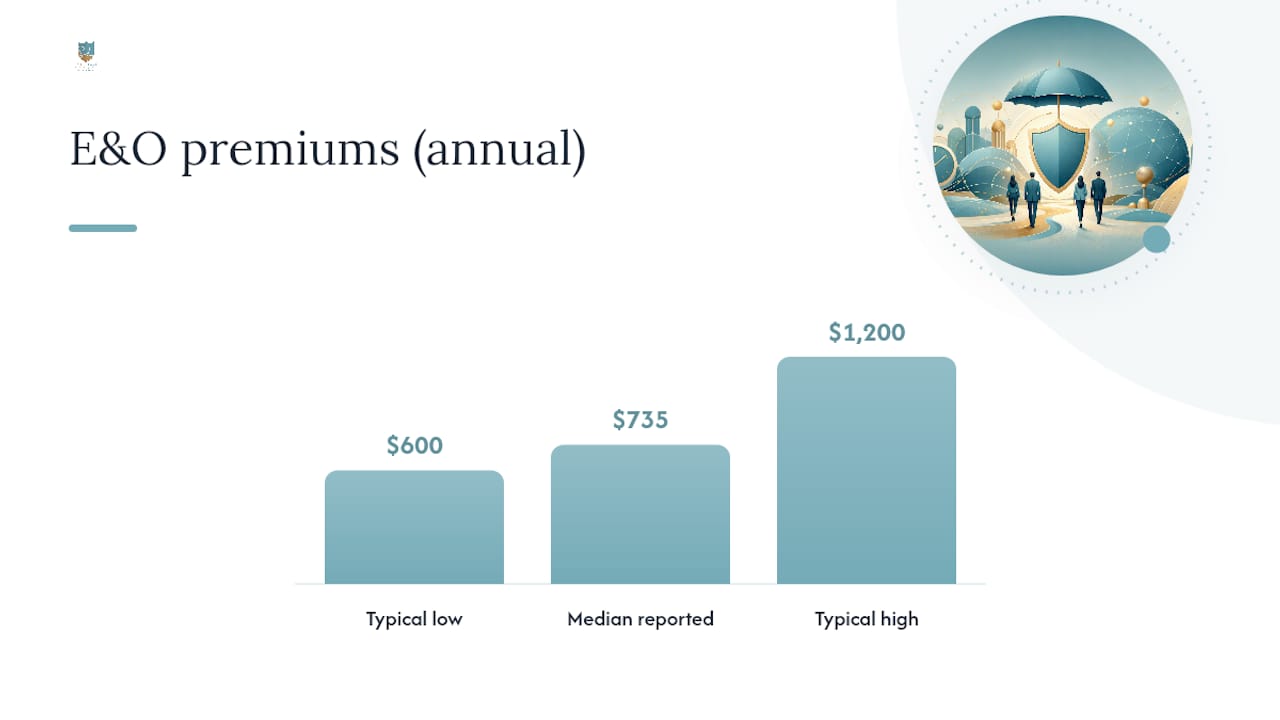
Premiums vary by industry, revenue, claims history, and the limits and deductible you choose, but small businesses typically land somewhere in the range of $600 to $1,200 per year, with market summaries often citing a median close to $735 annually. That works out to roughly $50 to $100 a month for a lot of solo professionals and small firms, though higher risk industries or larger contracts push well past that range.
Two structural choices drive price more than almost anything else:
Per-occurrence vs. aggregate limits: per-occurrence caps what the insurer pays for a single claim, while the aggregate caps total payouts for the whole policy period. A business facing multiple simultaneous claims needs to watch the aggregate closely.
Deductible level: a higher deductible lowers your premium but raises your out-of-pocket cost when a claim hits, so match it to what your cash flow could actually absorb without strain.
The smartest way to size your limit isn’t guesswork. Look at your largest single contract or your biggest client relationship, and make sure your limit could realistically cover a claim tied to that account. A $500,000 limit doesn’t help much if your largest client contract is worth $2 million.
Claims-Made vs. Occurrence: Why Timing Determines Coverage
A claims-made policy pays only if the policy is active both when the incident happened and when the claim is filed. An occurrence policy pays based on when the incident happened, regardless of when the claim shows up later, and most professional liability coverage is written as claims-made.
That distinction creates a real trap. If you switch carriers or let a policy lapse, a claim tied to work performed years earlier might not be covered by either your old or new insurer, depending on the retroactive date each one sets.
The retroactive date marks how far back a claims-made policy covers your prior work. Anything before it is excluded, no matter how long you’ve been insured.
Prior-acts coverage extends protection backward when you switch carriers, as long as the new insurer agrees to match your old retroactive date.
Tail coverage (extended reporting period) lets you report claims after a policy ends, which matters enormously if you retire, close a business, or change industries entirely.
Pro Tip: Before canceling any professional liability policy, get written confirmation from your new carrier that the retroactive date carries over. A gap of even a few months can leave years of past work completely uninsured.
How to Choose and Buy E&O Coverage
Getting a quote is the easy part. Getting the right quote takes a short checklist:
Confirm per-occurrence and aggregate limits match your largest contract exposure.
Ask whether defense costs sit inside or outside the policy limit.
Check the retroactive date and whether it matches or predates your current policy.
Ask about tail coverage options and their cost if you ever stop practicing or switch carriers.
Review endorsements for intellectual property, breach of contract, or industry-specific add-ons.
Compare deductible options against your actual cash reserves.
Disclose your full claims history honestly, since it affects both price and eligibility.
When you’re talking to an agent, ask directly how they handle claims, which exclusions apply to your specific profession, and whether a general liability bundle or a standalone E&O policy fits your risk better. Businesses with heavy client-facing advisory work usually need standalone E&O; businesses with more physical operations often bundle it alongside general liability for efficiency.
Pro Tip: If a carrier hesitates to answer questions about claims handling before you buy, that’s information too. You want an insurer that explains its process clearly upfront, not after you’ve filed a claim.
South Lake Agency’s Approach to Closing Coverage Gaps
South Lake Agency Insurance Brokers compares options across more than 20 carriers with no broker fees, which matters most when retroactive dates and endorsements need careful coordination during a carrier switch. We track continuity issues, flag missing endorsements, and handle renewal service so gaps don’t slip through. If your business needs a tailored review, that’s exactly the conversation worth having.
— Andrew
Get a Business Insurance Quote Without the Guesswork
South Lake Agency Insurance Brokers is the alternative to piecing together coverage on your own: instead of calling five carriers separately, you get quotes compared across more than 20 insurers, side by side, with no broker fees added to your premium.
Before you request a quote, gather a few things: your annual revenue, a plain description of the services you provide, any prior claims history, and your current policy’s retroactive date if you’re switching carriers. That paperwork lets an agent match your limits to your actual exposure instead of guessing at a generic package.
Head to the business insurance quote page to start the process, and expect a personalized comparison rather than a single canned quote. South Lake Agency’s average client saves $2,246 by shopping multiple carriers instead of settling for the first offer, and a 97.3% client renewal rate reflects what happens after that first policy is in place. If you’re also weighing general liability or workers’ comp alongside E&O, South Lake Agency Insurance Brokers can price those together in the same conversation.
Sources
FAQ
What does E&O insurance actually cover?
It covers legal defense costs, settlements, and judgments when a client claims financial loss from your professional negligence, errors, omissions, or misrepresentation. It doesn’t cover bodily injury, property damage, or cyber incidents.
How much does a $1,000,000 liability insurance policy cost?
Cost depends heavily on your industry, revenue, and claims history, but most small businesses pay somewhere between $600 and $1,200 per year for professional liability coverage, according to MoneyGeek’s cost data. Higher limits and riskier professions push toward the top of that range or beyond it.
How much does E&O insurance cost per month?
Based on typical annual premiums, monthly costs generally fall between $50 and $100 for solo professionals and small firms, though pricing varies by profession, revenue, and chosen limits. Clients can receive an exact figure by comparing quotes across multiple carriers at once.
What is not covered by E&O insurance?
Bodily injury, property damage, cyber and data breach incidents, intentional or criminal acts, and employee dishonesty all fall outside standard E&O coverage. These risks require separate policies like general liability, cyber liability, or crime coverage.
Recommended
Comments