




Before Closing: Mortgagee Clause Details Every Homebuyer Must Verify


A mortgagee clause names your mortgage lender on your homeowners policy and legally requires your insurer to notify and pay that lender first if your home suffers major damage. It exists to protect the lender’s financial stake in your property. Before closing, check the lender block on your policy for the correct legal name, mailing address, and loan number, because a single typo can delay your closing or your claim.
TL;DR:
Accurate lender information in the mortgagee clause, including legal name, mailing address, and loan number, is crucial to prevent delays and claim issues.
The clause must contain specific language like ISAOA and ATIMA to ensure protection persists through loan servicing transfers without requiring new policy amendments.
A properly attached mortgagee clause is typically found on the declarations page and must be verified before closing or during policy updates.
Clerical errors such as mismatched loan numbers or abbreviated lender names are the primary causes of delayed closings and forced-placed insurance.
An independent insurance broker can streamline the process by coordinating policy endorsements and verifying lender details to avoid costly mistakes.
Table of Contents
What Is a Mortgagee Clause and How Does It Function?
A mortgagee clause creates a separate contract between your insurance company and your lender, distinct from the policy you hold as the homeowner. IRMI’s definition makes this point clearly: the insurer owes the lender a duty of payment and notice even in situations where your own actions, like letting the policy lapse or committing fraud, would otherwise void your coverage. That separation is the entire point of the clause. Lenders hand over hundreds of thousands of dollars in financing, and they need assurance that a homeowner’s mistake won’t wipe out the collateral backing that loan.
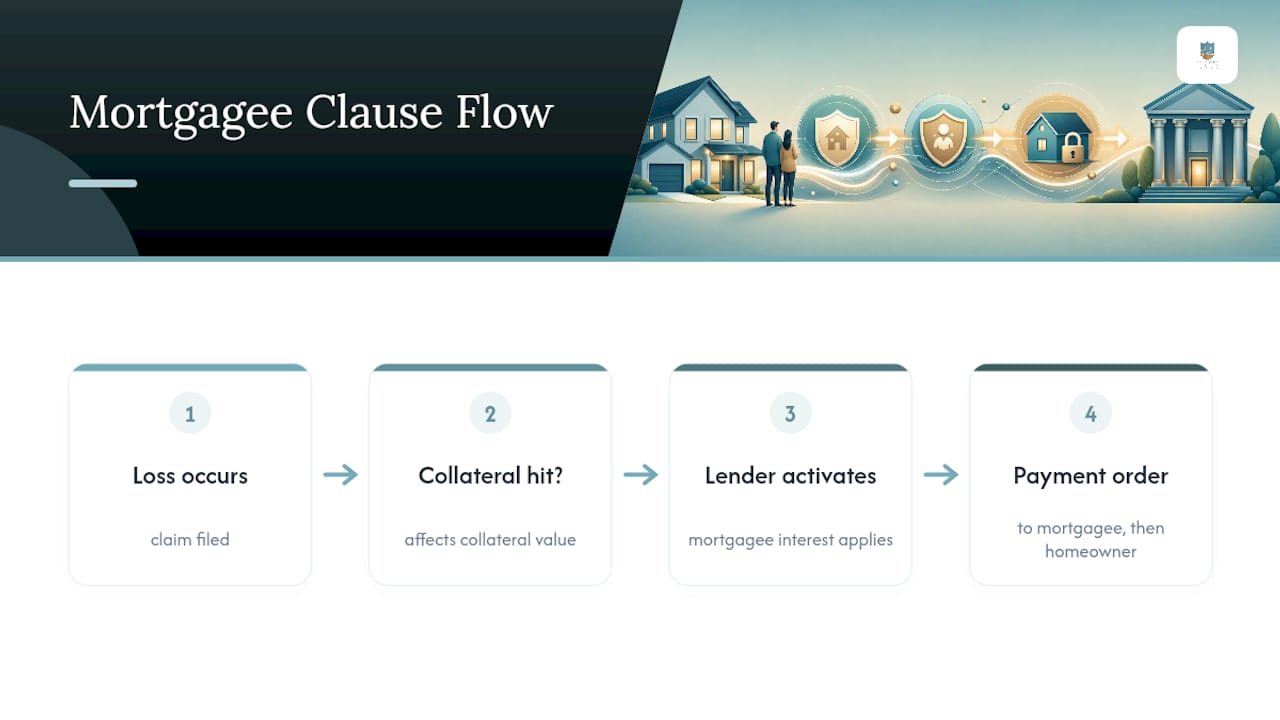
The payout mechanics follow a strict order. When a covered loss happens, your insurer pays the mortgagee first, up to the amount you still owe on the loan, and any remaining funds go to you as the homeowner. Investopedia confirms this priority structure is standard across nearly every homeowners policy with a lender attached.
This distinction matters most in scale. A cracked window or a minor roof leak rarely triggers lender involvement. Your insurer cuts you a check, you hire a contractor, and the lender never enters the conversation. A house fire or major storm damage is different. Once the claim crosses a threshold that affects the structure’s value as collateral, the lender’s interest activates, and the insurer routes funds according to the mortgagee clause rather than handing you the full amount.
Key Components: ISAOA, ATIMA, and Loss Payee Explained
Two acronyms show up constantly in the lender block, and both matter more than they look. ISAOA stands for “its successors and/or assigns,” and ATIMA means “as their interests may appear.” Together, they act as a standing instruction: if your lender sells your loan to another company, or if your loan gets bundled into a portfolio sale, the mortgagee protection transfers automatically without anyone having to amend the policy. Rocket Mortgage notes that this language is especially common with servicing transfers, which happen more often than most homeowners realize.
A loss payee designation looks similar but works differently. Loss payee status is often used for lienholders on personal property, like a boat or a camper, and it typically grants a simpler right to claim payment without the fuller notification and protection duties a true mortgagee clause carries. A mortgagee clause is the stronger, more protective designation reserved for the primary lender on your home.
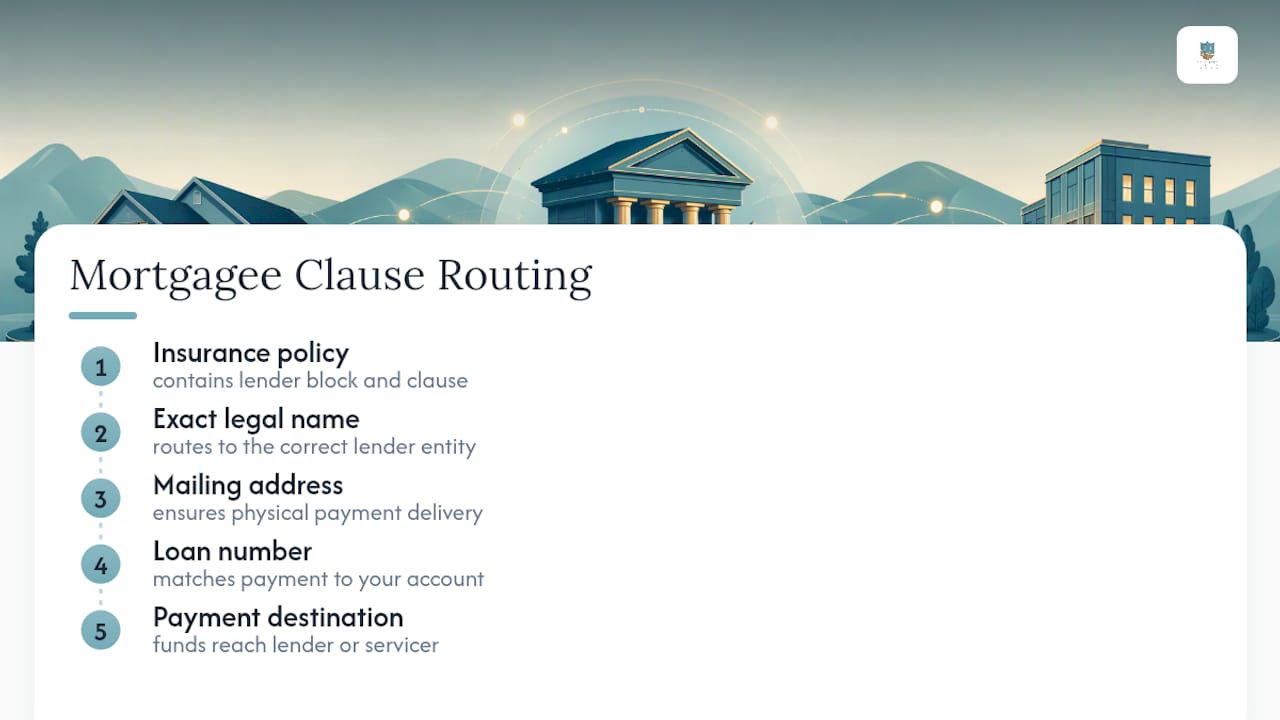
The lender block itself needs three pieces of information to work correctly: the lender’s exact legal name, its mailing address, and your loan number. Each field routes the payment, and each one is a place a clerical error can quietly break the whole system.
Where to Find Your Mortgagee Clause and What to Check
Your mortgagee clause typically sits on the Declarations page of your homeowners policy, often labeled “Mortgagee” or “Lienholder,” or it appears as a separate endorsement attached to your policy documents. If you can’t locate it there, check any rider pages included with your renewal packet.
Run through this short checklist before closing or before you need to file a claim:
Confirm the lender’s legal name matches exactly what appears on your loan documents, not an abbreviated or informal version.
Verify the mailing address is current, especially if your loan has been sold or transferred.
Double-check your loan number against your most recent mortgage statement.
Look for ISAOA/ATIMA language if your lender’s closing instructions require it.
Ask your agent to confirm the lender actually received a copy of the binder or declarations page.
Mismatches here aren’t cosmetic; for example, detailed questions about whether a garage floor coating is covered by homeowners insurance often reveal nuances that lenders and insurers need to resolve carefully. Lenders that can’t confirm accurate insurance information sometimes force-place their own coverage on the loan, which typically costs more and offers less protection than the policy you already have.
How to Add or Update a Mortgagee Clause on Your Policy
At closing, you or your agent supply the lender’s details directly to the insurer, and the insurer issues a binder or endorsement reflecting that information before the closing date. Bankrate walks through this process as a standard part of the closing checklist, and it’s worth treating as non-negotiable rather than an afterthought.
If you already own your home and need to update an existing mortgagee clause, follow these steps:
Contact your insurance broker or insurer directly rather than assuming your lender will handle it.
Provide your loan number and the lender’s exact legal name and address, ideally pulled straight from your mortgage statement.
Request written confirmation that the endorsement was issued and sent to the lender.
Follow up within a week or two to confirm your lender’s records match the update.
Skip this process, and you risk your lender force-placing insurance on your behalf, a scenario that almost always costs more than a standard policy and leaves you with weaker protection.
Common Mortgagee Clause Mistakes and How to Avoid Them
The single most frequent error agents encounter is a mismatched loan number, closely followed by an abbreviated or informal lender name that doesn’t match loan documents exactly. Missing ISAOA/ATIMA language ranks third, particularly for loans that have been through a servicing transfer. Field data from mortgage professionals points to typos and shorthand lender names as the leading cause of delayed binders.
These clerical slips create real consequences: delayed closings, forced-placed premiums that cost more than a standard policy, and in some cases, contested claim payments when the insurer can’t confirm which entity holds the loan.
Before closing, run these six checks:
Pull the lender’s legal name straight from your loan commitment letter, not from memory.
Cross-reference the loan number against your most recent lender correspondence.
Ask whether ISAOA/ATIMA language is required for this specific lender.
Confirm the mailing address matches the lender’s current servicing office, not a regional branch.
Request written proof the binder was sent to both you and the lender.
Loop in your title company early rather than the day before closing.
Pro Tip: Coordinate directly with your title company as soon as you have a lender commitment letter in hand. Title companies review mortgagee details daily and often catch a mismatched name or address before it ever reaches the insurer, saving you a scramble in the final days before closing.
What a Real Mortgagee Clause Looks Like
Public policy documents make the language less mysterious than it sounds. A sample mortgagee clause from a publicly posted state insurance rider shows the kind of wording you’ll find in the lender block of most homeowners policies:
Three lines carry the real weight here. “As interests may appear” is your ATIMA language, keeping the mortgagee’s protection intact regardless of who currently services the loan. “Shall not be invalidated by any act or neglect of the mortgagor” is the separate-contract principle in action: your lender stays covered even if you personally do something that would void your own coverage. And the phrase “payable to the mortgagee” establishes the payment order discussed earlier. When you scan your own declarations page, these are the exact phrases to look for.
Why Getting This Right Actually Matters
Homeowners tend to treat the mortgagee clause as boilerplate, something the insurer fills in automatically and nobody needs to think about twice. That assumption causes more closing delays than almost anything else in the insurance paperwork. A loan number typed one digit wrong, or a lender name shortened the way everyone shortens it in conversation, can sit unnoticed for months until a claim or a servicing transfer exposes it.
One case that sticks with me involved a homeowner whose lender’s name had been entered with an old servicing company that had since been acquired. Nobody caught it until a claim came in, and the payout stalled for weeks while the insurer verified who actually held the loan. A five-minute cross-check against the loan commitment letter would have prevented the entire delay.
Getting the lender block right isn’t paperwork for paperwork’s sake. It’s the difference between a claim that pays out smoothly and one that sits in limbo while everyone figures out who’s actually owed what.
— Andrew
How South Lake Agency Handles Your Mortgagee Clause Paperwork
Getting the lender block right shouldn’t fall entirely on you at the busiest moment of buying a home. An independent insurance broker compares quotes across multiple carriers and can handle the coordination piece directly: confirming your lender’s legal name, address, and loan number, issuing the binder your title company needs, and communicating straight with your lender so nothing gets lost between closing documents and your actual policy.

There is no broker fee added on top of your premium, and clients shopping through a brokerage can often save on insurance costs compared to going it alone. If you’re closing on a home soon, start with the new homebuyer insurance guide or head straight to a homeowners insurance quote and let an agent confirm your mortgagee details before your closing date arrives.
Where to Verify Mortgagee Clause Details
For the exact legal definition and contract-level explanation, IRMI’s mortgagee clause entry remains the industry-standard reference. To see genuine policy language, the Washington State sample mortgagee clause shows real rider wording rather than a paraphrase. For simpler consumer summaries, Bankrate, Investopedia, and Rocket Mortgage each break down the basics in plain language. If you need to confirm a lender’s exact legal name, NMLS Consumer Access is a free public registry built for that purpose.
This article is general information, not a substitute for advice from a qualified financial advisor. Consult a qualified financial professional about your own circumstances before acting on anything here.
Sources
FAQ
Is the mortgagee clause just an address?
No. It includes the lender’s legal name, mailing address, and loan number, plus contract language like ISAOA/ATIMA that determines how insurance proceeds get paid and protects the lender even if the borrower’s actions would otherwise void coverage.
Where do you find your mortgagee clause?
It’s typically listed on the Declarations page of your homeowners policy under a heading like “Mortgagee” or “Lienholder,” or as a separate endorsement attached to your policy documents.
Can you give me an example of a mortgagee clause?
A standard clause reads similarly to language found in a public policy rider: loss proceeds are payable to the mortgagee “as interests may appear,” and coverage for the lender’s interest isn’t invalidated by the borrower’s acts or neglect.
How do I get a mortgage clause added to my policy?
At closing, your agent or insurer adds it using the lender details from your loan documents. For an existing policy, contact your broker or insurer directly, provide your loan number and lender’s legal name, and request written confirmation the endorsement went out. Some agencies handle coordination directly with lenders and title companies for clients buying or refinancing a home.
What happens if the mortgagee clause has wrong information?
Incorrect lender names, addresses, or loan numbers can delay your closing, trigger forced-placed insurance from your lender, or complicate claim payments when the insurer can’t confirm who holds the loan.
Recommended
Comments