




Shop Insurance 3–4 Weeks Before Renewal: Calendar Rules and No Gaps


Shop auto insurance about three to four weeks before your policy renews, and shop homeowners insurance during escrow, ideally 14 to 30 days before closing. Beyond those calendar windows, shop immediately after a rate increase notice, a move, a new vehicle, or any major life change. Whenever you switch, start the new policy the same day the old one ends so you never go a single day without coverage.
TL;DR:
Shopping for auto insurance three to four weeks before renewal ensures price stability and ample time for accurate comparison, avoiding rushed decisions or coverage gaps.
Major life events such as moving, getting married, or buying a new vehicle should trigger immediate shopping, with coverage starting the same day the old policy ends.
For homeowners, insurance should be reviewed during escrow or after significant property changes, while storm season requires early preparation to prevent delays in coverage.
Reassess insurance immediately after a substantial credit score improvement or a major home renovation, as these can significantly lower premiums or justify increased coverage.
Switching policies to save at least $300 annually after fees is usually worthwhile, with setting calendar reminders and having quotes ready before deadlines essential for optimal timing.
Table of Contents
When to Shop for Auto Insurance: Windows, Triggers, and Cost Levers
The three to four week window before renewal isn’t arbitrary. It gives insurers time to underwrite your policy accurately, gives you time to bind coverage without rushing, and keeps quoted prices stable long enough to actually lock them in. Shop too early, say two months out, and the numbers you get quoted might shift by the time your policy actually needs to start. Shop too late, like the week your policy expires, and you’re stuck choosing between a rushed decision or a lapse. MoneyGeek’s research backs this specific window for a reason: it’s the sweet spot between price accuracy and enough runway to compare carriers properly.
You shouldn’t wait for renewal, though, if one of these happens first:
Your insurer sends a rate increase notice (most states require 30-plus days of advance warning, which is your shopping window).
You get married, move, buy a new car, or add a driver to the household.
Your credit score improves significantly, since many carriers use credit-based scoring.
A ticket or accident finally drops off your driving record, usually after three to five years depending on the violation.
Policy term length changes your rhythm, too. A growing share of carriers have shifted to six-month terms instead of the traditional annual policy, according to CNBC Select, which means you need to check rates twice as often if your policy renews every six months. Set a calendar reminder tied to your actual renewal date, not a generic annual one.
Statistic Callout: Raising your deductible from $500 to $1,000 can cut your premium by roughly 20 to 25 percent, according to Consumer Reports. Bundling home and auto, adjusting your annual mileage estimate, and dropping collision coverage on an older car with low resale value are the other three levers worth testing every time you shop.
Pro Tip: Before you drop collision coverage on an aging car, check its actual cash value against what you’d pay in annual premiums for that coverage. If the math is close, keep the coverage one more renewal cycle.
When to Shop for Homeowners Insurance: New Purchases, Renewals, and Home Changes
Homebuyers should start comparing homeowners insurance during escrow, typically a few weeks before closing, to secure quotes and proof of insurance in time. That gives you time to secure quotes, provide proof of insurance to your lender, and avoid the scramble that happens when a closing date moves up unexpectedly. Some carriers need extra underwriting time for homes in higher-risk ZIP codes or for higher-value properties, so binding coverage a few business days ahead of your actual closing date avoids delays on the lender’s end.
If you already own your home, an annual review is the baseline. But certain changes should trigger an immediate check rather than waiting for your renewal date:
A major renovation, especially anything affecting the roof, electrical, or plumbing systems.
A change in occupancy, such as renting out a room or converting the home into a rental property.
Replacing an aging HVAC, water heater, or roof, since insurers often reward system upgrades with lower premiums.
A significant jump in your home’s rebuilt value due to rising construction costs in your area.
Shopping right before or during storm season carries its own risk. Many carriers pause new homeowners policies or impose binding restrictions in regions under hurricane or wildfire watches, which means last-minute shopping right before a major weather event can leave you without options. Handle your review well ahead of your region’s high-risk season, not during it.
Pro Tip: If you’re closing on a home in a flood zone or wildfire-prone area, start your insurance search the moment you’re under contract, not after the inspection period closes. Underwriting on higher-risk properties takes longer.
Life Events That Should Make You Shop Right Now
Certain moments in life change your risk profile enough that waiting for your renewal date costs you money. Here’s what to do, and what to ask for, when they happen:
Getting married. Request a multi-policy discount and ask about combining auto policies onto one plan.
Adding a teen driver. Ask about good-student discounts, driver-training discounts, and whether a separate policy or an add-on saves more.
Buying or selling a vehicle. Get a fresh quote before you sign, since the vehicle’s safety rating and value directly affect your premium.
Buying or selling a home. Confirm coverage limits match the new property’s rebuild cost, not just its purchase price.
Moving to a new address. Rates vary by ZIP code due to local claims history, theft rates, and weather exposure.
A major credit score improvement. Ask your carrier to rerun your rate, since credit-based insurance scoring varies significantly by state and can swing premiums noticeably.
Retiring or driving fewer miles. Report the mileage change; low-mileage discounts are often underused.
Credit-based scoring rules differ by state, and a few states restrict its use entirely, so it’s worth confirming your state’s specific approach before assuming a credit bump will move your rate.
How Often Should You Shop Insurance? A Repeatable Calendar Rule
Treat shopping like a scheduled task, not a reaction to a bad renewal bill. Here’s the cadence that keeps you covered without wasting time chasing quotes every month:
Set a reminder 30 to 45 days before your renewal date. This gives you buffer time before the ideal shopping window opens.
Start actively shopping 21 to 28 days before your policy ends, gathering quotes from at least three carriers, a baseline Consumer Reports recommends for a meaningful comparison.
Bind your new policy to start the exact day your old one ends. No overlap, no gap.
For mid-term switching, a simple dollar threshold helps cut through the indecision. If switching saves you $300 or more per year after accounting for any cancellation fees or lost prepaid premium, it’s usually worth making the move before your renewal date. Calculate your refund by checking whether your current insurer prorates unused premium; most do, but some apply a short-rate penalty for early cancellation.
Statistic Callout: Some carriers offer early-shopping or advance-quote discounts specifically for locking in a policy 3 to 4 weeks before it’s needed, a detail MoneyGeek’s guidance highlights as one reason the standard window beats waiting until the last minute.
Shorter policy terms compress this whole cycle. If your insurer runs six-month terms instead of annual ones, you’re effectively running this calendar rule twice a year instead of once, which is exactly why setting a recurring reminder tied to your actual renewal notice matters more than ever.
How to Switch Insurance Without a Coverage Gap
Switching carriers is straightforward if you follow the sequence in order. Skipping a step is how people end up with a one-day lapse that shows up on their driving record or, worse, a mortgage company flagging a coverage gap.
Pull your current policy details, including your renewal date, coverage limits, and deductible.
Request quotes from at least three carriers using identical coverage limits so you’re comparing apples to apples.
Get a binder or proof of insurance from the new carrier before canceling anything.
Set the new policy’s effective date to match the exact day your current policy ends.
Confirm the new binder is active, then cancel the old policy in writing.
Save your cancellation confirmation and new proof of insurance for your records, your lender, or your state’s DMV if required.
The most common pitfall is an automatic renewal that kicks in before you’ve finalized the new policy, creating an unwanted overlap or, worse, a canceled-but-not-really situation. Double-check your current insurer’s renewal date against your calendar reminder, and watch for prorated refund fees that eat into your expected savings. For the full operational rundown, South Lake Agency’s guide to switching mid-term walks through the paperwork most people forget.
Pro Tip: Keep a digital copy of your new insurance ID card on your phone before you cancel the old policy. If your registration renewal or mortgage escrow team asks for proof during the transition window, you’ll have it instantly.
Your One-Page Insurance Shopping Checklist
Print this or save it to your phone. It covers the three scenarios readers hit most often.
Set a calendar reminder 30 to 45 days before your renewal date.
Gather your current policy’s coverage limits, deductible, and declarations page.
Request quotes from at least three carriers with matching coverage.
Compare not just price, but liability limits, deductibles, and claims-service reputation.
Set your new policy’s start date to match your old policy’s end date exactly.
Confirm your binder, then cancel the old policy in writing.
Three sample timelines:
Routine auto renewal: Start 30 days out, compare by day 21, bind by day 7 before expiration.
New home closing: Start shopping the day you’re under contract, aim to have quotes locked 14 to 30 days before closing.
Adding a teen driver: Call your carrier immediately for interim rates, then do a full shopping comparison within 30 days once the dust settles.
If a competing quote saves you $300 or more annually after fees, it’s usually worth the switch. Document your reason for switching, your new effective date, and your cancellation confirmation every time.
Why Timing Matters More Than People Think
Most people treat insurance shopping like a chore they’ll get to eventually, which is exactly why they overpay. Brokers see the pattern constantly: clients who shop reactively, only after a renewal bill shocks them, tend to settle for whatever the first quote offers because they’re already behind schedule. Clients who shop on a calendar, three to four weeks out, every time, end up with better prices and better coverage because they had room to compare instead of scramble.
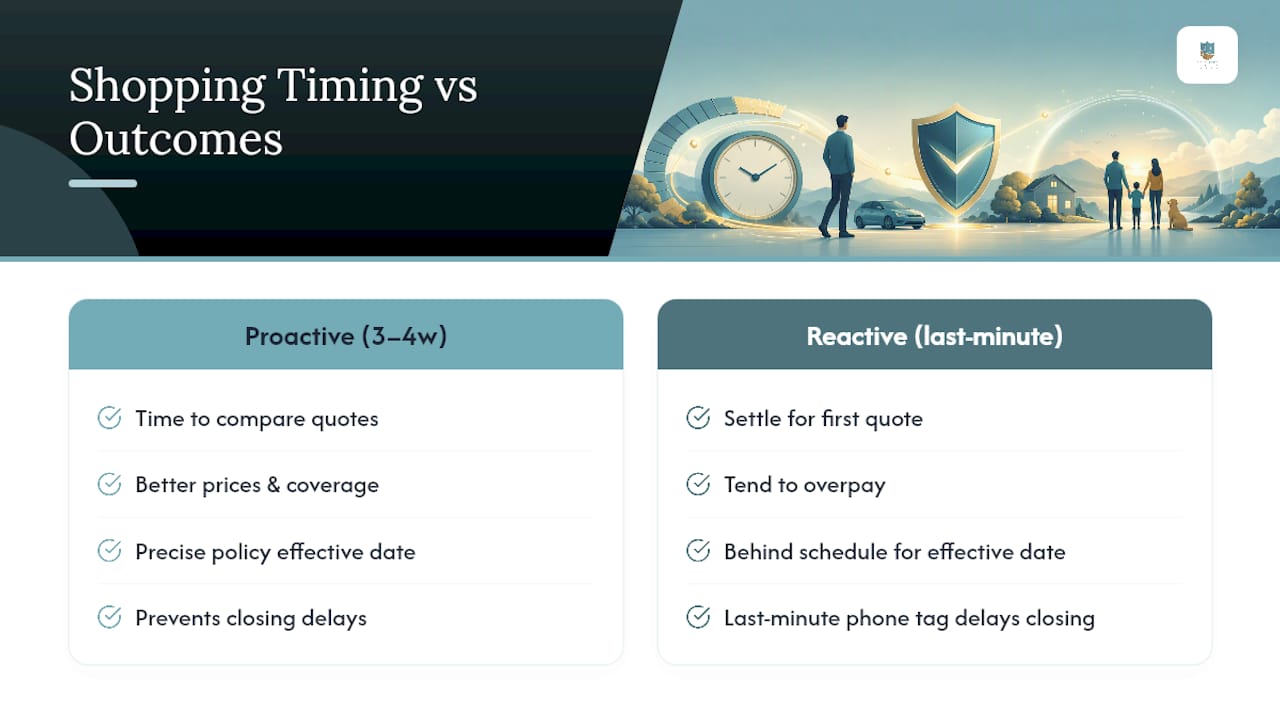
The closing process is where this shows up most starkly. A broker coordinating directly with a lender and title company can set a new policy’s effective date precisely, hand over proof of insurance on schedule, and prevent the kind of last-minute phone tag that delays closings. That coordination is worth something separate from price.
Price and claims service pull in different directions sometimes, and that’s worth saying plainly. The cheapest quote isn’t always the one with the fastest claims payout or the most flexible adjuster, so timing your shop well means you also have time to actually check that history, not just the sticker price.
— Andrew
Let South Lake Agency Insurance Brokers Time Your Next Shop
An independent insurance broker can be the alternative to shopping carrier by carrier on your own: instead of requesting quotes from three or four companies separately and comparing spreadsheets by hand, one conversation gets you multiple options at once, timed to your actual renewal date or closing schedule.

There is no broker fee added to your policy, and clients who work through a broker often save significantly by having someone else do the carrier comparison legwork. If you’re closing on a new home, the new homebuyer insurance guide walks through what to expect during escrow. If your auto renewal is coming up in the next month, get an auto insurance quote now so you’re not scrambling in three weeks. If you’re buying a home, start with a homeowners insurance quote as soon as you’re under contract, not after.
Sources
This article’s timing rules draw on guidance from MoneyGeek, Consumer Reports, CNBC Select, and U.S. News. For hands-on help executing any of it, South Lake Agency Insurance Brokers offers a free quote and a mid-term switching guide.
This article is general information, not a substitute for advice from a qualified financial advisor. Consult a qualified financial professional about your own circumstances before acting on anything here.
FAQ
What Is the 80% Rule for Insurance?
Review this figure every time your home’s rebuild value rises due to renovation or local construction cost increases.
Is $300 a Month a Lot for Insurance?
It depends heavily on your coverage type, location, driving history, and whether it covers a household or a single vehicle, so there’s no universal answer. If a competing quote saves you $300 or more per year, that’s generally the threshold worth acting on when deciding whether to switch mid-term.
Is It Cheaper to Buy Insurance Directly or Through an Agent?
Pricing itself comes from the carrier, not the seller, but a broker like South Lake Agency Insurance Brokers compares quotes across more than 20 carriers at once without charging a broker fee, which often surfaces savings a single direct quote won’t reveal.
What Time of Day Are Insurance Quotes Cheapest?
Quotes don’t fluctuate by time of day. What actually moves your price is timing relative to your renewal date, shopping three to four weeks out rather than waiting until the last minute, since that window balances quote accuracy with enough time to compare carriers properly.
Recommended
Comments