




Protect $40,000 of PIP After a Minnesota Crash: What to Claim


Personal injury protection pays your medical bills and a share of your lost income after a car accident, no matter who caused the crash. Minnesota requires a minimum of $40,000 in PIP benefits per person per accident, usually split into $20,000 for medical expenses and $20,000 for lost wages, replacement services, and funeral costs. Notify your insurer right away, because you generally have six months to file that initial claim.
TL;DR:
Minnesota’s minimum PIP benefit of $40,000 per person covers medical costs and nonmedical expenses like lost wages, replacement services, and funeral costs.
PIP typically pays up to $20,000 for medical expenses and $20,000 for wages, replacement services, and funeral benefits, with serious injuries often exhausting these limits quickly.
Buyers should consider increasing medical or wage-loss limits and stacking coverage across multiple vehicles, especially for high-risk households or those with high-deductible health plans.
File PIP claims promptly within six months after a crash, including submitting complete documentation like bills, wage verification, and medical notes to avoid claim denial.
Outside PIP, victims may pursue lawsuits against at-fault drivers if injuries meet serious injury thresholds, but insurers may seek reimbursement if damages are recovered.
Table of Contents
What Is No-Fault Insurance and Who Does PIP Cover in Minnesota?
Minnesota’s PIP Law: What Minn. Stat. §65B.44 Actually Requires
What PIP Actually Pays For: Medical Bills, Wages, Services, and More
Should You Buy Higher PIP Limits or Stack Coverage Across Vehicles?
Why Working With a Minnesota Broker Helps When PIP Gets Complicated
What Is No-Fault Insurance and Who Does PIP Cover in Minnesota?
Personal injury protection, or PIP, is part of Minnesota car insurance that pays your own accident-related medical bills and some lost income regardless of who caused the crash, so treatment can be covered without waiting on a liability investigation.
Coverage extends further than most policyholders realize. Under a standard Minnesota auto policy, PIP typically protects:
The policyholder, in any vehicle they’re driving or riding in
Household relatives who don’t carry their own auto policy
Anyone with permission to drive the insured vehicle
Pedestrians and bicyclists struck by the insured vehicle
PIP is different from liability coverage, which pays for damage or injuries you cause to someone else, and different from uninsured/underinsured motorist coverage, which fills gaps when the at-fault driver can’t pay. PIP pays first, fast, and without a fault determination.
Minnesota’s PIP Law: What Minn. Stat. §65B.44 Actually Requires
Minnesota’s no-fault statute sets the floor every auto policy in the state must meet. The state’s minimum requirement is $40,000 in basic economic loss benefits per person per accident, split $20,000 for medical expense benefits and $20,000 for nonmedical economic loss, which covers lost income, replacement services, and funeral expenses.
“Medical expense benefits” is a broader category than most drivers expect. The statute’s detailed billing provisions cover hospital and physician care, surgery, rehabilitation, prosthetic devices, ambulance transport, prescription and compound drug costs, and even interpreter services tied to medical treatment.
Minnesota Statutes Section 65B.44 sets the baseline every insurer must honor: $20,000 for medical costs, $20,000 for everything else PIP covers, for a combined $40,000 per person, per accident.
Read the statute’s language directly if you’re disputing a bill. It spells out exactly how prescription reimbursement and provider billing are supposed to work.
What PIP Actually Pays For: Medical Bills, Wages, Services, and More
PIP breaks down into four benefit categories, and each one has its own rules for how much you get and when it starts.
Medical expenses: hospital stays, physician visits, imaging, physical therapy, prosthetics, and prescription drugs, paid up to the $20,000 medical cap.
Lost wages: insurers typically calculate this at 85% of your gross lost income, subject to statutory limits often cited around $500 per week.
Replacement services: covers household tasks you can’t perform, like childcare or yard work, generally starting after a seven-day waiting period and capped near $200 per week.
Funeral and survivor benefits: pays a portion of funeral costs and ongoing support to dependents when a crash is fatal, drawn from the same $20,000 nonmedical pool.
Quick math that matters: if you’re out of work for eight weeks at the $500 weekly cap, that’s $4,000 of your $20,000 nonmedical benefit gone before replacement services or funeral costs even enter the picture. Serious injuries burn through PIP limits faster than most people expect.
Keep every itemized bill and pay stub. Insurers process claims faster when the paper trail is complete on the first submission.
Should You Buy Higher PIP Limits or Stack Coverage Across Vehicles?
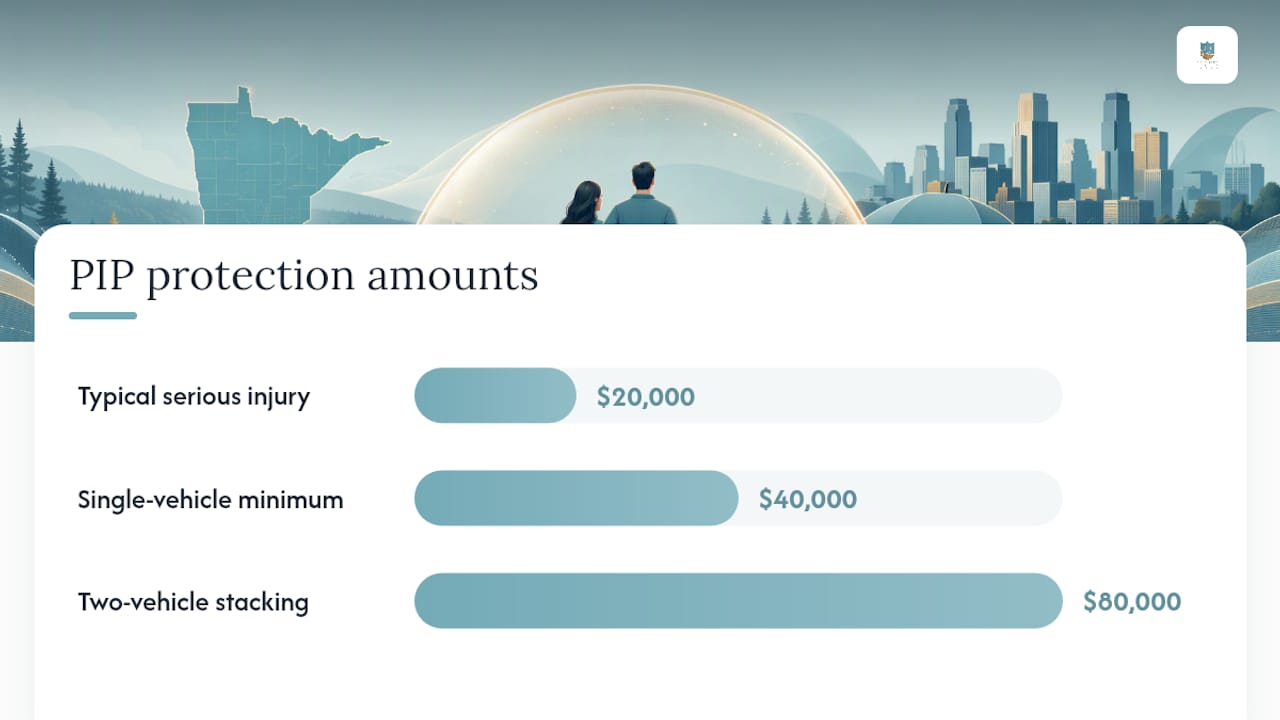
The $40,000 minimum is a floor, not a ceiling. Many carriers let you buy higher medical or wage-loss limits, and if you insure multiple vehicles, some policies allow stacking, meaning you add each vehicle’s PIP limit together for a larger available pool after a serious crash.
Whether that’s worth the extra premium depends on your household’s risk profile:
Families with young drivers or long commutes face higher accident exposure and burn through medical limits faster.
Households without strong health insurance benefit most from higher PIP medical limits, since PIP often pays before other coverage kicks in.
Small deductible changes on PIP rarely move your premium much, so raising limits usually delivers more protection per dollar than shrinking the deductible.
One serious injury, like a fracture requiring surgery and months of physical therapy, can exceed $20,000 in medical costs alone.
Pro Tip: If anyone in your household has a high-deductible health plan, ask about raising your PIP medical limit specifically. That single change often does more for your financial protection than any other tweak to your policy.
How to File a PIP Claim in Minnesota: Your Action Checklist
Acting fast after a crash protects both your health and your claim. Here’s the order that actually works:
Get medical care immediately, even if injuries seem minor. Delayed treatment gives insurers grounds to argue the injury isn’t accident-related.
Document the scene with photos, witness names, and the other driver’s insurance and contact information.
Notify your own insurer promptly by phone or through their online claims portal, and reference your policy number and accident date.
Submit your initial claim within six months of the accident. Missing this window can jeopardize your benefits under Minnesota’s no-fault rules.
Forward bills as they arrive rather than waiting to bundle them, since ongoing treatment generates a rolling paper trail insurers expect to see promptly.
Document | Why it matters |
Itemized medical bills | Ties treatment cost directly to the accident |
Wage verification from employer | Confirms pre-injury gross pay for lost-wage math |
Physician work-release notes | Establishes how long you were unable to work |
Replacement-service receipts | Supports reimbursement for household help |
A more detailed PIP claim checklist is available for a step-by-step walkthrough while gathering paperwork.
When You Can Sue the At-Fault Driver Beyond PIP
PIP isn’t the end of the road in every crash. Minnesota allows a third-party lawsuit against the at-fault driver when injuries meet certain thresholds, generally serious permanent injury, disfigurement, death, or medical expenses and disability that clear specific statutory tests. These thresholds are fact-specific, so don’t assume your case does or doesn’t qualify without checking.
If you do recover damages from the at-fault driver, your PIP insurer may be entitled to reimbursement for what it already paid, to prevent double recovery.
Talk to an attorney if any of these apply:
Your injury caused lasting impairment or disfigurement
Medical bills already exceed your PIP medical limit
The at-fault driver’s insurer disputes liability
Why PIP Claims Get Denied and How to Protect Yours
PIP won’t touch pain-and-suffering damages or property damage. Those fall under liability or collision coverage, not no-fault benefits, since PIP exists specifically for economic losses tied to injury.
Most denials trace back to a handful of avoidable mistakes:
Notifying the insurer late or missing the six-month filing window
Submitting incomplete bills or missing wage documentation
Treatment that isn’t clearly linked to the accident in medical notes
Skipping a provider’s preauthorization requirement
If you’re denied, request the specific reason in writing, gather the missing documentation, and ask for an internal review before assuming the claim is dead.
Pro Tip: Ask your treating physician to note the accident date directly in your medical records at every visit. That one habit closes off the most common reason insurers use to dispute a claim.

Why Working With a Minnesota Broker Helps When PIP Gets Complicated
Choosing the right PIP limits, or fighting a denied claim, gets complicated fast, and that’s exactly where an independent broker earns its keep. An independent insurance broker can compare policies across many carriers, charge no broker fee, and help clients weigh stacking and higher-limit options against real premium costs.
Call a broker when you’re facing a denied claim, deciding between limit options, or trying to coordinate PIP with your health insurance. Complex situations deserve a second set of eyes before you sign anything.
Get Help Comparing Auto Policies and PIP Limits
Shopping PIP limits alone means calling carrier after carrier and comparing fine print by hand. This service compares options across many carriers at once, with no broker fee added to your premium, so the quote you see is the quote you pay.

That matters most right when you need it: after a crash, when you’re deciding whether to raise your medical limit, add replacement-services coverage, or coordinate a claim with an existing health plan. An agent who already knows Minnesota’s $40,000 minimum and how stacking works can walk you through options a carrier’s call center won’t volunteer. If you’re filing a claim right now, the agency also helps coordinate documentation with your insurer so nothing falls through the cracks during the six-month window.
Ready to see where you stand? Compare auto insurance quotes or request a quote directly and ask specifically about PIP limit options and claims support for your situation.
Where to Verify Minnesota’s PIP Rules Yourself
Statutory language changes occasionally, so verify current limits before relying on secondhand summaries. Read the full text of Minn. Stat. §65B.44 for the legal detail, check the Minnesota Department of Commerce’s auto insurance guidance for consumer-facing explanations, and contact the Minnesota Automobile Assigned Claims Bureau if you’re injured by an uninsured driver with no policy of your own to claim against.
This article is general information, not a substitute for advice from a qualified lawyer. Consult a qualified legal professional about your own circumstances before acting on anything here.
Sources
FAQ
What Does PIP Insurance Cover in Minnesota?
PIP covers medical expenses, lost wages, replacement services for household tasks, and funeral costs after a car accident, regardless of fault. The statutory minimum is $40,000 total per person, split $20,000 medical and $20,000 nonmedical.
How Much Is a Fair Settlement for Pain and Suffering in a Minnesota Crash?
There’s no fixed formula, since pain-and-suffering damages fall outside PIP and depend on injury severity, medical documentation, and whether the case clears Minnesota’s tort threshold. A fair figure varies enough case to case that an attorney familiar with your specific injury and medical record is the only reliable source for an estimate.
Is PIP Coverage Worth Carrying Above the Minnesota Minimum?
For many households, yes, especially if medical coverage is thin or income loss would be financially disruptive. A single serious injury can exceed the $20,000 medical cap quickly, and higher limits typically cost far less than the gap they cover.
Which States Require PIP Coverage Like Minnesota?
Minnesota is one of roughly a dozen states with a no-fault system requiring PIP, alongside states like Florida, New York, and Michigan, though limits and rules vary by state. Always check the current requirement for your specific state rather than assuming another state’s rules apply.
How Long Do I Have to File a PIP Claim in Minnesota?
You should notify your insurer as soon as possible and submit your initial claim within six months of the accident. Waiting longer risks losing benefits you’d otherwise be entitled to.
Recommended
Comments