




Scheduled vs Blanket Coverage: Which One Protects You?
- andrew2biscay
- 1 day ago
- 7 min read


Scheduled coverage assigns a fixed limit to a single item or location, while blanket coverage spreads one shared limit across a group of items, buildings, or locations. Scheduled works best for unique, high-value property or a single building that you need insured at its exact replacement cost. Blanket works best when you own multiple locations or fluctuating inventory and want flexibility. Either way, your actual payout hinges on valuation method, coinsurance clauses, and the exact wording in your policy endorsements.
TL;DR:
Scheduled coverage provides precise limits for individual items or properties, making updates and valuations critical to avoid underinsurance penalties.
Blanket coverage offers flexibility across multiple locations or inventory, but requires regular inventory updates to ensure full recovery during a loss.
A claim at a single location favors blanket policies due to pooled limits, while dispersed small losses tend to favor scheduled coverage for independent recoveries.
Valuation methods, endorsements, and accurate documentation significantly influence payouts, with replacement cost offering higher recovery potential than actual cash value.
Having a professional review your insurance policies ensures your scheduled items and blanket limits align with current values and reduces the risk of coverage gaps.
Table of Contents
What Scheduled Coverage Means for Your Property
Scheduled coverage means an item or location has to appear on your property schedule by name, with its own dollar limit, or it isn’t covered. There’s no gray area here. If your policy schedule lists a pole barn at $180,000 and a stand of contractors equipment at $95,000, that’s exactly what you can recover, subject to the valuation method attached to each line.
This structure shows up most often with:
Buildings scheduled individually at replacement cost
Contractors equipment listed piece by piece
High-value contents like jewelry, art, or specialty machinery
Electronic data processing (EDP) equipment tied to an itemized inventory
Replacement cost pays what it takes to rebuild or replace today; actual cash value subtracts depreciation, so an older roof or an aging generator recovers less. Getting the number wrong on the schedule doesn’t just cost you at claim time; it can trigger a coinsurance penalty even on a partial loss. If you’re building a new home or adding a structure, reporting the new construction promptly and updating the schedule annually keeps your numbers honest.
What Blanket Coverage Means Across Multiple Locations
Blanket coverage puts one limit over a group of items, buildings, or locations instead of itemizing each one separately. A blanket limit covering multiple warehouses means you’re not boxed in by how much value sits at any single address. Depending on the policy wording, the full limit can potentially apply to a loss at just one location, which matters if one building carries more value than the others.
Common blanket arrangements include:
Contents coverage across an entire building
Multi-building portfolios under a single umbrella limit
EDP coverage written on a blanket basis rather than itemized
Inventory-supported limits for equipment that turns over often
Carriers frequently require an itemized inventory to support blanket EDP coverage, and that inventory needs a refresh at least once a year. Buy new servers, add a warehouse, or swap out major equipment, and skipping that update can quietly shrink what you’re able to recover later.
Scheduled vs Blanket: How Payouts and Costs Actually Compare
The mechanics diverge sharply once a claim happens. A scheduled item caps out at its listed value, full stop. A blanket policy draws from a shared pool, so a bad year at one location doesn’t necessarily leave the others exposed, as long as the total limit was sized correctly to begin with.
Scheduled coverage rewards precision. You get exact protection for a specific asset, but no flexibility if that asset’s value shifts and you forget to update it.
Blanket coverage rewards flexibility. You get room to move value around without re-filing paperwork, but you carry the burden of tracking your true total exposure.
Premiums often run higher for blanket policies covering large portfolios, largely because insurers price in the risk that a full limit gets applied to one bad location rather than spread evenly.
A single catastrophic loss at one address tends to favor blanket coverage, since the whole limit is available there. Scattered small losses across several locations often favor scheduled limits, since each one recovers independently without competing for the same dollars.
Pro Tip: If your business has one location that holds far more value than the others, run the math both ways before renewal. A blanket limit sized for your average location can leave your biggest one underinsured.
Valuation, Coinsurance, and What Actually Gets Paid
Whether you’re scheduled or blanket, valuation method decides your real payout. Replacement cost gets you a new equivalent; actual cash value knocks off depreciation, sometimes by a lot on older buildings or equipment.
Some programs pay up to 125% of a scheduled item’s listed value at time of loss to account for value changes since the last renewal, but that cushion only exists if the policy language spells it out.
Language matters more than most people realize. In Beazley Underwriting v. Max & Mia Realty, a court enforced the scheduled limit of liability endorsement in the issued policy even though pre-policy broker communications had referred to a “blanket” limit. The lesson: your declarations page and endorsements control the claim, not what someone told you during the sales process.
Keep these on hand before you ever need to file:
A recent professional appraisal for high-value or unique items
A written inventory with photos and serial numbers
Purchase invoices or receipts for major equipment
Copies of every endorsement attached to your current policy
How to Decide: A Practical Checklist for Your Policy Review
Start with how your value is distributed. If most of it sits in one building or one irreplaceable item, scheduled coverage usually fits. If value is spread across several locations or turns over often through new equipment purchases, blanket coverage usually fits better.
Count your locations and how concentrated your value is. One warehouse holding 70% of your inventory needs different treatment than five locations holding it evenly.
Ask your broker directly: is this line item scheduled or shared under a blanket limit? Don’t assume from a summary sheet.
Ask which endorsement controls this coverage, and get a copy of it, not just a verbal description.
Ask exactly how coinsurance applies to each schedule or blanket category on your policy.
Pull your declarations page and check for mismatches between what you were quoted and what’s actually listed.
Pro Tip: If your declarations page lists a dollar figure you don’t recognize or can’t trace to a specific asset, ask for a corrected copy before you sign anything. Vague line items are where coinsurance penalties hide.
Bring a current inventory template, your most recent appraisals, and a list of anything purchased in the last year. That’s what turns a policy review from a formality into an actual correction of your risk.

Why a Broker Catches What Self-Service Quotes Miss
Scheduling errors happen constantly when people compare quotes without a second set of eyes on the fine print, making commercial insurance review essential for proper coverage Commercial Insurance Baton Rouge LA | Business & BOP Coverage | The Root Agency. South Lake Agency Insurance Brokers reviews declarations line by line across more than 20 carriers, checking that scheduled items carry the right valuation basis and that blanket limits actually reflect combined exposure, not a guess.
That review work includes:
Shopping multiple carriers to compare scheduled and blanket structures side by side
Verifying schedules and inventories match current values before binding
Coordinating directly with mortgage lenders and title companies during a home purchase
Flagging endorsement language that contradicts what was originally proposed
Clients who go through this process save money with no broker fee attached, and the agency holds a high client renewal rate backed by many five-star reviews. If you’re managing coverage yourself with a spreadsheet and a renewal notice, that’s fine for a single small policy. Once you own multiple properties, equipment, or a business with turnover, a second review catches what a self-service quote tool won’t.
What Most Advice Gets Wrong About This Decision
Most explainers treat scheduled and blanket coverage like a binary choice you make once and forget. That’s backwards. The real risk isn’t picking the wrong one at renewal, it’s letting either one go stale. A scheduled item that hasn’t been reappraised in five years and a blanket limit that never accounted for last year’s equipment purchases fail in the exact same way: they both underpay you at the worst possible moment.
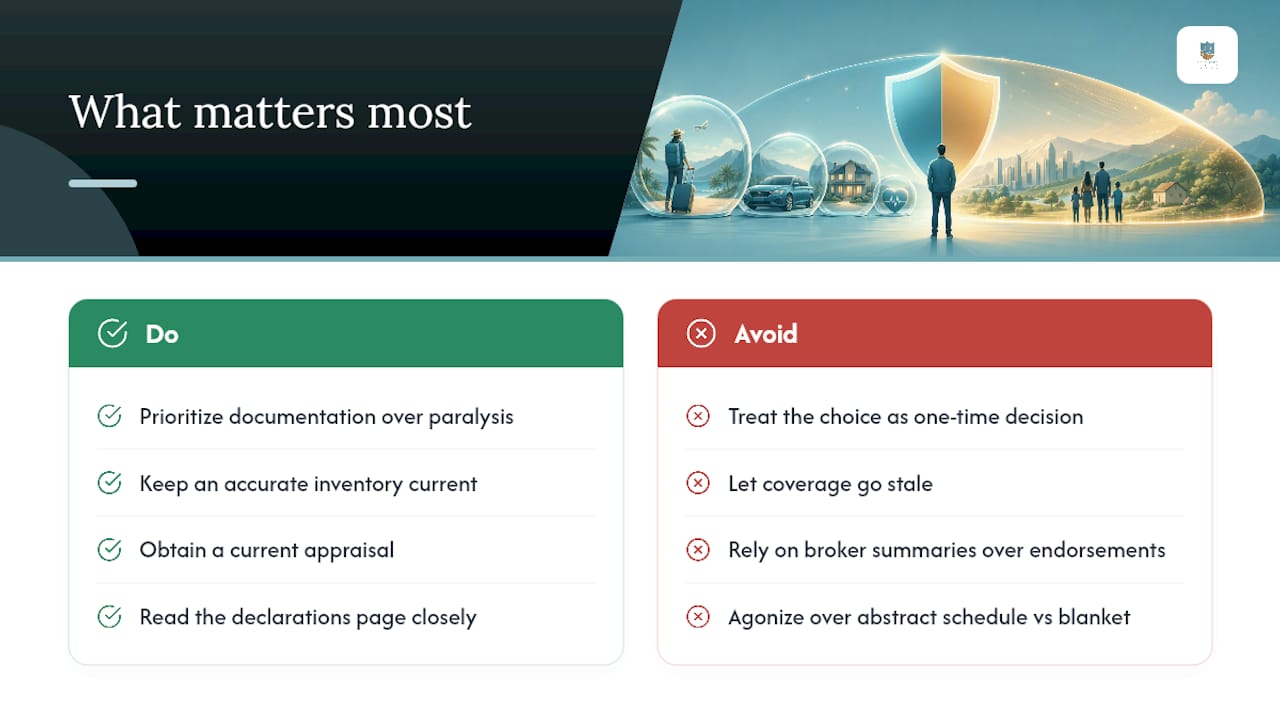
The conventional wisdom also underweights how much the fine print matters. The Beazley case is a reminder that a broker’s summary or a proposal email means nothing if the endorsement says something different. Read your declarations page like it’s the actual contract, because it is.
If you take one thing from this, prioritize documentation over decision paralysis. Whichever structure you choose, an accurate inventory and a current appraisal do more to protect your payout than agonizing over scheduled versus blanket in the abstract. Get the paperwork right, then let the structure follow the paperwork.
— Andrew
Get Your Policy Reviewed Before Your Next Renewal
South Lake Agency Insurance Brokers checks your current schedule and blanket limits against real replacement values across more than 20 carriers, at no cost to you since there’s no broker fee involved. A policy review typically covers your declarations page, any scheduled items, and whether your blanket limits still match what you actually own.

Before you reach out, pull together a rough inventory of major items, any recent appraisals, and a list of anything you’ve purchased or built in the past year, including new construction or major renovations. If you’re buying a home, the new homebuyer insurance guide walks through exactly what to schedule and when. If you’re renewing existing coverage, get a homeowners insurance quote and have an agent walk through your current schedule line by line before you sign anything.
This article is general information, not a substitute for advice from a qualified financial advisor. Consult a qualified financial professional about your own circumstances before acting on anything here.
Sources
Recommended
Comments