




Insurance Credit Check: What Consumers Need to Know and Do
- andrew2biscay
- 59 minutes ago
- 6 min read


Yes, most insurers that are legally allowed to do so run a credit-based insurance score into your rate, and it typically moves your premium rather than whether you qualify at all. That score isn’t your credit score. Regulators require notice when it hurts you. If your quote looks high, pull your reports, read the adverse-action notice carefully, and shop around before assuming the number is final.
TL;DR:
Most insurers report that credit-based insurance scores primarily affect premiums, not eligibility, with the impact often revealed through adverse-action notices.
Insurance scores are built from different, often proprietary, credit report data and are weighted differently than standard consumer credit scores.
Checking your credit reports and disputing errors can lead to a meaningful reduction in your insurance premium if inaccuracies are corrected.
Rates for the same driver can vary significantly between carriers due to differing scoring models and weight given to credit factors.
Working with an independent broker helps identify carriers that weigh credit less heavily, potentially lowering your premium even if your credit profile is thin or recovering.
Table of Contents
What Is an Insurance Credit Check, Exactly?
An insurance credit check produces something called a credit-based insurance score, and it has a narrower job than a regular credit score. Lenders use credit scores to predict whether you’ll repay a loan. Insurers use insurance scores to predict how likely you are to file a claim, and the math behind that prediction is built from your credit report but weighted differently.
The scale is different too. A typical consumer credit score runs from 300 to 850. Insurance scoring models often use their own range entirely, and the number you’d see on a credit card statement doesn’t map directly onto what an insurer sees. On top of that, insurers don’t all use the same model. Some license scores from FICO, others use proprietary or bureau-built models, so two carriers pulling your file on the same day can land on different numbers.
How Insurers Actually Use Credit in Underwriting
Credit information touches two separate decisions: whether you get offered a policy at all, and what you pay for it. Most state regulators restrict insurers from denying or non-renewing a policy based on credit alone, so the bigger effect almost always shows up in your premium, not your eligibility.
Carriers sort applicants into risk pools and price accordingly, and credit is one input alongside your driving record, prior claims, your property’s age and location, and your ZIP code. FICO estimates that roughly 95% of auto insurers and 85% of homeowners insurers use credit-based insurance scores in states where the practice is permitted, which tells you this isn’t a fringe underwriting tool. It’s closer to standard practice.
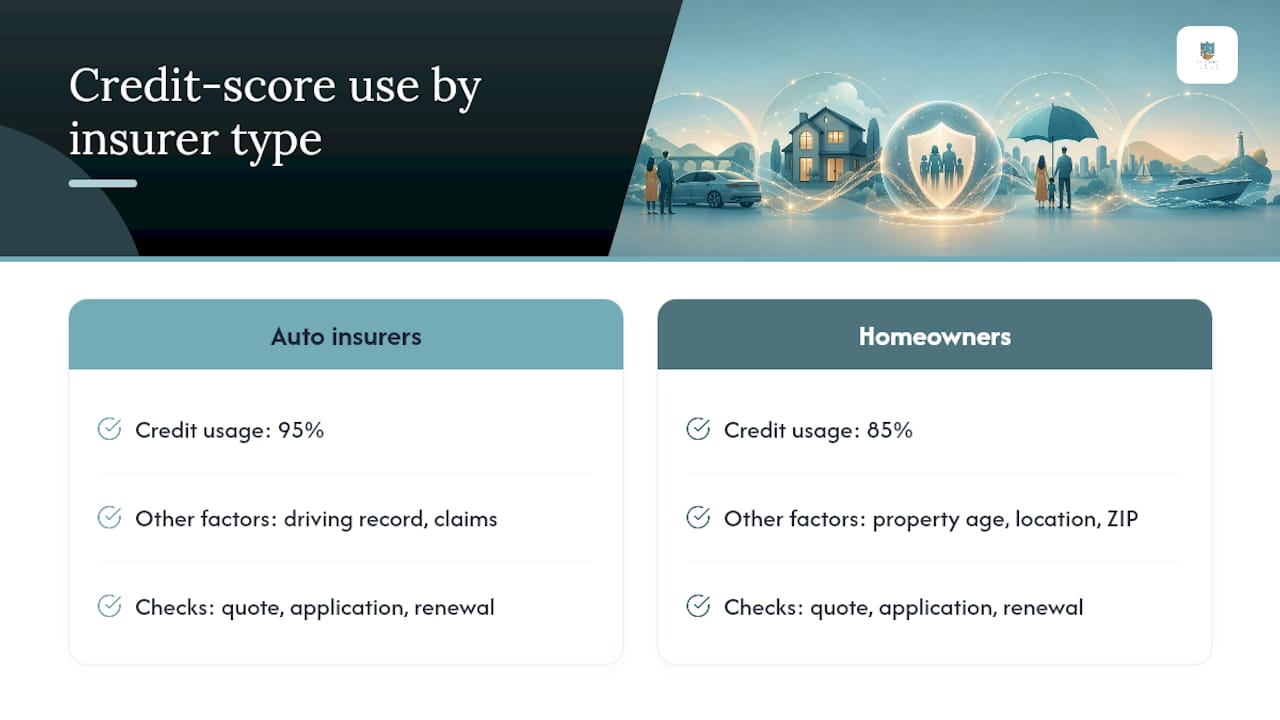
Checks happen at several points: when you first get a quote, when you formally apply, and again at renewal. Most of these are “soft” pulls that don’t affect your credit score, similar to how a credit card issuer checks your file before a pre-approval offer. Because renewal checks are common, a credit dip after your last policy started can raise your next bill even if nothing else about your risk profile changed.

The Five Factors That Build an Insurance Score
Insurance scoring models generally draw on the same five categories that shape your regular credit score, just with different weight given to each one. According to NAIC’s breakdown of credit-based insurance scores, the approximate weighting looks like this:
Payment history (40%): late payments and collections carry the heaviest weight by far.
Outstanding debt (30%): how much you owe relative to your available credit.
Length of credit history (15%): older accounts in good standing help.
Pursuit of new credit (10%): a flurry of new applications signals risk to the model.
Credit mix (5%): a blend of credit types, but it is the smallest lever you have.
Know Your State’s Rules Before You Assume Anything
Credit-based insurance scoring is not legal everywhere, and where it is legal, the rules for how insurers can use it vary widely. Some states ban or sharply limit the practice, including California, Hawaii, and Massachusetts, while most others allow it with conditions attached. Your state’s Department of Insurance is the authoritative place to confirm what applies where you live.
Federal law adds a layer of protection on top of state rules. Under the Fair Credit Reporting Act, if an insurer takes an adverse action, meaning it charges you more or denies coverage in whole or in part because of your credit, it has to send you a notice naming the specific credit bureau it used. That notice is your entry point to a free copy of the exact report the insurer relied on.
From there, your rights are straightforward. You can request the free report tied to the notice, dispute anything that’s wrong, and file a complaint with your state insurance regulator if you believe the score was misapplied. NAIC’s consumer guidance frames this as a two-way expectation: insurers owe you transparency, and you owe yourself a quick follow-up when a rate looks off.
How to Check, Dispute, and Improve What Insurers See
Don’t let a high quote sit unchallenged. Work through this in order:
Get the adverse-action notice and ask which bureau was used. The notice is required by law, and it tells you exactly where to look.
Pull all three of your credit reports at annualcreditreport.com and compare them against whatever the insurer cited. Errors on one bureau’s file are common and easy to miss.
File a dispute directly with the bureau that shows the error, attach supporting documents, and give it time to process.
Follow up with your insurer once the correction posts and ask for a re-rate. Correcting an error often leads to a real, quantifiable premium change, not just a cosmetic score bump.
Beyond disputes, the improvement path is the same one that helps your regular credit: bring past-due accounts current, keep credit card balances well below your limits, avoid opening several new accounts in a short window, and leave old accounts open rather than closing them. None of this moves fast. Expect a few billing cycles before a meaningful shift shows up, and a full year or more before major derogatory marks stop dragging on your number.
Shop Around, and Know When a Broker Earns Their Keep
Rates for the exact same driver or homeowner can swing by hundreds of dollars from one carrier to the next, largely because each company weighs credit and risk differently. Comparing offers across a wider pool, whether through a general rate comparison or a broker’s carrier list, is the most reliable way to keep a credit penalty from sticking.
When you talk to an agent, ask pointed questions:
Does this carrier use credit-based scoring, and how heavily does it weigh compared to my driving or claims history?
What specific factors on my report triggered the higher rate?
Are there carriers on your panel that place less emphasis on credit?
If you have a thin credit file, meaning limited history rather than bad history, an independent broker’s access to multiple carriers can matter more than it does for someone with a thick, clean file, since some carriers treat thin files neutrally while others price them as a risk. That’s a decision a single-carrier agent simply can’t make for you, but a broker checking what actually drives your home and auto premiums across 20-plus companies can.
What Brokers See That Consumers Usually Miss
Working across dozens of carriers exposes a pattern most people never get to see: the same credit profile can produce wildly different quotes depending on which company’s model is doing the scoring. South Lake Agency Insurance Brokers has seen clients save significant amounts by moving to a carrier that weighs credit less aggressively, with a very high client renewal rate reflecting how often that first placement holds up over time. None of that means a broker can override state law or force an exception where one legally doesn’t exist. What it means is that the “best rate” almost never comes from the first quote you get.
— Andrew
Get a Second Opinion on Your Rate
If a credit-based insurance score just pushed your premium higher, you don’t have to accept the first number an insurer gives you. South Lake Agency Insurance Brokers compares quotes across 20-plus carriers at no broker fee, so instead of negotiating with one company that already scored you, you get a side-by-side look at carriers that may weigh your file differently, including ones better suited to a thin or recovering credit history.

South Lake Agency Insurance Brokers also coordinates directly with mortgage and title companies when a credit-driven rate change intersects with a home purchase, so nothing falls through the cracks at closing.
If your adverse-action notice raised more questions than it answered, bring it to an agent for a plain-language review. Ready to see what a broader carrier comparison could save you? Get a homeowners insurance quote or an auto insurance quote started today, and find out whether your credit-based rate is actually the best one available to you.
Sources
Recommended
Comments