




Start at 120 Days: 90/60/30 Policy Renewal Strategy for Brokers


The strongest policy renewal strategy is a proactive, phase-based program that flags accounts early with data, remarkets only when a defined threshold is crossed, and keeps clients informed on a fixed 90/60/30-day cadence. Start reviews 120 days before expiration by pulling dec pages and loss runs. Track renewal rate and remarket-to-bind ratio as your two core signals, and let those numbers, not gut instinct, decide which accounts get shopped.
TL;DR:
Agencies should start renewal reviews at 120 days before expiration, pulling comprehensive data to identify potential issues early.
Timing outreach across 60 to 120 days reduces last-minute churn and allows clients to absorb rate changes without panic.
Remarketing should be based on specific numeric thresholds, such as a 10-15% premium increase, rather than automatic renewal commands.
Tracking renewal rate, remarket-to-bind ratio, and loss trends over three years provides meaningful insights into program effectiveness.
A phased renewal approach, combined with targeted communication and data-driven triggers, improves client retention and optimizes carrier relationships.
Table of Contents
What Is a Policy Renewal Strategy, and Why Does Timing Matter?
A policy renewal strategy is the structured process an agency or risk manager uses to review, negotiate, and reissue coverage before it lapses, rather than scrambling in the final two weeks. Most agencies still treat renewal as a single event 30 days out. That’s backwards. BCG’s research on retention in insurance argues the industry needs to move from episodic remarketing to an “always-on” model that uses continuous data signals to decide where to intervene, rather than reacting to a renewal date on a calendar.
Break the work into three phases and the whole process gets easier to staff, measure, and defend when a client asks why their premium moved.
Planning (120 to 90 days out). Pull the current dec page, order loss runs from the incumbent carrier, and inventory any exposure changes: new equipment, added drivers, square footage, payroll, or revenue shifts. Build your certificate of insurance (COI) holder list now, not after renewal, so you’re not chasing lienholders and vendors during the busiest week. This is also when an annual insurance review earns its keep. Life changes, business expansions, and new assets all surface here.
Execution (90 to 30 days out). Run the client review call, confirm exposures match what’s on file, and decide whether the account stays with the incumbent or gets remarketed against the thresholds covered below. If remarketing is warranted, submit to carriers early enough to get quotes back with room to negotiate, not rubber stamp whatever comes in three days before expiration.
Assessment (30 to 0 days, and after binding). Confirm the bind, reissue every COI on your list with updated dates, and update your agency management system with the new terms. Post-renewal, log what changed: premium delta, coverage changes, and whether the client asked questions that reveal a gap in your communication. That log is what makes next year’s planning phase faster.
Agencies that follow a standardized, phased process rather than a single frantic push in the final month report higher retention and fewer missed cross-sell opportunities, largely because nothing gets discovered for the first time on the renewal call itself.
What Tactics Actually Move Renewal Rates?
Timing gets you organized. Tactics are what actually change the outcome once you’re in the room, or on the phone, with the client. Four levers do most of the work.
Communication cadence: A single renewal letter 30 days out isn’t a strategy, it’s a formality. Space outreach across three touchpoints:
90 days out: A short email or call flagging that renewal is approaching and inviting the client to note any changes since last year.
60 days out: A more detailed review, ideally a call, covering exposure changes, any claims activity, and a preliminary sense of where the market is moving for their coverage type.
30 days out: Confirmation of terms, final numbers, and next steps, with COI updates already staged.
Starting outreach in this 60 to 120 day window rather than waiting for the last month reduces last-minute churn and gives clients time to actually absorb a rate change instead of reacting to it in a panic.
Targeted remarketing, not blanket remarketing. Shopping every account every year burns staff hours and annoys underwriters who see the same risk cross their desk repeatedly. Remarket selectively, and when a rate increase alone triggers the review, consider cheaper alternatives first: raising the deductible, adjusting billing frequency, or requesting a scheduled endorsement change before you pull the account entirely and start over with new carriers.
Cross-sell and bundling. A renewal conversation is the natural moment to ask about umbrella coverage, a second vehicle, or a business owner’s personal lines. Clients who hold two or more policies with the same broker are structurally stickier, and the conversation costs you nothing extra since you’re already on the call.
Claims experience: This one gets underestimated constantly. A client who files a claim and gets a smooth, responsive experience renews at a meaningfully higher rate than one who gets radio silence or a slow adjuster. If your agency doesn’t have a process for checking in on open claims independent of the carrier, build one. It protects renewals more reliably than a discount does.
Pro Tip: Log every claim interaction in your agency management system with a follow-up date, even for claims the carrier is handling directly. A two-minute check-in call after a claim closes does more for retention than a discount offer ever will.
Renewal Checklist: What to Pull Before Every Client Call
Walking into a renewal review without the right documents in hand is how coverage gaps happen. A structured pull list, the same one experienced commercial agents use, catches problems before the client does.
Gather these before scheduling the call:
Current declarations page and full endorsement list.
The last three years of dec pages, to spot creeping changes in limits or exclusions.
Loss runs from the incumbent carrier, ideally five years for commercial accounts.
Updated payroll, revenue, or square footage figures depending on the policy type.
A current inventory of insurable assets: vehicles, equipment, property additions.
A checklist built around these five items is the same framework used across commercial lines to avoid surprise coverage gaps, and it works just as well scaled down for personal lines.
Beyond documents, run through this before the client conversation:
Confirm every active COI holder, lender, landlord, vendor contract, and flag any that need reissuance regardless of what changes at renewal.
Check whether any contract the client signed this year imposes new insurance requirements you haven’t accounted for.
Draft three or four specific questions for the call: any new hires, new locations, new equipment, or claims not yet reported.
Note last year’s premium and coverage terms side by side with this year’s renewal offer so the comparison is visual, not just verbal.
Reviews built this way tend to surface discount opportunities too. Annual reviews routinely reveal bundling savings or unnecessary coverage that nobody would have caught without the side-by-side comparison.
When Should You Remarket a Policy Instead of Renewing It?
Remarketing every account every year wastes underwriter goodwill and staff time. Accepting every renewal without question leaves money and coverage gaps on the table. The fix is a threshold, not a feeling.
Use numeric triggers as your first filter:
Personal lines: remarket when the renewal premium increases more than roughly 15% without a corresponding claim or coverage change.
Commercial lines: the threshold runs wider, typically 10% to 20%, depending on the account’s loss history and how exposure-sensitive the class of business is.
Layer in non-numeric triggers that override the math entirely:
The incumbent carrier issues a non-renewal or restricts coverage, regardless of price.
A new material exposure appears, such as a new product line, new location, or fleet addition, that the current carrier may not want to write.
A claims spike suggests the account is heading toward a program the current carrier won’t want to keep at the same terms.
A contract, lender, or lease imposes new insurance requirements the existing policy doesn’t meet.
One more rule worth adopting: don’t remarket the same account every year by default. A documented cadence of full remarketing every two to three years, unless a trigger above fires sooner, protects your loss-run continuity with carriers and keeps underwriters willing to compete for the account when you actually need them to.
How Do You Track Whether the Program Is Working?
None of this holds together without measurement. The KPIs that matter most for a renewal program are renewal rate by segment, remarket-to-bind ratio, average premium change, and loss ratio trends over a rolling three-year window. Retention that looks healthy in aggregate can hide a personal-lines segment quietly bleeding out, so break the numbers down by line of business, not just overall.
On the tooling side, most agencies get real traction from three categories: agency management system dashboards that flag upcoming renewals automatically, comparative rating platforms for fast remarket quotes, and COI automation tools that cut reissuance from a manual task to a batch job. Shifting toward continuous, data-driven signals rather than periodic manual review is exactly the direction the industry is moving, and it’s far more achievable at small-agency scale now than it was five years ago.
A simple prioritization view: sort upcoming renewals by days-to-expiration crossed with premium size and claims activity, so the highest-stakes accounts surface first.
Set an alert threshold at 120 days out for any account tagged commercial or high-value personal lines.
How South Lake Agency Insurance Brokers Puts This Into Practice
Frameworks are only useful if someone actually runs them. An independent insurance brokerage working with multiple carriers can remarket an account efficiently when thresholds are crossed, without needing to start carrier relationships from scratch.
A few specifics worth knowing:
Broker fees are typically not charged to clients, so a remarket review costs the client nothing beyond the time on the call.
Clients can potentially save through the comparison process across multiple carriers.
Some agencies report high client renewal rates supported by positive reviews.
Certificate of insurance (COI) reissuance and lender or title company coordination can be handled directly by brokers, easing paperwork burdens on clients.
Operationally, that means a renewal call at South Lake Agency Insurance Brokers follows the same phased structure outlined above: exposure review first, threshold check second, remarket only if warranted, and COIs updated the moment terms are confirmed.
Where Renewal Programs Actually Fall Apart
The most common failure isn’t a bad strategy. It’s waiting until the renewal notice arrives to start working the account, which turns every review into a fire drill. A close second: remarketing on every single rate increase, which trains carriers to see your submissions as noise rather than serious business.
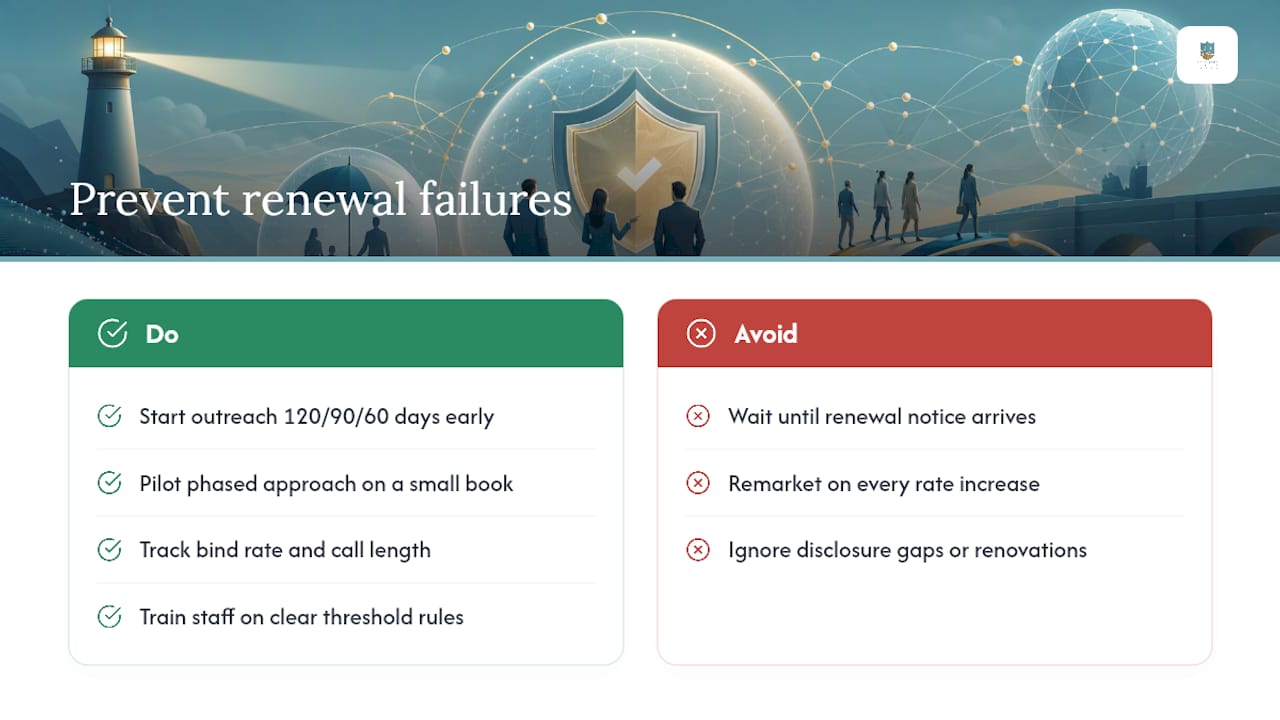
Disclosure gaps cause the quiet damage. An undisclosed renovation or a new piece of equipment doesn’t show up until a claim gets denied, and understanding renovation costs vs cash offer can help homeowners better set insurance limits. An undisclosed renovation or a new piece of equipment doesn’t show up until a claim gets denied, and that’s a trust problem, not a paperwork one.
Pilot the phased approach on a slice of your book first, maybe the accounts renewing in the next quarter, and track bind rate and call length before rolling it agency-wide. Train staff on the threshold rules specifically; ambiguity here is what causes both over-remarketing and under-remarketing.
— Andrew
Ready to Put a Renewal Strategy to Work?
You don’t have to build this system alone or run it with a single carrier’s rate as your only option. South Lake Agency Insurance Brokers already runs the multi-carrier shopping, COI reissuance, and lender or title company coordination described throughout this guide, without charging a broker fee for it.
If you’re a new homeowner sorting out coverage on a recent purchase, the New Homebuyer Insurance Guide walks through exactly what changes at closing and what to check before your first renewal. Business owners weighing whether their current program still fits their exposure can request a business insurance renewal review and get a real comparison across carriers instead of a single quote. And if your home policy is up for renewal soon, start with a homeowners insurance quote to see where you stand against the market before you accept whatever number shows up in the mail.
Sources
Recommended
Comments