




Sump Pump Coverage HO 06 95: Broker Checklist for Homeowners

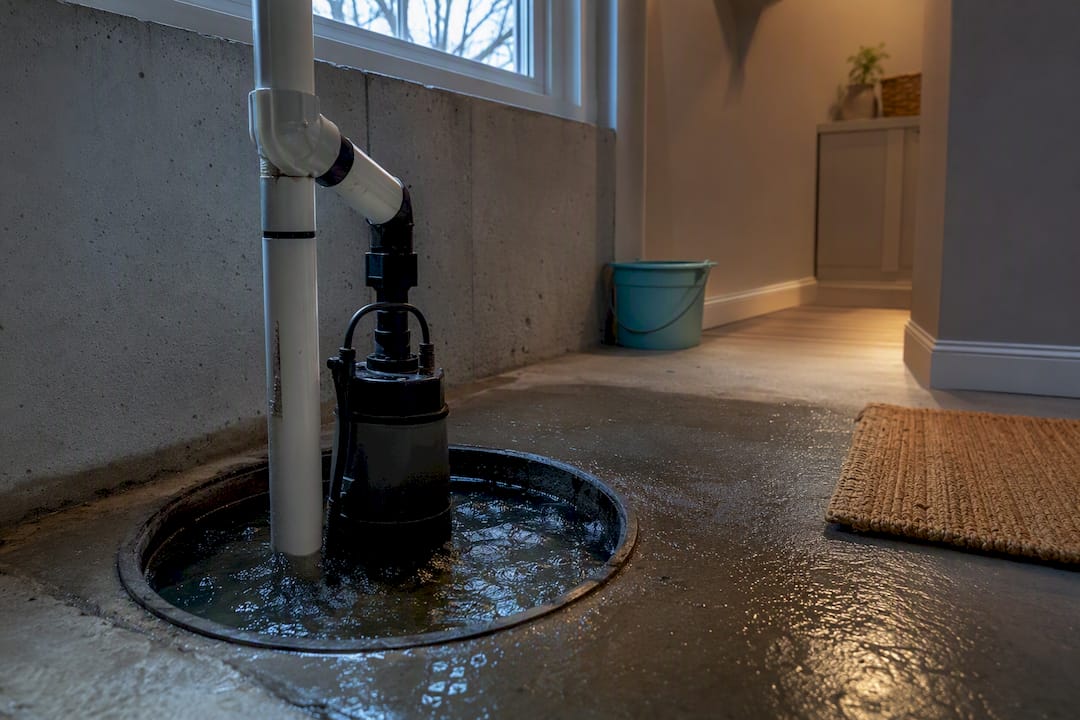
Standard homeowners insurance almost never covers sump pump failure or sewer backup on its own. That protection comes from an optional endorsement, most commonly the ISO form HO 06 95, which you either have or don’t. Pull your declarations page right now and look for “water backup” or “sump discharge/overflow” and a dollar limit next to it. If you don’t see it, call your broker before your basement gives you a reason to.
TL;DR:
Water backup coverage typically limits payout to between $5,000 and $25,000, depending on the policy and the scheduled amount you select.
The endorsement covers damage caused by sump overflow and sewer backup, but explicitly excludes flood-related damage from rising groundwater or surface water.
Knowledge of your policy’s specific exclusions, limits, and deductibles is crucial, especially since some policies exclude pump replacement and wear-and-tear.
Installing a backup pump, performing regular maintenance, and increasing your coverage limit can significantly reduce your financial risk from basement water damage.
Understanding the origin of water during a flood is essential, as water-backup coverage and flood insurance cover different sources and may both be necessary in flood-prone areas.
Table of Contents
What Does Sump Pump Coverage Actually Pay For?
Water backup and sump overflow coverage pays for damage when water backs up through a sewer or drain, or when your sump pump overflows or fails to keep pace with groundwater trying to enter your basement. It exists because a standard homeowners policy treats water that enters from below or backs up through pipes as an entirely different animal than water that falls from the sky or bursts from a pipe inside your walls.
The endorsement typically pays for:
Finished basement materials: drywall, flooring, insulation, and trim
Personal belongings stored in the basement: furniture, electronics, storage boxes
Structural drying and mold remediation tied directly to the covered event
Some policies extend to detached structures if the endorsement language includes them
Here’s the distinction that trips people up: this coverage applies to backup and overflow, not flood. If the Mississippi overflows and groundwater rises to force its way into your foundation, that’s flood, and it needs a separate flood policy. If your sump pump’s float switch fails during a heavy storm and water pools in your finished basement, that’s an overflow event the endorsement is built for.
Limits are scheduled, meaning you pick a dollar cap when you buy the endorsement. Common tiers run from $5,000 at the basic level up to $25,000 or higher, depending on the carrier and how much finished square footage you’re protecting.
Common Exclusions: What Homeowners Should Expect Is Not Covered
Every water-backup endorsement comes with a short list of hard lines insurers won’t cross, and knowing them up front saves you a painful conversation with an adjuster later.
Flood and surface water. If the water’s origin is rising groundwater, a swollen river, or surface runoff pooling against your foundation, the endorsement doesn’t apply. You need a National Flood Insurance Program policy or private flood coverage for that.
Pump replacement itself. The endorsement covers damage the overflow causes, not the cost of a new pump. That’s a maintenance expense, not a covered loss, according to public-adjuster guidance on sump pump endorsement claims.
Wear and tear. A pump that dies of old age after a decade of service is a maintenance failure, not an insurable event.
Known conditions you ignored. If you knew the pump was failing and didn’t fix it, insurers can deny the claim on negligence grounds.
Groundwater pressure during a flood event, even if your sump pump was involved, stays excluded because the underlying cause is flood, not mechanical failure.
How the HO 06 95 Endorsement Actually Works
The ISO form HO 06 95 rewrote the rules for water-backup coverage across the industry, and the change matters more than most homeowners realize. Before this form existed, many older endorsements were vague about whether overflow caused by a mechanical breakdown or a power outage counted as a covered loss. HO 06 95 closes that gap explicitly: it covers direct physical loss from water that backs up through a sewer or drain, or that overflows or discharges from a sump, even when the root cause is a failed pump motor or a lost electrical connection, according to industry analysis of the HO 06 95 form.
What it still won’t touch is flood-origin water. That distinction is the whole ballgame when you file a claim.
Picture two scenarios. In the first, your sump pump’s motor burns out during a normal spring thaw, and water fills your finished basement overnight. HO 06 95 pays, up to your scheduled limit. In the second, a hundred-year storm overwhelms the municipal storm system and floodwater surrounds your house, seeping in regardless of whether your pump was running. That’s a flood claim, and the endorsement sits this one out no matter how new your pump is.
Carriers typically let you schedule the limit yourself, often between $5,000 and $25,000, with the premium rising modestly as the limit climbs.
Is Sump Pump Coverage Worth the Extra Cost?
Premium impact for this endorsement is usually modest, but three factors drive the price more than anything else: the limit you choose, your local flood and sewer risk, and whether you’ve filed a water claim before. A finished basement with an aging pump and a history of heavy spring runoff pushes the cost up; a dry, unfinished basement with a newer pump pushes it down.
Run this quick framework:
Finished basement, older pump, known municipal sewer issues: add the endorsement. The math almost always favors you.
Unfinished basement, minimal storage, newer pump, no history of backup: lower priority, though still cheap insurance against a bad year.
A $5,000 basement remodel wiped out by one bad overflow costs more than years of endorsement premiums combined. That’s the math worth doing before you skip it.
What to Do Immediately After Sump Pump Failure
The steps you take in the first hour after discovering water in your basement shape whether your claim goes smoothly or turns into a fight.
Cut the power to any submerged outlets or equipment before wading in. Safety comes before documentation.
Stop the source if you safely can — reset a tripped breaker, check the discharge line for a clog, or shut off the water supply feeding the issue.
Photograph and video everything before you touch anything. Timestamp it if your phone doesn’t do it automatically.
Preserve the failed pump. Don’t toss it. The adjuster needs to see it to confirm cause and rule out negligence.
Call your broker before you call a contractor. Reference “water backup” or the specific endorsement name on your policy so the right adjuster gets assigned from the start.
Keep every receipt from mitigation companies, dehumidifier rentals, and temporary repairs.
Hold off on permanent repairs until the adjuster inspects, if the water damage allows you to wait safely.
Pro Tip: Save mitigation receipts separately from repair receipts. Adjusters often treat emergency drying and mold prevention costs as a distinct claim category, and undocumented mitigation work is one of the most common reasons payouts get delayed.
Following this sequence gives your claim a much cleaner path from report to payout, and it removes most of the ambiguity an adjuster would otherwise have to resolve by asking you questions weeks later.
Questions to Ask Your Broker Right Now
Before your next renewal, or ideally today, get these answers in writing from whoever holds your policy.
Does my policy include a water-backup or sump discharge/overflow endorsement, and what’s its exact form name?
What’s my current scheduled limit, and what would it cost to raise it to $15,000 or $25,000?
Is there a separate deductible for this endorsement, and how does it interact with my regular homeowners deductible?
If I also carry flood insurance, how do the two policies coordinate if a claim involves both backup and rising water?
Does my policy include equipment breakdown coverage, and would that pay to replace the pump itself if it fails mechanically?
Has my home’s claim history affected pricing on this endorsement, and would switching carriers change that?
Most homeowners have never asked these questions because they didn’t know the endorsement existed until they needed it and didn’t have it. A five-minute call now beats a denied claim later.
Typical Causes of Sump Pump Failure Leading to Claims
Sump pumps fail for a short list of predictable reasons, and most of them show up during exactly the moment you need the pump most: a heavy storm.
Power loss tops the list. A storm knocks out electricity right when groundwater is rising fastest, and a pump without battery backup simply stops. Float switch failure is close behind. Sediment, debris, or a switch that’s jammed in the wrong position means the pump never triggers even though power is fine. Mechanical burnout happens when a motor runs too long, overheats, or simply reaches the end of its service life, often five to ten years depending on use.
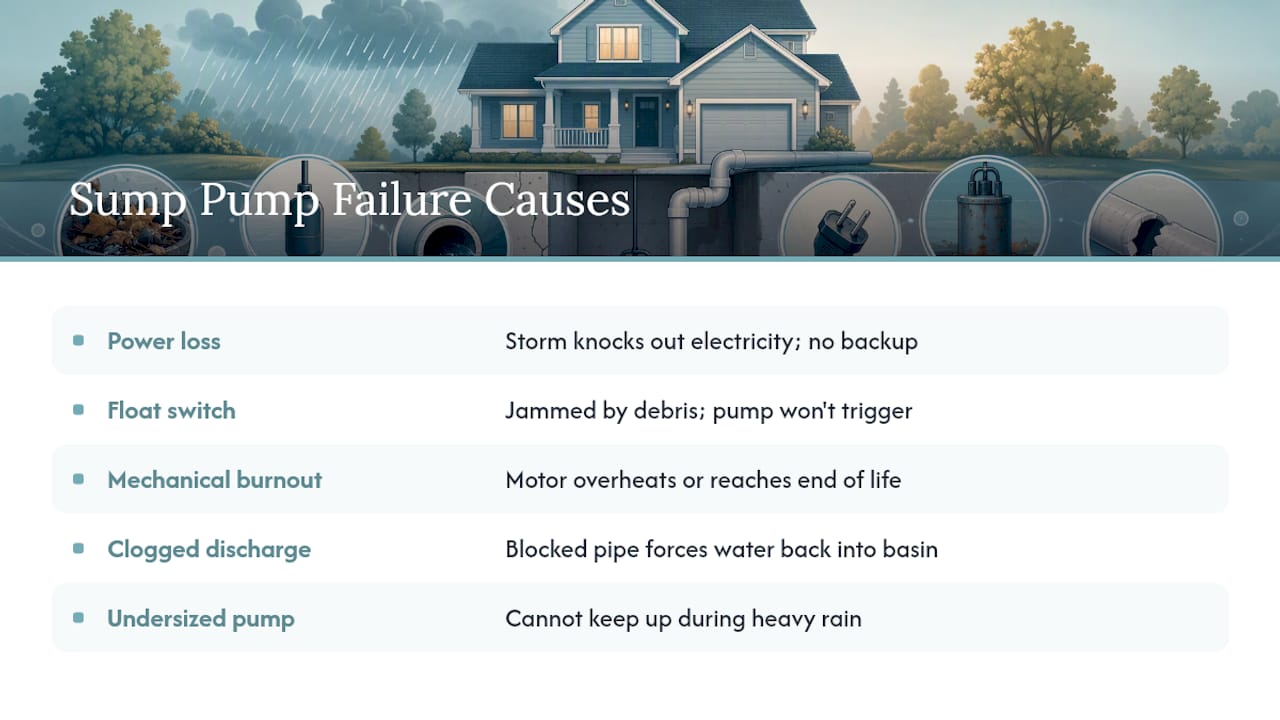
Clogged discharge lines cause overflow even when the pump itself is working. If the pipe carrying water away from your house is blocked by debris, ice, or a collapsed section, water has nowhere to go but back into the basin. Undersized pumps are a quieter problem: a pump rated for a small basin can’t keep up during an unusually heavy rain event, even with everything else functioning normally, according to guidance from sump pump industry groups like the Sump Pump & Sewage Pump Manufacturers Association.
Age matters more than most homeowners assume. A pump that’s been quietly running for a decade is statistically closer to failure than one installed two years ago, and insurers factor that into both underwriting and claims review.
Preventative Maintenance That Actually Reduces Risk
Test your pump twice a year, ideally in spring before the heavy rain season and again in fall. Pour a few gallons of water into the basin and confirm the float switch triggers the pump to activate and shut off cleanly.
Clean the pump and basin annually to clear sediment and debris that can jam the float switch or clog the intake screen. Check the discharge line for blockages, ice dams in winter, or disconnected sections outside the house where you can’t see them from indoors.
Install a battery backup system or a water-powered backup pump. Since power loss during storms is one of the leading causes of failure, a backup system that keeps running when the grid doesn’t is one of the more effective upgrades you can make. Consider a water-level alarm that alerts you before the basin overflows rather than after.
Replace the pump proactively around the seven to ten year mark rather than waiting for it to fail. A new pump costs far less than the water damage one failure can cause, and it’s a maintenance expense your insurance won’t reimburse anyway.
How Coverage Differs Across Insurance Providers
Not every carrier writes the water-backup endorsement the same way, and the differences show up in three places: the form language, the available limit tiers, and the deductible structure.
Some carriers use the standardized HO 06 95 language directly. Others write proprietary endorsements with similar intent but different exclusions buried in the fine print, particularly around what counts as “mechanical failure” versus “neglect.” A policy that looks identical on the surface can handle the same claim very differently depending on which version you’re holding.
Limit tiers also vary. Some carriers cap the endorsement at $10,000 with no option to raise it; others let you schedule up to $25,000 or more for an additional premium. If your basement is fully finished with real value at stake, that ceiling matters a lot more than the base premium difference between carriers.
Deductible structure is the third variable. Some insurers apply your standard homeowners deductible to a water-backup claim. Others carry a separate, often higher deductible specifically for this endorsement. Comparing across carriers rather than assuming your current insurer’s terms are standard is often the only way to know whether you’re getting real value, which is exactly the kind of comparison a broker who works with multiple carriers is built to run for you.

Sump Pump Coverage and Flood Insurance: How They Overlap
These two coverages solve different problems, and the line between them comes down entirely to where the water originated, not how much damage it caused or which room it ended up in.
Water-backup coverage handles water that backs up through your sewer or drain, or that overflows from your sump system because of mechanical failure, power loss, or a pump that simply can’t keep up. Flood insurance, issued through the National Flood Insurance Program or a private flood carrier, handles water that enters from rising groundwater, overflowing rivers, or surface water accumulation, regardless of whether your sump pump was involved.
Here’s where it gets confusing for homeowners: you can have both types of water enter your basement during the same storm, and only one might be covered. If floodwater surrounds your home and seeps in through the foundation while your sump pump is also overwhelmed, an adjuster will look at the origin of the water that caused the damage, not just the fact that your basement flooded. That’s why homes in areas with any flood risk, even outside a mapped flood zone, often benefit from carrying both the water-backup endorsement and a separate flood policy rather than assuming one covers the other.
A Broker’s Take on Sump Pump Coverage
Most homeowners find out whether they have this endorsement the hard way, standing in two inches of water with a shop vac and a sinking feeling. That’s backward. Checking your declarations page for water backup or sump discharge/overflow language takes five minutes and costs nothing.
A licensed broker who works across multiple carriers can tell you within a phone call whether your current limit matches your actual risk, and whether a different carrier offers a better tier for a similar premium. That comparison work is exactly what South Lake Agency does for clients reviewing this exact gap. If it’s been more than a year since anyone looked at your endorsement limit, that’s reason enough to ask.
— Andrew
Let South Lake Agency Insurance Brokers Check Your Coverage Gap
An independent insurance brokerage is the alternative to guessing whether your policy actually protects your basement: some brokerages compare your current terms against multiple carriers to find the right water-backup endorsement and the limit that matches your real exposure, often without charging broker fees.

Every carrier writes this endorsement a little differently, and most homeowners have never had someone actually compare the fine print for them. We have. If you’re a new homebuyer setting up coverage for the first time, or you’ve owned your home for years and never checked this endorsement, get a homeowners insurance quote and we’ll walk through your declarations page together, line by line, until you know exactly what you’re protected against.
Sources
Recommended
Comments