




Minnesota Boat Insurance: A Broker's Cost Breakdown, Avg $816/yr


Most Minnesota boat owners pay various amounts annually, depending on the vessel. Small fishing boats sit near the bottom of that range; pontoons and runabouts land in the middle; PWCs and high-performance boats push toward the top. The smartest first move is getting an apples-to-apples quote and confirming your liability limits, since your homeowners policy probably covers less than you think. An independent insurance broker can shop that quote across multiple Minnesota carriers at once.
TL;DR:
Storage location, boat characteristics, and owner history significantly influence premiums, with trailer storage and winterization documentation leading to discounts.
Coverage options vary, with agreed value hull coverage being more suitable for newer or expensive boats to avoid depreciation deductions.
Comparing policies requires examining geographic zones, liability limits, deductibles, sublimits, and exclusions like racing or chartering to prevent gaps.
Using a broker to shop across multiple carriers helps identify coverage gaps and secure better rates, especially when bundling with home or auto policies.
Table of Contents
How Much Is Boat Insurance in Minnesota? Cost Ranges by Boat Type
Your premium depends almost entirely on what you’re insuring and how you use it. A basic fishing boat with a small outboard motor is cheap to insure because it’s cheap to replace and rarely goes fast enough to cause serious damage. A 24 foot cruiser with a diesel engine and a cabin full of electronics is a different animal entirely.
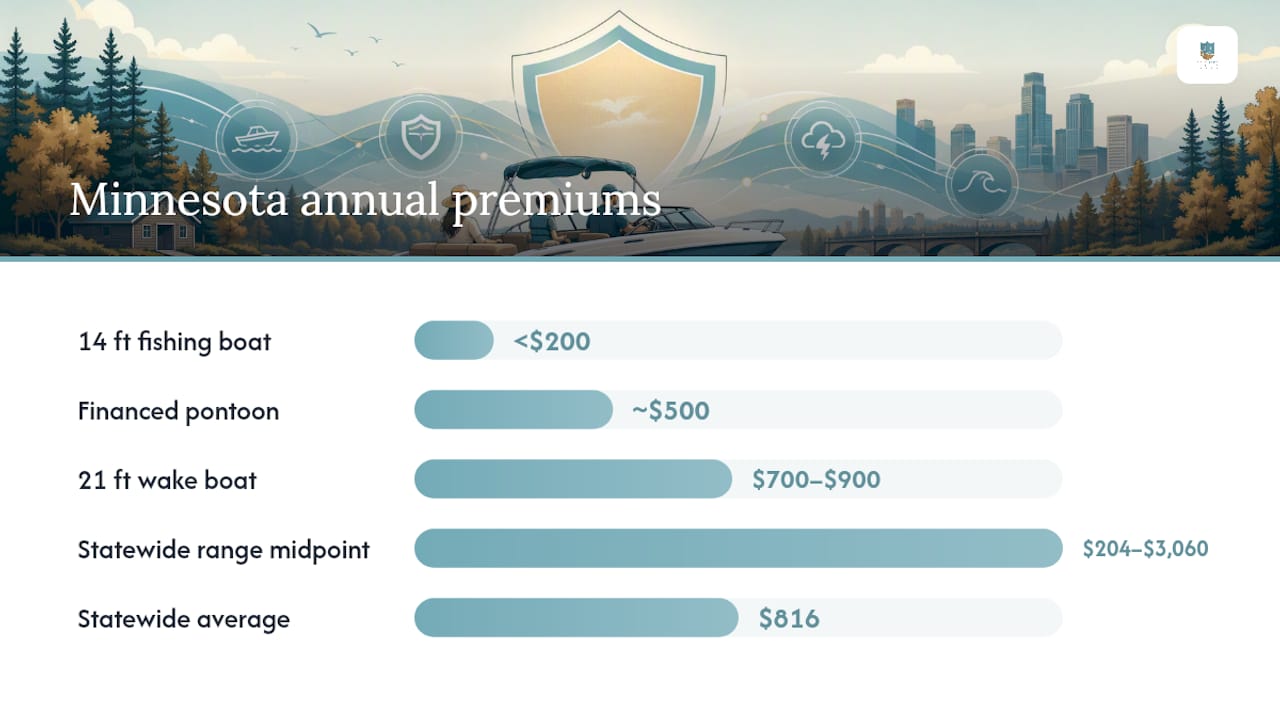
CostWhale’s 2026 data puts the Minnesota average near $816 a year, with a statewide range running from roughly $204 to $3,060 depending on the boat. That spread reflects real differences in value, horsepower, and risk, not random pricing.
Boat insurance costs vary by category, with smaller boats generally costing less to insure and larger or more powerful boats costing more.
A retired angler running a 14 foot Lund on a quiet lake near Brainerd might pay under $200 a year for full coverage. A family with a financed pontoon on Lake Minnetonka, hauling passengers every summer weekend, often lands closer to $500. Add a loan on a 21 foot wake boat and you’re likely in the $700 to $900 range once lenders require full physical damage coverage. Boat-Ed’s cost breakdown confirms these patterns track with boat type, use, and owner history nationally, and Minnesota fits that curve closely.
What Actually Drives Your Minnesota Boat Insurance Premium
Insurers price risk, not sentiment. Four categories do most of the work in setting your rate.
Boat characteristics matter first. Type, length, age, horsepower, and current value all feed the calculation. A 15 year old boat with a rebuilt engine prices differently than a brand new model with identical specs, and horsepower above certain thresholds triggers higher liability pricing almost everywhere.
Use and location matter just as much in Minnesota specifically. A boat that only sees a quiet inland lake carries less risk than one that spends weekends on Lake Mille Lacs or the St. Croix River, where traffic, wave action, and collision exposure run higher. Frequent towing or skiing use also raises risk because it increases the chance of a passenger injury claim.
Owner profile rounds out the picture: claims history, boating experience, age, and where you store the boat during the season and off it.
Policy structure changes price too:
Liability limits you choose
Agreed value versus actual cash value on hull coverage
Deductible amount
Add ons like towing, roadside assistance, or gear coverage
Pro Tip: If you store your boat on a trailer at home rather than a marina slip, tell your agent. Storage location affects theft and damage risk, and insurers usually price it into the quote.
Boat Insurance Coverage Options in Minnesota: Limits and Deductibles
Coverage names sound similar across carriers, but the fine print varies enough to change your actual protection. Knowing what each piece does helps you read a quote instead of just trusting the bottom line number.
Liability coverage amounts often start in moderate ranges, with options to increase limits at additional cost, providing important protection in case of injury or damage claims.
Hull and physical damage coverage comes in two flavors. Agreed value pays a fixed amount you and the insurer settle on upfront, with no depreciation deducted after a total loss. Actual cash value factors in depreciation, so an older boat pays out less. Agreed value costs a bit more but matters most for newer or high-value boats.
Other coverages worth checking:
Medical payments for you and your passengers
Uninsured boater coverage
Wreck removal and salvage, often a separate sublimit
Trailer and onboard accessory coverage
Deductibles commonly range from $250 to $1,000. If you already carry an umbrella policy, ask whether it extends liability protection over your boat, since many umbrella policies do.
Discounts That Lower Boat Insurance Premiums in Minnesota
You have more control over your rate than most people realize. A handful of documented behaviors and policy choices routinely earn real discounts.
Bundle your boat with home and auto policies. Multi-policy discounts are among the largest and easiest to secure.
Complete a boating safety course. Many Minnesota insurers credit this, and the Minnesota DNR lists approved course options.
Stay claim free. No-loss credits build over consecutive years without a claim.
Document winter storage and winterization. Insurers reward owners who store off-water and winterize properly, since it lowers off-season risk.
Add anti-theft devices or secure trailer locks. Marina slip storage versus home trailering also changes theft exposure differently by carrier.
Ask your broker directly which discounts apply and what proof you need. Some require documentation like a course completion certificate or a receipt for winterization service.
Comparing Boat Insurance Quotes: What to Ask Before You Buy
Two quotes with similar premiums can offer very different protection. Compare them line by line rather than by price alone.
Check the geographic territory the policy covers, the liability limit, whether hull coverage is agreed value or actual cash value, and whether towing and trailer coverage are included or sold separately. Deductibles should be compared side by side too, since a cheaper premium with a $1,000 deductible might cost more in the long run than a slightly higher premium with a $250 deductible.
Ask your agent these questions directly:
Where geographically is coverage valid, and does it change for out-of-state trips?
Does the policy cover winter storage, or do I need a separate off-season endorsement?
What sublimits apply to wreck removal or salvage?
Are there exclusions for racing, chartering, or lending the boat to others?
Pro Tip: If a quote seems unusually cheap, ask specifically what the wreck removal sublimit is. That’s where insurers often trim costs quietly, and it’s an expensive gap to discover after a sinking.
A red flag worth remembering: any quote that can’t clearly explain its hull valuation method deserves a second look. That’s exactly the kind of gap a broker comparing multiple carriers tends to catch that a single-carrier agent might miss.
Minnesota Boat Registration Rules and Where to Get Help
Minnesota law does not require boat insurance, but that doesn’t mean it’s optional in practice. Marinas, lenders, and financing companies routinely require proof of coverage before they’ll let you dock or approve a loan, and the Minnesota Department of Commerce confirms homeowners coverage rarely fills that gap completely.
For registration and safety course requirements, the Minnesota DNR watercraft registration page covers forms and fees. For a broader look at how Minnesota’s boating statutes compare nationally, the USCG state boating laws summary is a reliable reference. If you have a coverage dispute or a general insurance question, the Minnesota Department of Commerce’s Consumer Response Team handles those directly.
A broker’s take on why Minnesota boat owners overpay
Most Minnesota boat owners who overpay aren’t buying too much coverage. They’re buying the wrong shape of coverage, then compounding it by never shopping the renewal. I’ve seen the same pattern play out again and again: someone buys a boat, adds it to their homeowners policy as an afterthought, and finds out only after a claim that their coverage tops out at a few thousand dollars in liability protection. That’s not a hypothetical gap. It’s the default state for a lot of policies written without anyone checking the fine print.
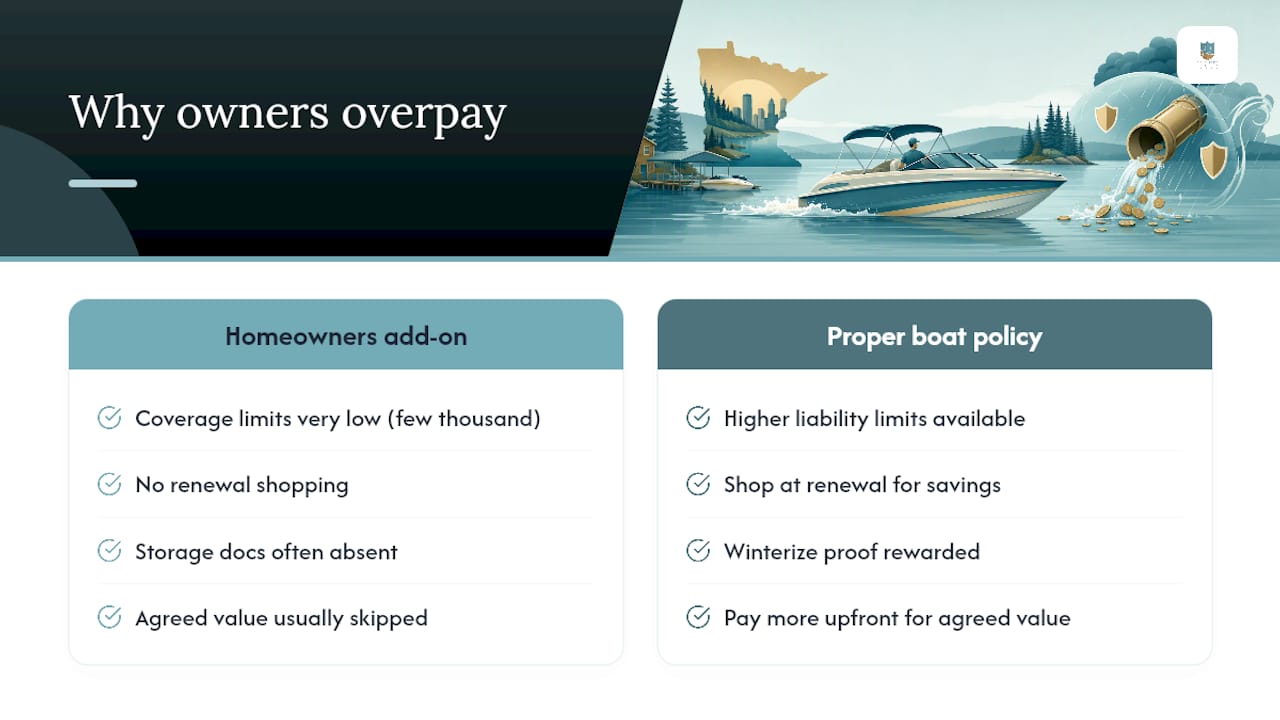
The Minnesota-specific wrinkle people underestimate is storage documentation. Owners who winterize properly and can prove it, whether through a receipt or a service record, consistently get better renewal pricing than owners who just let the policy roll over untouched. Insurers reward paperwork because paperwork reduces their uncertainty about your risk. Most people never think to ask what documentation actually moves the needle, so they leave savings on the table year after year.
The other blind spot is agreed value coverage. It costs a little more upfront, and that’s exactly why people skip it. But actual cash value on a five year old boat after a total loss can leave you thousands short of what you’d need to replace it, and that math rarely gets explained clearly at the point of sale.
— Andrew
Get a Boat Insurance Quote from a Minnesota Broker
An insurance broker can shop your boat across multiple carriers instead of running one quote through one company, which can help catch the coverage gaps this article just walked through. There is typically no broker fee added to your premium, and bundling boat coverage with home or auto insurance can often save on both policies at once.

Questions about where you store the boat, how you use it, and other factors help ensure the quote matches your risk instead of overcharging you for coverage you don’t need. If you’re a new boat owner who also just bought a home, our new homebuyer insurance guide is worth a look too, since bundling often unlocks better pricing on both.
Ready to see what your boat actually costs to insure in Minnesota? Request a boat insurance quote and compare real numbers instead of guessing.
Sources
Recommended
Comments