




HO3 vs HO5: Which Policy Should Homeowners Choose?


For most U.S. homeowners, an HO-3 is the right baseline. An HO-5 earns its higher premium when you own high-value portable belongings, want broad accidental-loss protection, or prefer a simpler claims process where the insurer must justify a denial rather than you proving a covered cause.
Three facts drive that verdict:
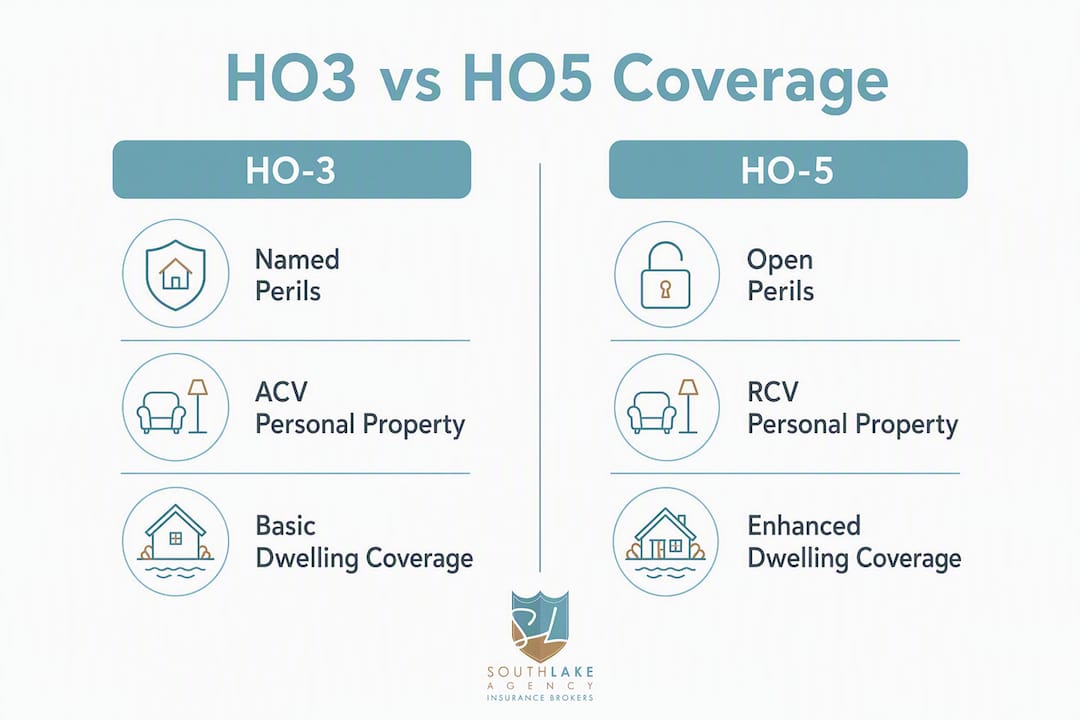
Perils covered: An HO-3 covers your personal property only against a named list of perils; an HO-5 covers it against everything not specifically excluded, a meaningful difference when an everyday accident destroys a laptop or a piece of jewelry goes missing.
Valuation method: HO-3 personal property claims typically settle at actual cash value (ACV), meaning depreciation comes out of your pocket. HO-5 pays replacement cost value (RCV), so the insurer covers a comparable new item.
Premium trade-off: HO-5 costs more, but the gap varies by carrier and homeowner profile. For many households, adding targeted endorsements to an HO-3 closes most of the coverage gap at a lower cost.
Pro Tip: Before upgrading to a full HO-5, ask your agent about the HO 00 15 endorsement (special personal property/open perils) combined with a personal property replacement-cost endorsement. That combination can replicate HO-5-level personal property protection on an HO-3 chassis, often for less.
Table of Contents
What are ISO homeowners forms and why does the form number matter?
What are the key differences that actually change your claim outcome?
What should you ask your agent before choosing between HO-3 and HO-5?
What do neither HO-3 nor HO-5 cover, and how do you close those gaps?
When is HO-5 worth the premium? Broker data and South Lake Agency’s perspective
South Lake Agency Insurance Brokers can compare both forms for you
How do HO-3 and HO-5 compare at a glance?
Both forms cover your dwelling on an open-perils, replacement-cost basis. The real difference lives in how each handles your personal property.

Dimension | HO-3 | HO-5 |
Perils covered — dwelling | Open perils (all-risk) | Open perils (all-risk) |
Perils covered — personal property | Named perils only | Open perils (all-risk) |
Personal property valuation | ACV (depreciated) by default | RCV (replacement cost) |
Dwelling coverage basis | Replacement cost | Replacement cost |
Availability | Widely available; standard lender requirement | Less universal; subject to underwriting filters |
Typical premium impact | Lower baseline | Higher; gap varies by carrier and profile |
Best for | Budget-conscious owners; standard household items | High-value portable property; frequent accidental-use risk |
The sections below unpack each row with real-dollar examples and buyer profiles.
What are ISO homeowners forms and why does the form number matter?
The Insurance Services Office (ISO) publishes standardized policy forms that most U.S. carriers use as a starting point. When an insurer says “HO-3” or “HO-5,” they are referencing one of these ISO templates. Carriers can customize with endorsements, but the form number tells you the baseline structure before any modifications.
Two concepts determine how much a form actually pays on a claim:
Named perils vs. open perils. A named-perils policy lists the specific causes of loss it covers (fire, theft, windstorm, and so on). If the cause is not on the list, the claim is denied. An open-perils (also called “all-risk”) policy covers every cause of loss except those it explicitly excludes. That distinction shifts the burden of proof: under named perils, you must show the cause is listed; under open perils, the insurer must point to a written exclusion to deny you.
ACV vs. RCV. Actual cash value subtracts depreciation from the replacement price. A five-year-old couch that costs $1,200 new might be worth $400 at ACV. Replacement cost value pays what a comparable new item costs today, regardless of age. RCV claims often work in two steps: the insurer pays ACV first, then releases the recoverable depreciation once you submit receipts showing you replaced the item.
Here is where each ISO form sits in the lineup:
Form | Coverage type | Typical use |
HO-1 | Basic named perils | Rarely offered today |
HO-2 | Broad named perils | Limited availability |
HO-3 | Open perils (dwelling) / Named perils (personal property) | Most common owner-occupied form |
HO-4 | Named perils (personal property only) | Renters insurance |
HO-5 | Open perils (dwelling and personal property) | Comprehensive owner-occupied form |
HO-6 | Named perils (unit interior) | Condo owners |
HO-7 | Open perils | Mobile/manufactured homes |
HO-8 | Modified replacement cost | Older/historic homes |
Mortgage lenders typically require at minimum an HO-3 to satisfy dwelling coverage requirements. Understanding lender insurance requirements before you shop helps you avoid surprises at closing.
What does an HO-3 actually cover?
HO-3 is the most common homeowners form in the U.S. and the standard minimum most mortgage lenders accept. Here is how its five coverage components work in practice:
Coverage A (Dwelling): Open-perils protection for the structure of your home. A fire, windstorm, or burst pipe is covered; the insurer must cite an exclusion to deny a structural claim.
Coverage B (Other structures): Fences, detached garages, and sheds, also on an open-perils basis, typically at 10% of Coverage A limits.
Coverage C (Personal property): Named-perils only. Standard covered perils include fire, theft, vandalism, and windstorm, but everyday accidents — a spilled drink destroying a laptop, a TV knocked off a stand — are generally not covered unless a listed peril caused the damage.
Coverage D (Loss of use): Pays additional living expenses if a covered loss makes your home uninhabitable.
Coverage E (Liability): Covers legal costs and damages if someone is injured on your property.
Where HO-3 personal property falls short
Because personal property settles at ACV, depreciation can create a significant gap. A three-year-old $1,500 laptop might pay out around $600 at ACV after depreciation. You replace it for $1,500. That $900 difference comes from your pocket.
HO-3 policies also carry sub-limits for specific categories. Jewelry is commonly capped at $1,500 for theft; silverware at $2,500; business property at $2,500. A single engagement ring worth $8,000 is dramatically underinsured at those limits.
Common HO-3 endorsements worth considering
Personal property replacement-cost endorsement: Switches Coverage C settlement from ACV to RCV.
HO 00 15 / special personal property endorsement: Converts personal property from named perils to open perils.
Scheduled personal property floater: Adds agreed-value coverage for specific high-value items (jewelry, art, instruments) above standard sub-limits.
Water backup endorsement: Covers sewer or drain backup, which neither HO-3 nor HO-5 covers by default.
Pro Tip: If your total portable possessions are of moderate value and you have no single item of exceptionally high worth, an HO-3 with a replacement-cost endorsement often delivers most of HO-5’s practical benefit at a noticeably lower premium.
What does an HO-5 cover that an HO-3 doesn’t?
The headline difference is personal property. Under HO-5, both the dwelling and personal property are covered on an open-perils basis, and belongings are settled at replacement cost by default. That combination changes the claims experience in two concrete ways.
Burden of proof shifts to the insurer
Under HO-3, you must show the cause of loss is on the named-perils list. Under HO-5, the insurer must point to a written exclusion to deny a personal property claim. Drop your phone in a lake, accidentally break a mirror, or have a piece of jewelry go missing — an HO-5 covers those losses unless the policy specifically excludes them. An HO-3 almost certainly does not, because “accidental damage” and “mysterious disappearance” are not standard named perils.
A short scenario
You own a $2,500 camera. It falls off a tripod during a shoot and the lens shatters. Under HO-3: the cause (accidental breakage) is not a named peril, so the claim is denied. Under HO-5: the insurer must find a written exclusion to deny it. Absent one, you receive a check for a comparable replacement camera.
Coverage element | HO-3 | HO-5 |
Personal property perils | Named list only | All perils not excluded |
Personal property settlement | ACV (depreciated) | RCV (replacement cost) |
Accidental breakage | Generally not covered | Generally covered |
Mysterious disappearance | Generally not covered | Generally covered |
Dwelling perils | Open perils | Open perils |
Underwriting constraints
HO-5 availability is not universal. Carriers typically apply filters: home age (many require construction within the last 30–40 years), roof condition, updated electrical and plumbing systems, prior claims history, and geographic risk factors like wildfire or hurricane exposure. In high-risk states — Florida, Louisiana, California — HO-5 options are often limited or priced out of reach for many homeowners.
Sub-limits still apply even under HO-5. Jewelry theft, for example, is commonly capped at $1,500–$2,500 regardless of form type. Scheduling individual valuables with a floater remains necessary for full protection on high-value items.
What are the key differences that actually change your claim outcome?
Named perils vs. open perils in practice
The practical gap shows up most clearly in personal property claims. Industry analysis consistently shows that everyday accidental losses — the most common source of homeowner frustration with HO-3 — are frequently denied because the cause is not on the named-perils list. HO-5 eliminates most of those denials by covering all perils not specifically excluded.
The real-dollar math: ACV vs. RCV
Take a five-year-old laptop purchased for $1,000. Assume a depreciation rate that leaves it at 40% of original value after five years.
HO-3 (ACV) payout: $400
Your replacement cost: $1,000 (comparable new model)
Out-of-pocket gap: $600
Under HO-5 (RCV), the insurer pays $1,000 for the replacement. The two-step process: you receive an initial ACV payment of $400, then submit your replacement receipt and collect the remaining $600 as recoverable depreciation.
That $600 gap on a single laptop is manageable. Multiply it across a home office, a camera kit, and a collection of power tools, and the gap becomes a real financial hit.
Claims handling and burden of proof
Under named perils, a denial is the default unless you prove the cause is listed. Under open perils, approval is the default unless the insurer finds an exclusion. That difference affects not just outcomes but the time and effort involved in a dispute. HO-5 claims for personal property tend to move faster because the insurer’s path to denial is narrower.
Premium differential drivers
HO-5 generally costs more than HO-3, but the gap is driven almost entirely by the broader personal property protection and RCV settlement, since both forms already provide open-perils, replacement-cost coverage for the dwelling. The marginal cost depends heavily on the carrier, the homeowner’s profile, and local underwriting conditions.
Key insight: Because both HO-3 and HO-5 cover the dwelling identically (open perils, replacement cost), every dollar of premium difference between the two forms is buying broader personal property protection. That framing helps you decide whether the upgrade is worth it for your specific household.
Pro Tip: If your primary concern is the dwelling structure, the form type barely matters — both cover it the same way. Focus your HO-3 vs. HO-5 decision entirely on your personal property: its total value, how portable it is, and how often accidental damage is a realistic risk.
Who should choose HO-5, and who is better served by HO-3?
Buyer profiles
Collector or antique owner. High-value items with agreed or appraised values need scheduled coverage regardless of form. HO-5 provides a better base, but scheduling individual pieces is still necessary. Start with HO-5 and add floaters for items above sub-limits.

Home office with expensive equipment. Cameras, computers, audio gear, and professional tools add up fast. If your portable work equipment totals a significant value, the ACV gap on an HO-3 can be painful. HO-5 or a business property endorsement makes sense here.
First-time homeowner on a tight budget. HO-3 with a personal property replacement-cost endorsement covers the most common gap at a lower premium. Add a floater for any single item worth more than $3,000.
Homeowner with standard household items. Furniture, appliances, and everyday electronics depreciate quickly but are also easy to replace. ACV settlement stings less when items are not particularly valuable or unique. HO-3 is usually sufficient.
Frequent traveler or renter of belongings. Personal property coverage under both forms extends to belongings away from home, but HO-5’s open-perils basis covers accidental loss on the road. If you regularly travel with expensive gear, HO-5 is worth the premium.
Owner of an older home. Many carriers restrict HO-5 to newer or well-maintained homes. If your home does not qualify, HO-3 with targeted endorsements is the practical path.
Homeowner in a high-risk state. In states where HO-5 availability is limited or premiums are prohibitive, HO-3 plus endorsements is often the only realistic option.
Homeowner with a high-value jewelry or art collection. Neither form provides adequate base coverage for fine jewelry or art above standard sub-limits. Schedule those items regardless of which form you choose, then decide whether HO-5’s broader base coverage justifies the premium.
Triggers that push you toward HO-5
Total portable possessions value exceeds $30,000–$50,000
You own items that are difficult to value at depreciated cost (instruments, collectibles, custom equipment)
Accidental damage is a realistic risk in your household (young children, active lifestyle, home studio)
You want a simpler claims process with less documentation burden
Your home qualifies under carrier underwriting guidelines
Pro Tip: Build a rough home inventory before your next renewal. List every portable item worth more than $500, note its purchase price and age, and add it up. That total is the number that determines whether HO-5’s RCV settlement is worth the premium difference for your household.
What should you ask your agent before choosing between HO-3 and HO-5?
The right questions surface coverage gaps before a claim does. Bring this list to your first call.
Priority questions
“Is personal property covered on a named-perils or open-perils basis?” This is the single most important question. Named perils means everyday accidents are likely excluded.
“Does the policy settle personal property claims at ACV or RCV?” If ACV, ask what the replacement-cost endorsement costs.
“What are the sub-limits for jewelry, electronics, and business property?” Get the exact dollar figures, not a general answer.
“What endorsements do you recommend for my household profile, and what do they cost?” A good agent will price out HO-3 plus endorsements alongside a straight HO-5 quote.
“What deductible structures are available, and how does a higher deductible affect the premium?” A $2,500 deductible instead of $1,000 can meaningfully reduce annual cost on either form.
“Does bundling with auto or umbrella insurance reduce the premium, and by how much?” Bundling discounts vary by carrier but can offset much of the HO-5 premium gap.
Red flags to watch for
Vague answers about which perils cover personal property (“it covers most things”)
Unusually low RCV estimates for your dwelling that may not reflect actual rebuild costs
No mention of flood or earthquake exclusions in a high-risk area
An agent who quotes only one form without pricing the alternative
What to bring to the call
A rough home inventory with purchase prices and ages for items over $500
Receipts or appraisals for high-value items (jewelry, art, instruments)
Your current policy declarations page
Serial numbers for electronics and appliances
A home inventory is also your best protection at claim time, regardless of which form you choose. Photograph or video every room before you need it.
How much more does HO-5 cost, and who can actually get it?
Premium drivers
The premium gap between HO-3 and HO-5 is real but not fixed. HO-5 generally runs higher than HO-3, with the difference driven almost entirely by the broader personal property protection. Carriers price that broader coverage based on the total value of your belongings, your claims history, and local risk factors. A homeowner with modest possessions in a low-risk area may find the gap small; a homeowner with $80,000 in portable valuables in a high-theft urban market will see a larger difference.
Factors that commonly affect HO-5 pricing and eligibility:
Home age and condition: Many carriers restrict HO-5 to homes built within the last 30–40 years with updated roofing, electrical, and plumbing systems. Roof age is a particularly common filter.
Prior claims history: Multiple claims in the past three to five years can disqualify a homeowner from HO-5 or trigger a significant surcharge.
Credit score: In most states, insurers use credit-based insurance scores as a rating factor. A stronger credit profile generally produces better premiums on both forms, but the effect can be more pronounced on HO-5 given its higher base cost. Credit and claims history both affect your rate.
Geographic risk: Wildfire, hurricane, and hail exposure affect both availability and pricing. In Florida, California, and parts of the Gulf Coast, HO-5 is often unavailable from standard carriers or priced well above the national norm.
Bundling: Combining home and auto insurance with the same carrier typically produces a discount on both policies. That discount can close a meaningful portion of the HO-3 to HO-5 premium gap.
State-by-state availability
HO-5 is not uniformly available across the U.S. Standard carriers in most Midwest and Northeast states offer it to qualifying homes. In coastal and wildfire-prone states, availability narrows significantly. Homeowners in those markets often find that HO-3 with endorsements is the only practical path to comprehensive coverage, regardless of their preference for HO-5.
Adapting your coverage as your home’s risk profile changes is worth reviewing annually, particularly if you have made renovations or your neighborhood’s risk classification has shifted.
What do neither HO-3 nor HO-5 cover, and how do you close those gaps?
Both forms share the same core exclusions. Knowing them prevents the most common claim surprises.
Standard exclusions on both forms
Flood: Water damage from rising water, storm surge, or overland flooding is excluded from every standard homeowners form. Separate flood insurance through the National Flood Insurance Program (NFIP) or a private carrier is the only remedy.
Earthquake: Ground movement, including landslides and sinkholes in some states, requires a separate earthquake policy or endorsement.
Wear and tear / maintenance: Gradual deterioration, rot, mold from long-term moisture, and pest damage (termites, rodents) are not covered. These are maintenance issues, not sudden losses.
Intentional acts: Damage you cause deliberately is excluded.
Power failure: Off-premises power outages that damage appliances or food are generally excluded.
Endorsements and separate policies that close the gaps
Flood insurance (NFIP or private): Required by lenders in designated flood zones; worth considering anywhere with meaningful flood risk.
Earthquake endorsement or policy: Particularly relevant in California, the Pacific Northwest, and parts of the Midwest near the New Madrid fault zone.
Water backup endorsement: Covers sewer or drain backup, a common and expensive loss not covered by either base form.
Ordinance or law coverage: Pays the additional cost to bring a repaired structure up to current building codes, which standard forms do not cover.
Scheduled personal property floater: Adds agreed-value or appraised-value coverage for specific items above standard sub-limits (jewelry, fine art, musical instruments, collectibles).
Equipment breakdown endorsement: Covers mechanical or electrical failure of home systems and appliances, which wear-and-tear exclusions otherwise leave unprotected.
How to decide whether to schedule an item
If a single item’s value exceeds the policy’s sub-limit for its category, scheduling it is almost always worth the cost. A $6,000 engagement ring against a $1,500 jewelry theft sub-limit leaves $4,500 uninsured. The annual premium for a scheduled floater on that ring is typically a small fraction of its value.
When is HO-5 worth the premium? Broker data and South Lake Agency’s perspective
The clearest case for HO-5 is a household with significant portable, high-value possessions and a realistic risk of accidental loss. Consider a homeowner with a home studio: $4,000 in camera gear, $3,500 in audio equipment, $2,000 in a laptop setup, and $5,000 in instruments. Total portable value: roughly $14,500. Under HO-3 at ACV, a single theft or accidental-damage event on that equipment could leave a $6,000–$8,000 gap after depreciation. Under HO-5 at RCV, the insurer covers full replacement.
Industry context: According to the Insurance Information Institute, the choice between HO-3 and HO-5 should be driven by the value and mobility of your possessions. Homeowners with mostly standard household items often get better value from HO-3 plus targeted endorsements. Those with high-value portable property or frequent accidental-use exposure are the natural HO-5 candidates.
Industry data confirms that when a household’s portable possessions exceed several thousand dollars in high-value items, or when accidental-use exposures are frequent, HO-5 or scheduled coverage becomes the more cost-effective choice over the life of the policy.
At South Lake Agency Insurance Brokers, the evaluation process for HO-3 vs. HO-5 starts with a household inventory review. The brokerage shops more than 20 carriers to find which ones offer HO-5 for a given home profile, then prices HO-3 plus endorsements alongside a straight HO-5 quote so clients can compare projected payout on their actual possessions. With no broker fees and an average client savings of $2,246, the goal is the right coverage at the best available price, not the most expensive form by default.
What to prepare before a broker review:
A rough inventory of portable items worth more than $500, with purchase prices and approximate ages
Receipts or appraisals for jewelry, art, instruments, or collectibles
Your current policy declarations page
Any recent home improvements (new roof, updated electrical) that may improve underwriting eligibility
Key Takeaways
An HO-3 is the right baseline for most homeowners; HO-5 earns its premium when your portable possessions are high-value, frequently used, or at realistic risk of accidental loss.
Point | Details |
Personal property is the deciding factor | Both forms cover the dwelling identically; the HO-3 vs. HO-5 decision is entirely about personal property perils and valuation. |
ACV vs. RCV creates real dollar gaps | A $1,000 laptop at ACV after five years may pay out around $400; RCV pays the full replacement cost. |
Endorsements can close most gaps | HO 00 15 plus a replacement-cost endorsement on an HO-3 replicates HO-5 personal property protection, often at lower cost. |
HO-5 availability is not universal | Carrier underwriting filters (home age, roof condition, claims history, location) limit HO-5 access in many markets. |
South Lake Agency Insurance Brokers | Shops 20+ carriers with no broker fees to compare HO-3 plus endorsements against HO-5 for your specific household profile. |
The case for getting this decision right the first time
Most homeowners pick a policy form at closing and never revisit it. That is the real problem. The HO-3 vs. HO-5 decision is not a one-time checkbox; it is a question that should be re-evaluated every time your possessions change materially, you renovate, or your carrier’s underwriting appetite shifts.
The conventional wisdom says HO-5 is “better.” Technically, it is. But “better” is only meaningful relative to what you actually own and what you are actually paying. A homeowner who upgrades to HO-5 for $200 more per year to protect $8,000 in standard furniture and a five-year-old TV is overpaying. A homeowner who stays on HO-3 with a $15,000 camera collection and no floater is underinsured in a way that will hurt when it matters.
The endorsement path is underused and underexplained. Carriers and agents do not always volunteer that an HO 00 15 endorsement plus a replacement-cost rider can get you most of the way to HO-5 protection for personal property at a fraction of the form upgrade cost. That is the gap an independent broker fills: pricing both paths side by side so you can see the actual dollar difference in projected payout, not just the premium line.
One more thing worth saying plainly: sub-limits are where both forms quietly fail people. Jewelry, silverware, business property, and electronics all carry caps that most homeowners have never read. A $1,500 jewelry theft sub-limit on either form is not a coverage problem until your $7,000 ring is stolen, and then it is a very expensive surprise. Schedule the items that matter. That step is independent of which form you choose.
South Lake Agency Insurance Brokers can compare both forms for you
Choosing between HO-3 and HO-5 is faster and more accurate when someone runs the numbers across multiple carriers at once. South Lake Agency Insurance Brokers does exactly that, with access to more than 20 top-rated carriers and no broker fees passed to clients.
The brokerage prices HO-3 plus endorsements alongside a straight HO-5 quote for every home insurance client, so you see the actual premium difference and the projected payout gap on your specific possessions, not a generic estimate. Clients save an average of $2,246 and renew at a 97.3% rate, which reflects what happens when coverage is matched to the household rather than defaulted to the cheapest form.
Before you call, pull together your home inventory, any receipts for high-value items, and your current declarations page. That 10-minute prep makes the quote conversation significantly more useful. Request a personalized home insurance quote and get a side-by-side comparison built around your home and your possessions.
Sources and further reading
The following authoritative sources informed this article. Inline citations appear throughout the text.
Recommended
Comments