




Homeowners: Cancel Force Placed Charges and Get Refunds in 15 Days


Force-placed insurance is a policy your lender buys for your property when your required homeowners coverage is missing, and it protects the lender, not you. It usually costs far more than a standard policy and covers less. If you get a notice, keep paying your mortgage and send proof of your own policy to your servicer immediately, before the deadline in that notice expires.
TL;DR:
Servicers must send at least two notices 45 and 30 days before charging for force-placed insurance, and must refund overlapping premiums within 15 days of proof.
Force-placed policies only cover the home’s structure and do not protect personal belongings, liability, or additional living expenses.
Premium costs are significantly higher than voluntary policies due to lack of competition, rapid underwriting, and risk factors, often inflating prices.
Keeping an active, properly documented homeowners policy and promptly providing proof after renewal prevents force-placed coverage.
In case of wrongful charges, quickly submit proof to your servicer, document all communication, and consider involving a broker for faster resolution.
Table of Contents
CFPB §1024.37: The Notice, Timeline, and Borrower Protections You Can Rely On
Why Force-Placed Insurance Costs More: Pricing Drivers and Regulatory Concerns
Common Servicer and Escrow Errors That Trigger Force-Placed Charges
How Brokers Help Homeowners Get Out of Force-Placed Insurance
Get a Homeowners Policy That Keeps Your Servicer Off Your Back
What Force-Placed Insurance Is and When Servicers Use It
Lenders call it several things: force-placed insurance, lender-placed insurance, or creditor-placed hazard insurance. All three terms describe the same product. It’s a hazard insurance policy a mortgage servicer buys on your behalf, then bills to your loan account, usually through your escrow account or as a direct charge.
Your mortgage contract requires continuous hazard insurance for the life of the loan, not state law. That distinction trips people up more than it should. A servicer will typically place forced coverage after one of a few triggers:
Your homeowners policy lapses because a premium payment was missed
Your insurer cancels or nonrenews the policy for underwriting reasons
Your existing coverage falls below what the mortgage contract requires
The servicer never receives updated proof of insurance after a renewal or carrier switch
There’s also a technical split worth knowing. A single-interest force-placed policy protects only the lender’s stake, the remaining loan balance, and nothing else. A dual-interest policy protects both the loan balance and, to some extent, the borrower’s equity. Which one you get depends on your servicer’s program and your state, and it directly affects how much of a payout would go toward rebuilding your home versus just paying off the bank.
CFPB §1024.37: The Notice, Timeline, and Borrower Protections You Can Rely On
Federal law gives you a specific, enforceable timeline before a servicer can charge you for force-placed insurance. Under CFPB regulation §1024.37, a servicer must:
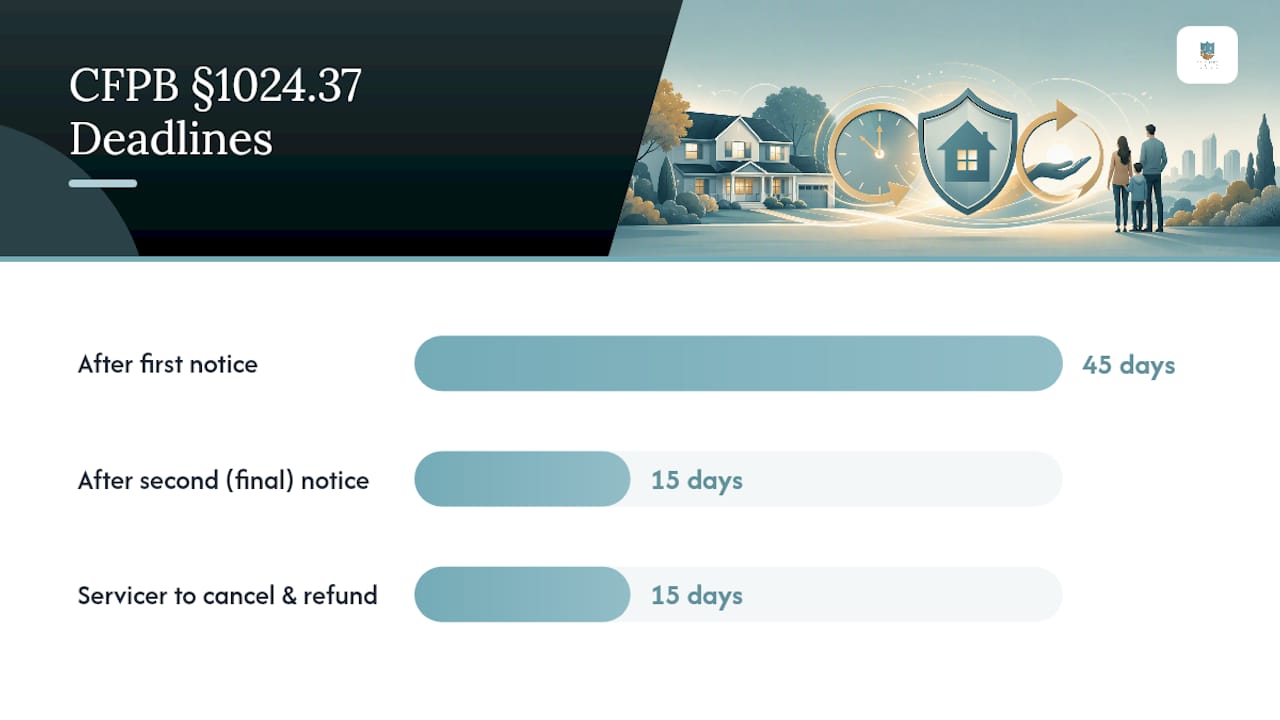
Send a written notice at least 45 days before charging any force-placed premium
Send a second, “final” notice no earlier than 30 days after the first, giving you at least 15 more days to respond
Cancel the force-placed policy and refund any overlapping premiums within 15 days of receiving proof you already had compliant coverage
The evidence bar isn’t complicated. A current declarations page or written confirmation from your insurer showing coverage dates and amounts satisfies the requirement.
The 45/15 rule, in plain terms: You get at least 45 days from the first notice, then another 15 days minimum after the second notice, before your servicer can legally charge you for force-placed coverage. Once you send proof, the clock resets: the servicer has 15 days to cancel and refund.
There’s a second layer of protection people miss. Servicers can’t just place coverage on a hunch. Under the same rule, a servicer needs a reasonable basis to believe you’ve actually let your coverage lapse, and must exercise reasonable diligence to check before charging you. The premiums charged also have to be bona fide and reasonable, not padded, except where a specific state law says otherwise.
What Those Policies Actually Cover, and What They Leave Out
Force-placed insurance protects the structure your lender has a financial stake in. It does not protect your stuff, and it does not protect you legally.
Here’s what’s typically missing from a force-placed policy:
Personal property and contents (furniture, electronics, appliances, clothing)
Personal liability coverage if someone gets hurt on your property
Additional living expenses if the home becomes uninhabitable
Scheduled coverage for higher-value items like jewelry or collectibles
The single-interest versus dual-interest distinction matters here too. A single-interest policy pays out based on the loan balance, which might be far less than what it would cost to actually rebuild the home. A dual-interest policy tends to cover more of the replacement value, but even then, you’re not protected the way a personal policy protects you.
This is why regulators frame force-placed coverage as a fallback, not a substitute. NAIC guidance describes it explicitly as a tool to protect the lender’s collateral, and nothing more. If your house burns down while covered only by a force-placed policy, you could be left with no coverage for your belongings, no liability protection, and a payout that only satisfies what you owe the bank, not what you need to rebuild your life.
Why Force-Placed Insurance Costs More: Pricing Drivers and Regulatory Concerns
Force-placed premiums run higher for reasons that have nothing to do with your actual risk profile. The core issue is what economists call reverse competition: the lender picks the insurer and the policy, but you pay the bill. Normal market pressure, where a buyer shops around for the best price, doesn’t exist in this transaction.
Force-placed policies generally cost significantly more than a comparable voluntary homeowners policy, according to industry estimates cited by NerdWallet.
A few other factors stack the price higher:
Insurers writing force-placed policies often have no inspection history or claims record on the property, so they price for worst-case risk
The pool of properties covered under force-placed programs skews toward higher-risk borrowers, pushing average losses up
Underwriting happens fast, with limited data, which insurers offset by charging more
The NAIC has flagged this pricing pattern for years, and some state regulators have investigated whether affiliated arrangements between servicers and force-placed insurers inflate costs further. Fannie Mae’s servicing guide explicitly restricts kickbacks and captive arrangements tied to force-placed premiums, which tells you regulators consider conflicts of interest a real risk in this corner of the industry.
How to Avoid Force-Placed Insurance: A Practical Checklist
Avoiding forced insurance placement comes down to one habit: never let your servicer wonder whether you’re covered.
Keep an active homeowners policy with no coverage gaps. Renew before the expiration date, not after.
List your lender or mortgage servicer as mortgagee or lienholder on your policy’s declarations page. This is how your insurer notifies your lender directly when your policy renews or changes.
Send your declarations page to your servicer every time your policy renews, changes carriers, or changes coverage amounts. Don’t assume your insurer’s notice reached them.
Track your renewal date and escrow disbursement schedule. Set a calendar reminder 60 days out, and confirm your escrow account actually paid the premium when due.
Work with an insurance broker if you’re juggling multiple properties or a recent refinance. A broker can confirm your carrier sent proof and resend it if your servicer’s records show a gap.
Pro Tip: Don’t rely on your insurer’s automated renewal notice alone. Servicers process thousands of files, and yours can slip through. Call your servicer once a year, right after your policy renews, and confirm they have your current declarations page on file.
For a deeper look at what counts as acceptable proof, see our guide on evidence of insurance for a mortgage.
How to Cancel Force-Placed Insurance and Recover Refunds
If you’re already facing a force-placed charge, the fix is usually faster than people expect, as long as you move quickly and keep records.
Get your declarations page or a written confirmation letter from your insurer showing your coverage was active during the overlap period.
Send it directly to your servicer, ideally through their insurance department’s dedicated fax, upload portal, or email, not just customer service.
Confirm the servicer must cancel the force-placed policy and refund overlapping premiums within 15 days of receiving valid proof, per §1024.37.
Request written confirmation of both the cancellation and the refund amount.
A few habits protect you if anything goes sideways:
Save every email, fax confirmation, and phone call log, including the date, time, and representative’s name
Note your policy’s exact effective dates so there’s no ambiguity about the overlap period
If your servicer misses the 15-day window, file an internal complaint first, then escalate
Common Servicer and Escrow Errors That Trigger Force-Placed Charges
Not every force-placed charge is your fault. Servicer errors cause a real share of these cases, and the fix looks different than a genuine lapse.
Typical culprits include:
Escrow funds that were collected but never actually remitted to your insurer
Payments misapplied to the wrong loan or account
Proof of insurance that was received but lost or never logged
Outdated contact information that caused renewal notices to go to the wrong address
If you suspect a servicer error, pull your escrow statements and payment history, get written verification from your insurer that the policy was active, and demand a written correction from your servicer.
Pro Tip: Keep making your mortgage payments the entire time you’re disputing a force-placed charge. Withholding payment, even over a legitimate billing dispute, can trigger late fees or put you on a path toward default, and that’s a much harder problem to unwind than a wrongful insurance charge.
How Brokers Help Homeowners Get Out of Force-Placed Insurance
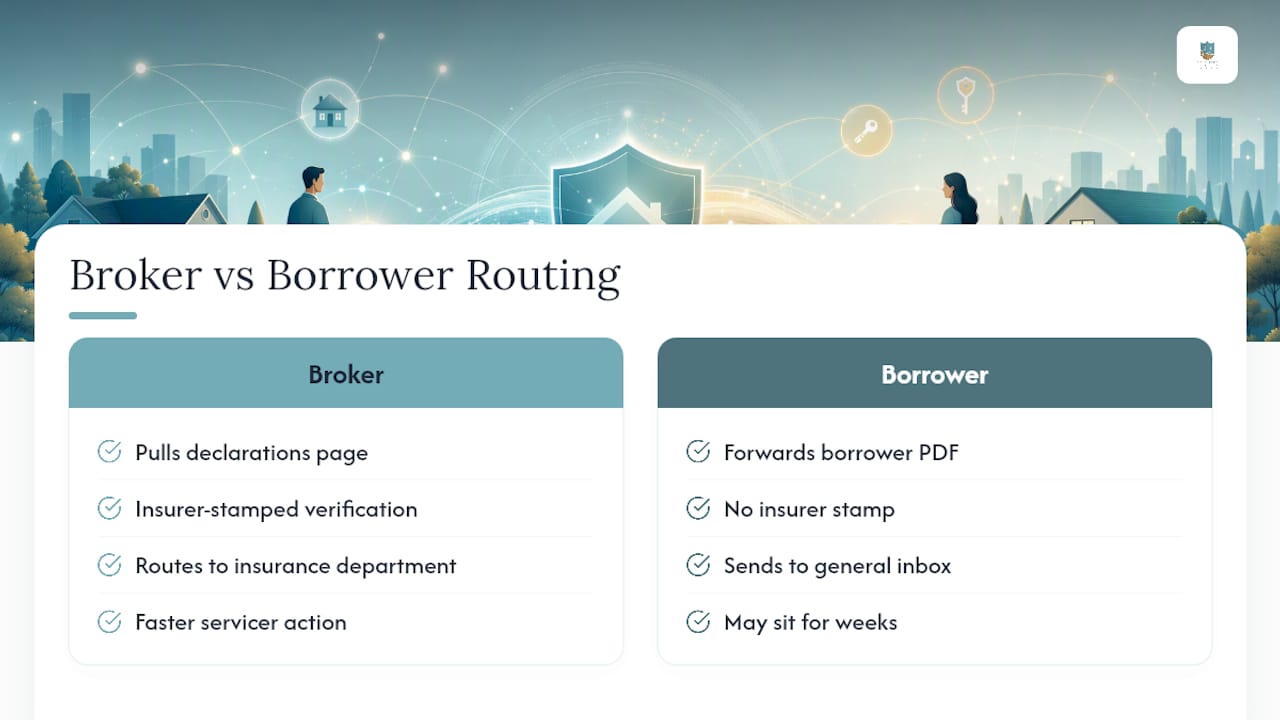
Most force-placed cases I’ve seen resolve faster when a broker is involved in the paperwork, not because the rules change, but because the documentation gets to the right desk faster. A broker can pull your declarations page straight from the carrier, stamp it as verified, and route it directly to your servicer’s insurance department instead of a general inbox where it might sit for weeks.
Agent-confirmed declarations and insurer-stamped proof tend to get faster action than a borrower’s forwarded PDF, since servicers can verify the source instantly. None of that replaces your own diligence: keep your mortgage payments current, and hold onto copies of everything you send. For readers weighing whether their current coverage even meets mortgage insurance requirements, a quick policy review often catches gaps before a servicer does.
— Andrew
Get a Homeowners Policy That Keeps Your Servicer Off Your Back
Insurance brokers exist to help you get real coverage fast enough so that force-placed insurance never becomes an issue. Policies are shopped across multiple carriers, so you’re not stuck with whatever’s fastest to bind, and your declarations page can be sent directly to your lender or servicer once your policy is active.

If you’re closing on a new home, our new homebuyer insurance guide walks through exactly what your lender needs before closing and how to get proof into their hands on time. If you’re dealing with a lapse right now or just want a second look at your current policy, get a homeowners insurance quote and we’ll confirm your coverage meets what your servicer requires, then handle the paperwork on your end.
Where to Verify These Rules Yourself
CFPB §1024.37: the actual regulation text covering notice timelines and refund obligations
NAIC’s lender-placed insurance overview: industry context on pricing and regulatory concerns
Your state insurance department: the right place to file a complaint if your servicer misses a deadline
If you’re negotiating directly with a lender over a related dispute, this guide on lender negotiation covers practical escalation steps
Sources
Recommended
Comments