




Save $2,246 on Minnesota Auto Insurance With an Independent Broker


Minnesota drivers pay roughly $1,300 to $2,600 a year for full coverage and $500 to $1,400 a year for state minimum coverage, depending on which pricing study you trust. The gap comes down to methodology, not a mistake in the data. Your actual price hinges on your driving record, ZIP code, and vehicle, so the smartest move is comparing quotes with identical limits or asking an independent broker to shop them for you.
TL;DR:
Minnesota drivers’ full coverage costs range from roughly $1,300 to $2,600 annually, with average quotes varying significantly depending on coverage limits and driver profile.
Most drivers should expect to pay higher premiums if they are teens or have recent violations, with DUI convictions increasing rates by about 145%.
State minimum liability coverage is $30,000 per person, but higher limits are recommended to protect assets in serious crashes.
Comparing quotes requires matching coverage limits, vehicle details, and considering local factors like ZIP code and driving history to get an accurate rate.
Using an independent broker can often find savings by accessing multiple insurers and tailoring coverage to individual needs without extra fees.
Table of Contents
Average Auto Insurance Cost in Minnesota: Full Coverage vs. Minimum
Minnesota’s Minimum Coverage Requirements and No-Fault Rules
Understanding Liability, Collision, Comprehensive, and UM/UIM Coverage
An Editorial Take on Coverage Priorities for Minnesota Drivers
Get a Personalized Minnesota Auto Quote Without the Broker Fee
Average Auto Insurance Cost in Minnesota: Full Coverage vs. Minimum
Ask four data sources what Minnesota drivers pay, and you’ll get four different answers. That’s not a red flag. It reflects different sample pools, different assumed coverage limits, and different collection dates.
Experian puts the Minnesota average at $2,043 a year, or about $170 a month, based on July 2026 data. Break that down further and Experian’s full-coverage average lands at $2,279 a year ($190/month), while minimum coverage runs about $1,398 a year ($117/month). NerdWallet’s August 2026 analysis reports a higher full-coverage median, near $2,549 a year, and flags Travelers as one of the cheaper full-coverage carriers in its sample. MoneyGeek reports a lower full-coverage figure, about $1,310 a year ($109/month), with minimum coverage around $535 a year ($45/month). Carinsurance lands higher still, near $2,591 a year for full coverage.
The spread exists because these firms don’t measure the same thing. Some average across every coverage tier and driver age. Others isolate a “standard” profile, like a 40-year-old with a clean record and good credit. Coverage limit assumptions vary too. A study built around $100,000 in liability coverage will report lower averages than one built around $250,000 or $500,000.
Here’s how that plays out for real driver profiles:
A 35-year-old with a clean record and good credit typically sits near the lower end of these ranges, often $1,300 to $1,800 a year for full coverage.
A teen driver on a family policy can push full-coverage costs toward $3,500 to $4,500 a year, since age is one of the heaviest-weighted rating factors any carrier uses.
A driver with one recent speeding ticket usually sees a moderate bump. CarInsurance.com’s violation data shows a single speeding ticket adding roughly 37% to a premium, while an at-fault accident adds about 59%, and a DUI conviction can add around 145%.
The bottom line on averages: treat every published number as a starting reference, not a quote. Your ZIP code, carrier, and driving history will move you up or down from any of these figures by hundreds of dollars.
Minnesota’s Minimum Coverage Requirements and No-Fault Rules
Minnesota requires drivers to carry specific minimum liability limits, and the state runs on a no-fault system, which changes how claims get paid compared to most other states.
Minnesota law requires liability coverage of at least $30,000 per person and $60,000 per accident for bodily injury, plus $10,000 for property damage, often written as 30/60/10. Drivers must also carry Personal Injury Protection (PIP) of at least $40,000, along with uninsured and underinsured motorist coverage matching the liability limits. South Lake Agency’s breakdown of Minnesota’s requirements covers how these figures compare to what most financial advisors consider adequate protection.
Because Minnesota is a no-fault state, your own PIP coverage pays your medical bills after a crash regardless of who caused it, up to your policy limit. That speeds up claims and cuts down on lawsuits for smaller accidents, but it also means your PIP limit is the ceiling on what your own policy covers for your injuries.
Minimum limits keep you legal, but they leave a real gap:
A serious crash with $80,000 in medical bills and only $30,000 in per-person liability coverage leaves the other driver’s remaining costs coming straight out of your assets.
PIP set at the $40,000 floor can run out fast after a hospital stay, an ambulance ride, and physical therapy.
Minimum property damage coverage of $10,000 barely covers a newer vehicle, let alone a truck or SUV.
Most agents recommend limits well above the state floor once you own a home or have meaningful savings to protect.
Understanding Liability, Collision, Comprehensive, and UM/UIM Coverage
Every auto quote breaks into line items, and knowing what each one actually pays for makes it much easier to spot where you’re overpaying or underprotected.
Liability pays for the other driver’s injuries and property damage when you’re at fault. Collision pays to repair or replace your own car after a crash, regardless of fault. Comprehensive covers non-collision damage: hail, theft, deer strikes, a cracked windshield. Uninsured/underinsured motorist (UM/UIM) protects you when the at-fault driver has no insurance or not enough. PIP or medical payments covers your own medical bills after an accident.
Whether collision and comprehensive make financial sense often comes down to what you drive:
A financed or leased vehicle almost always requires both, since the lender wants its collateral protected.
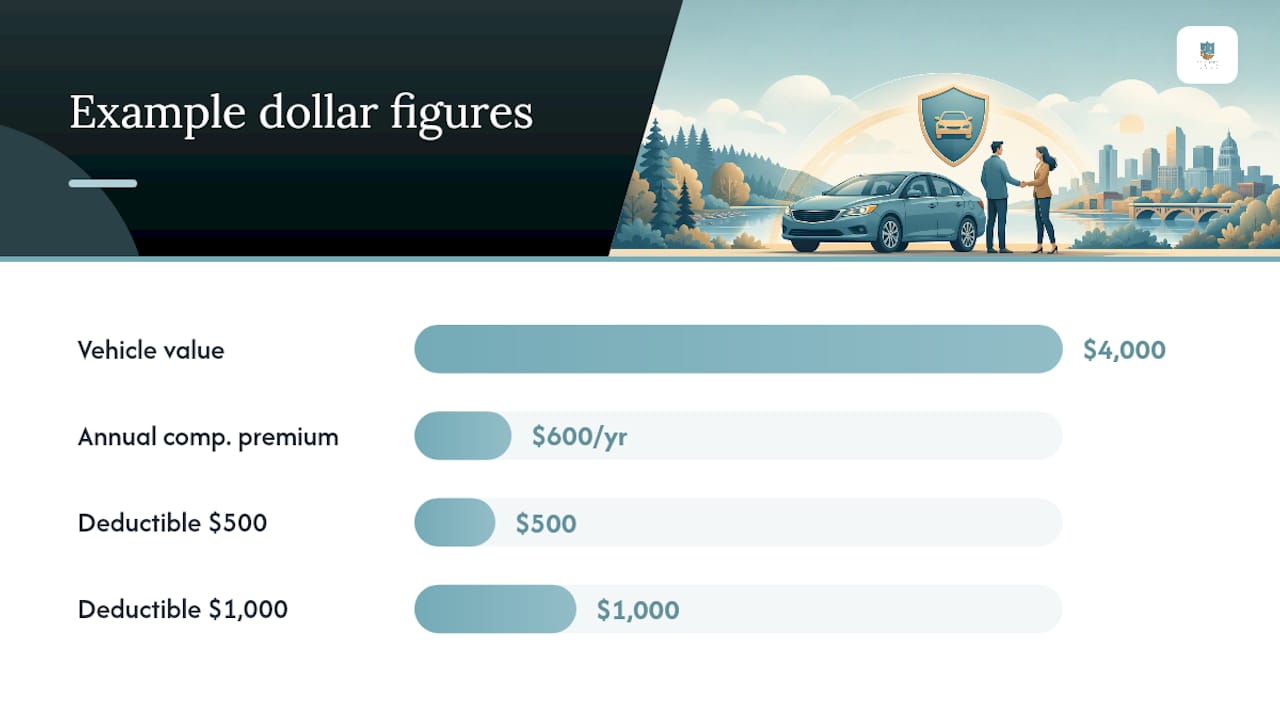
An older vehicle worth $4,000 might not be worth $600 a year in comprehensive premium. If the payout would barely exceed a year or two of premiums, dropping the coverage can make sense.
A newer vehicle you own outright still benefits from comprehensive given Minnesota’s deer-collision frequency and harsh winters.
Deductibles are the lever most drivers ignore. Raising a collision deductible from $500 to $1,000 typically trims your premium by a noticeable percentage, but it also means you’re on the hook for an extra $500 out of pocket at claim time.
Pro Tip: Match your deductible to what you could pay in cash today without touching a credit card. If a $1,000 deductible would wreck your budget, the premium savings aren’t worth the risk.
What Actually Moves Your Premium in Minnesota
Two neighbors with the same car and the same coverage can pay wildly different rates, and it’s rarely random.
Carriers weigh a mix of personal, vehicle, and location factors: your age, driving record, ZIP code, the year and type of vehicle you drive, annual mileage, credit-based insurance score where the carrier uses one, your chosen coverage limits, and any prior claims history. Each of these gets a different weight depending on the insurer.
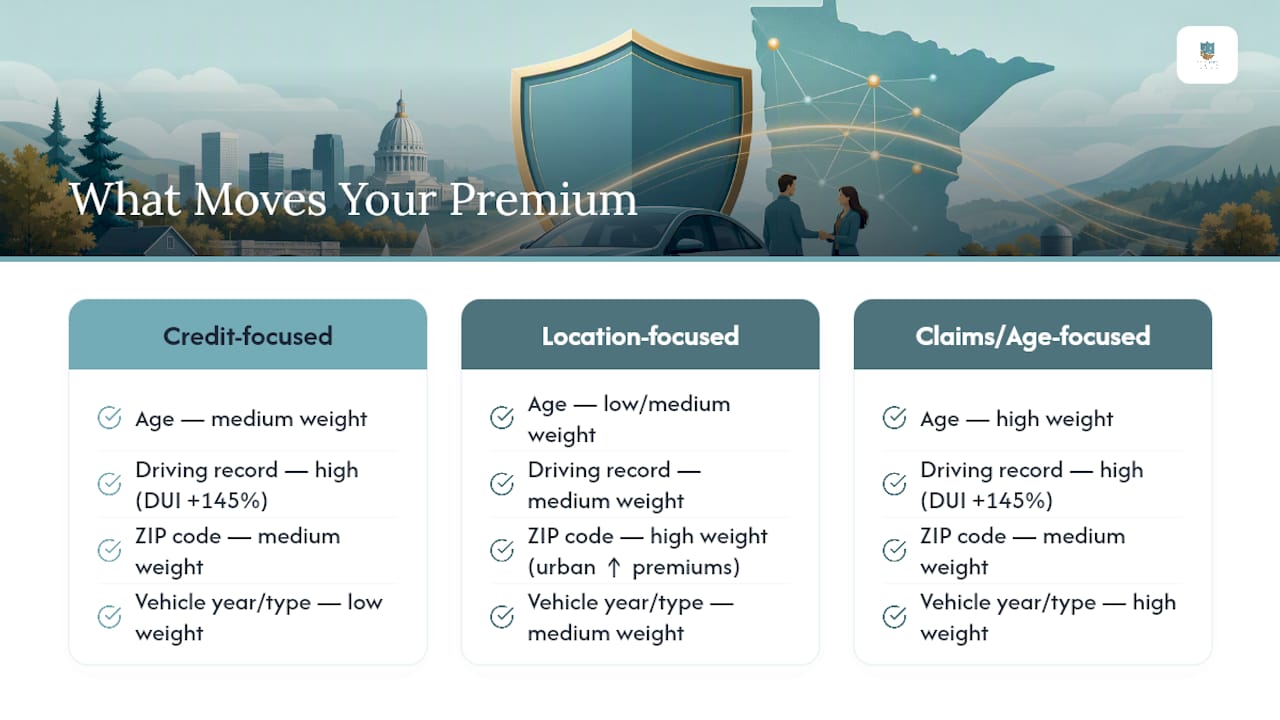
Location matters more than most drivers assume. Urban ZIP codes in the Twin Cities metro typically see higher premiums than rural counties, driven by denser traffic, higher theft rates, and more frequent claims. Rural Minnesota drivers often pay less for liability but can see comprehensive premiums climb during peak deer season in October and November, when collision claims involving wildlife spike statewide.
The biggest reason quotes vary so much between companies is that carriers build their own rating algorithms, weighting age, credit, ZIP code, and claims history differently. One insurer might penalize a thin credit file heavily while another barely factors it in. That’s precisely why the cheapest company for your neighbor might not be the cheapest for you, and why shopping multiple carriers by profile tends to beat sticking with a single insurer year after year.
A single violation illustrates the stakes clearly: CarInsurance.com’s data shows a DUI conviction adding roughly 145% to a Minnesota premium, turning a $1,500 policy into one closer to $3,675.
Discounts and Practical Ways to Lower Your Rate
Minnesota carriers offer a real menu of discounts, and most drivers qualify for more of them than they realize.
Multi-policy and multi-car discounts reward bundling auto with home or renters insurance, or insuring more than one vehicle on the same policy.
Safe driver and good student discounts reward a clean record over three to five years or a strong GPA for a young driver on the family policy.
Anti-theft and safety equipment discounts apply to vehicles with factory alarms, tracking devices, or advanced driver-assist features.
Low-mileage discounts help anyone who works from home or has a short commute log fewer annual miles than the carrier’s threshold.
Usage-based programs track real driving behavior through an app or plug-in device. These can save cautious drivers a meaningful amount, but they can backfire for anyone who brakes hard or drives late at night regularly.
Beyond discounts, a few tactical moves make an immediate dent: raise your deductible if you have the cash cushion to cover it, drop comprehensive on a car that isn’t worth the premium, and bundle your policies with one carrier when the combined price beats splitting them.
Pro Tip: Before you accept your renewal rate, ask specifically which discounts you’re missing. Carriers rarely apply every discount automatically, even when you already qualify.
How to Compare Auto Insurance Quotes the Right Way
Comparing insurance quotes side by side only works if the quotes are actually comparable, and that’s where most people go wrong.
Request quotes with identical limits and deductibles. A $2,000 quote with $30,000 liability isn’t cheaper than a $2,400 quote with $100,000 liability. It’s just less coverage.
Use the same vehicle details across every quote. Your VIN, annual mileage estimate, and garaging address all affect price, so keep them consistent.
Read the full premium breakdown, not just the total. Look at what you’re paying for collision, comprehensive, UM/UIM, and any add-on endorsements like rental reimbursement or roadside assistance.
Check how each insurer handles claims locally. A cheaper policy isn’t a bargain if the claims process drags on for months after a Minnesota hailstorm.
Call a broker if the comparison feels like too much manual work. An independent broker can pull quotes across carriers using your exact profile in far less time than doing it yourself insurer by insurer.
A few things worth double-checking before you sign anything:
Confirm your new policy’s effective date lines up so you’re never without coverage for even a day.
Ask whether switching mid-term triggers a cancellation fee on your current policy.
Verify that any discount quoted verbally actually appears on the written declarations page.
If your vehicle is financed, it’s also worth checking how your loan terms interact with required coverage. Baywall’s benchmarks on auto loan rates by credit tier explain why lenders often require higher collision and comprehensive limits than the state minimum demands, and understanding that trade-off can help you decide what to keep versus drop.
Why an Independent Broker Often Finds a Better Rate
Direct-to-consumer sites only show you their own carrier’s price. An independent broker works differently.
A broker with access to 20 or more carriers can run your exact profile through multiple rating algorithms at once, catching the insurer that happens to weigh your age, credit, or ZIP code more favorably than the rest. That’s the kind of savings that rarely shows up when you request a single quote from a national brand’s website.
South Lake Agency Insurance Brokers works this way for Minnesota clients:
Compares pricing across more than 20 carriers instead of just one.
Charges no broker fees, so you pay only what the carrier charges.
Reports average client savings of $2,246 and a 97.3% client renewal rate, backed by more than 337 five-star reviews.
Clients who switch to an independent broker often discover their previous rate wasn’t the best price available. It was simply the only price they’d seen.
Before requesting a broker quote, have your current policy declarations page, vehicle VINs, and driving history handy. That’s usually enough for a Minnesota agent to start comparing carriers immediately.
An Editorial Take on Coverage Priorities for Minnesota Drivers
A commuter driving 20,000 miles a year on I-94 needs higher liability limits more than a low-mileage retiree does; exposure scales with time on the road, not just age. A parent adding a teen driver should prioritize good-student and defensive-driving discounts over shopping for the absolute cheapest base rate, since age already inflates the premium more than almost any other factor. A homeowner with real assets to protect should treat the state’s 30/60/10 minimum as a floor, not a target. Minimum limits are legal, but in a serious crash, they can leave you paying the difference personally.
— Andrew
Get a Personalized Minnesota Auto Quote Without the Broker Fee
South Lake Agency Insurance Brokers is the alternative to shopping ten separate carrier websites yourself: one call gets your driver profile checked against 20 or more Minnesota insurers, with no broker fee added to whatever the carrier quotes.

That matters because, as the averages above show, the “cheapest” carrier changes depending on your age, ZIP code, and record, and no single direct insurer can tell you that. If you’re bundling home and auto, or moving into a newly purchased house, the new homebuyer insurance guide walks through how to coordinate both policies without duplicate coverage or gaps.
To get started, gather your current declarations page, your vehicle VIN, and your driving history, then request a personalized auto insurance quote from South Lake Agency. A licensed Minnesota agent will run your profile across multiple carriers and show you exactly where the savings are, not just a single number from a single company.
Sources
Recommended
Comments