




6 Steps to Secure an Additional Insured Endorsement for Businesses
- andrew2biscay
- 1 day ago
- 8 min read


An additional insured endorsement adds a specific third party, like a property owner, general contractor, or landlord, to another company’s general liability policy so that party gets defense and payout protection for claims tied to the named insured’s work. It usually kicks in because a contract, lease, or vendor agreement requires it. Coverage is real but limited: it rides on the named insured’s policy limits and only applies to liability connected to that party’s acts.
TL;DR:
Scheduled endorsements specify the additional insured by name, offering precise coverage but requiring separate paperwork for each new party.
Blanket endorsements automatically cover contractual requirements but may have narrower language and lack statutory notice rights.
Coverage typically applies only to liability caused by the named insured’s acts and shares existing policy limits, not as a standalone sum.
Properly requesting and verifying endorsement wording, named entities, and coverage scope prevents common disputes and claims denials.
Maintaining detailed records and promptly notifying carriers with endorsed documentation is essential for protecting against long-term or liability claims.
Table of Contents
What Is an Additional Insured Endorsement and Why Does It Exist?
Every general liability policy has a section that defines “who is an insured.” An additional insured endorsement rewrites that section, adding a named party without making them a policyholder. They don’t pay the premium, they don’t own the policy, and they can’t make changes to it. What they get is a slice of protection: if a lawsuit names them for something connected to the named insured’s work, that policy can defend them and pay a judgment, up to its limits.
That’s a fundamentally different position from carrying your own policy. Your own GL policy protects you for anything within its scope. Additional insured status protects you only for liability caused by someone else’s operations, and only as far as that endorsement’s language allows.
Parties request this status for a few practical reasons:
Contractual risk transfer. A general contractor doesn’t want to eat a lawsuit caused by a subcontractor’s mistake, so the contract requires the sub to add the GC as an additional insured.
Defense cost protection. Legal defense is often more expensive than the eventual settlement, and additional insured status means the named insured’s carrier picks up that tab.
Backing the indemnity clause. Most contracts already have an indemnification clause. The endorsement makes that promise collectible instead of theoretical.
Scheduled, Blanket, and Completed Operations: The Endorsement Types That Matter
Not every additional insured endorsement is written the same way, and the differences show up exactly when you need coverage most.
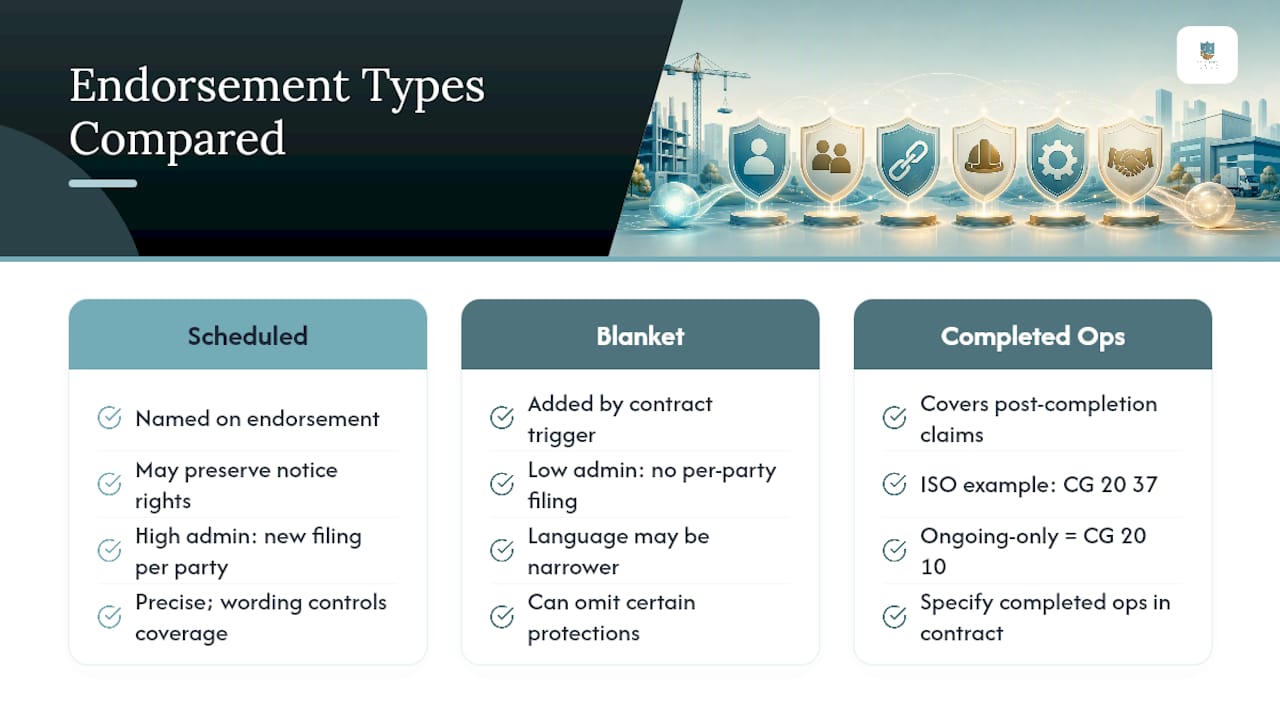
Scheduled (named) endorsements list the specific additional insured by name on the endorsement itself. They’re precise, and in some states, being named preserves statutory notice rights that blanket endorsements don’t guarantee. The tradeoff is paperwork: every new party needs a fresh endorsement.
Blanket (automatic) endorsements add anyone the named insured is contractually required to add, without a separate filing for each one. They cut administrative work dramatically, but the language often reads “as required by contract,” which can be narrower than it sounds and may skip certain protections entirely.
The bigger divide is ongoing versus completed operations. Standard ISO forms illustrate this well: CG 20 10 typically covers liability arising from ongoing operations, while CG 20 37 extends that protection to injuries or damage discovered after the job is finished. A contractor who only secures CG 20 10 coverage and then gets sued two years after a roof job wraps up may find there’s no coverage at all for that claim.
Pro Tip: Never accept “we’ll add you as additional insured” as a contract term. Specify the ISO form number or exact equivalent wording you require, and name completed operations coverage explicitly if the work involves anything that could cause harm after completion.
Insurers enforce the endorsement’s actual wording over whatever the contract says should have happened, so generic contract language doesn’t override a narrower endorsement form.
Who Actually Needs Additional Insured Status?
Additional insured requirements show up constantly in commercial relationships, and knowing your role tells you whether to request it or insist on it.
Property owners and landlords hiring contractors for repairs or renovations should require additional insured status from every vendor doing physical work on the property, since a landlord’s own liability exposure often depends on transferring risk contractually.
General contractors virtually always require it from subcontractors. It’s a standard clause in nearly every subcontract agreement in construction.
Event hosts hiring caterers, photographers, or equipment vendors typically require additional insured status for the event date, and sometimes for setup and teardown too.
Tenants in commercial leases are frequently asked to name the landlord as additional insured, protecting the building owner from liability tied to the tenant’s use of the space.
Vendors and subcontractors should expect to provide this coverage as a cost of doing business. If a landscaping company can’t produce it, most GCs won’t sign the subcontract.
A subcontractor pouring concrete for a new home build, a caterer working a wedding venue, and a retail tenant leasing storefront space all face the same basic question from the other party: prove you can cover damage your work might cause.
What Additional Insured Coverage Won’t Do
The biggest misunderstanding about this coverage is treating it like a blank check. It isn’t.
Additional insured endorsements generally only respond to liability caused, at least in part, by the named insured’s acts or omissions. If the additional insured is sued for something entirely their own doing, unrelated to the named insured’s work, the endorsement typically doesn’t apply, and professional liability claims are usually excluded outright.
Other limitations worth knowing before you rely on this coverage:
Additional insureds share the named insured’s policy limits. The endorsement doesn’t add a dollar of coverage; it just extends who can access what’s already there.
Some states have anti-indemnity statutes that void or narrow indemnification agreements, and endorsements often include “only as permitted by law” language that quietly limits scope.
Blanket endorsements can lose statutory cancellation notice rights that a scheduled, named endorsement would preserve.
Coverage can be narrowly tied to a specific activity. An endorsement written around a single event or delivery may not cover an unrelated incident on the same day.
One detail gets missed constantly: a certificate of insurance is not the endorsement. It’s a summary snapshot that can be outdated or wrong the moment it’s issued, and courts have generally sided with insurers when a certificate promised more than the actual policy delivered.
How to Request and Verify an Additional Insured Endorsement
Getting this right is mostly about specificity, not luck.
Name the exact legal entity. Use the precise name on formation documents, not a DBA or shorthand. Mismatches between the contract party and the endorsement are one of the most common reasons carriers deny a claim.
Specify the endorsement form or exact scope. Reference CG 20 10 or CG 20 37 by number, or spell out the equivalent language you require if the carrier uses a proprietary form.
Require primary and non-contributory (P&NC) wording. This forces the named insured’s policy to pay first, before the additional insured’s own coverage is touched.
Require a waiver of subrogation (WOS). This stops the named insured’s carrier from turning around and suing the additional insured after paying a claim, which otherwise defeats much of the protection’s purpose.
Ask the broker to issue the actual endorsement, not just a certificate. Request a copy of the endorsement page and the declarations page so you can confirm names, limits, and edition dates match what the contract requires.
Compare it against the contract before signing off. If the carrier pushes back on specific wording, that’s the moment to negotiate, not after the work has started.
Pro Tip: Build a 30 to 60 day buffer into your contract timeline for endorsement requests. Carriers sometimes push back on non-standard wording, and getting a corrected endorsement can take longer than either party expects.
Premiums for adding an additional insured are usually modest, often a flat fee or a small percentage adjustment, but if a carrier flatly refuses required wording like completed operations coverage, that’s a signal to find a different carrier rather than accept a gap.
Where Coverage Disputes Actually Come From
Most additional insured disputes trace back to a small handful of recurring mistakes, and every one of them is preventable at the contract stage.
Relying on a certificate of insurance instead of the endorsement itself is the most frequent trigger. The certificate can list coverage that was never actually issued, and by the time anyone checks, the incident has already happened. Entity name mismatches are close behind: naming “ABC Construction” when the actual entity is “ABC Construction LLC” has been the deciding factor in real coverage denials. Missing completed operations coverage is the third big one, especially in construction and home improvement work where damage often surfaces months or years after the job ends.
Vague contract language makes all of this worse. Phrases like “as required by contract” leave the carrier room to issue a proprietary, narrower form than what either party intended.
Contract checklist item | Why it matters |
Exact legal entity name | Prevents denial from name mismatches |
Specific form number or equivalent scope | Stops carriers from substituting weaker language |
Primary and non-contributory wording | Forces the named insured’s policy to pay first |
Waiver of subrogation | Blocks a subrogation lawsuit after a paid claim |
Copy of endorsement and declarations | Confirms coverage actually exists as written |
Renewal tracking | Catches lapses before a gap becomes a claim |
Keeping Records and Handling a Claim
Documentation is where a lot of additional insured protection quietly falls apart, usually because nobody kept the paperwork long enough.
Retain contracts, certificates, endorsement copies, and declarations pages for at least three to five years when the work involves completed operations exposure, since claims can surface long after a project wraps.
If a claim arises, notify the named insured’s carrier immediately and include the endorsement copy and underlying contract with the tender letter. Delayed notice can jeopardize coverage rights entirely.
Track renewal dates on any ongoing vendor relationship. An endorsement tied to an expired policy period offers nothing.
Store documents somewhere retrievable, not just in an email thread that gets buried. A dispute years later depends on producing the exact endorsement in effect at the time of the incident.
How a Broker Actually Reduces This Risk
Negotiating endorsement language, chasing down the actual endorsement copy instead of settling for a certificate, and confirming names and dates match the contract is tedious work most business owners don’t have time for. South Lake Agency Insurance Brokers handles that verification directly with carriers, coordinating with lenders and counterparties so the paperwork is right before a dispute ever tests it.
— Andrew
Getting Your Additional Insured Coverage Right the First Time
South Lake Agency Insurance Brokers works with more than 20 carriers, which means when a contract requires specific endorsement wording, there’s room to shop for a carrier that will actually issue it, rather than settling for whatever one insurer offers.
Here’s what that looks like in practice: you tell us what a lease, vendor contract, or construction agreement requires, and the team verifies the endorsement itself, not just a certificate, checks that primary and non-contributory language and waiver of subrogation terms are actually in the policy, and flags gaps before you sign anything. If you’re a homeowner working with contractors on new construction, that same verification applies to protecting your own coverage, and it’s worth reviewing alongside a homeowners insurance quote. For business owners managing subcontractor or vendor requirements regularly, start with a conversation about your business insurance needs, and we’ll walk through exactly what your contracts should require and confirm it’s what you’re actually getting.
Where to Verify Endorsement Language and Contract Terms
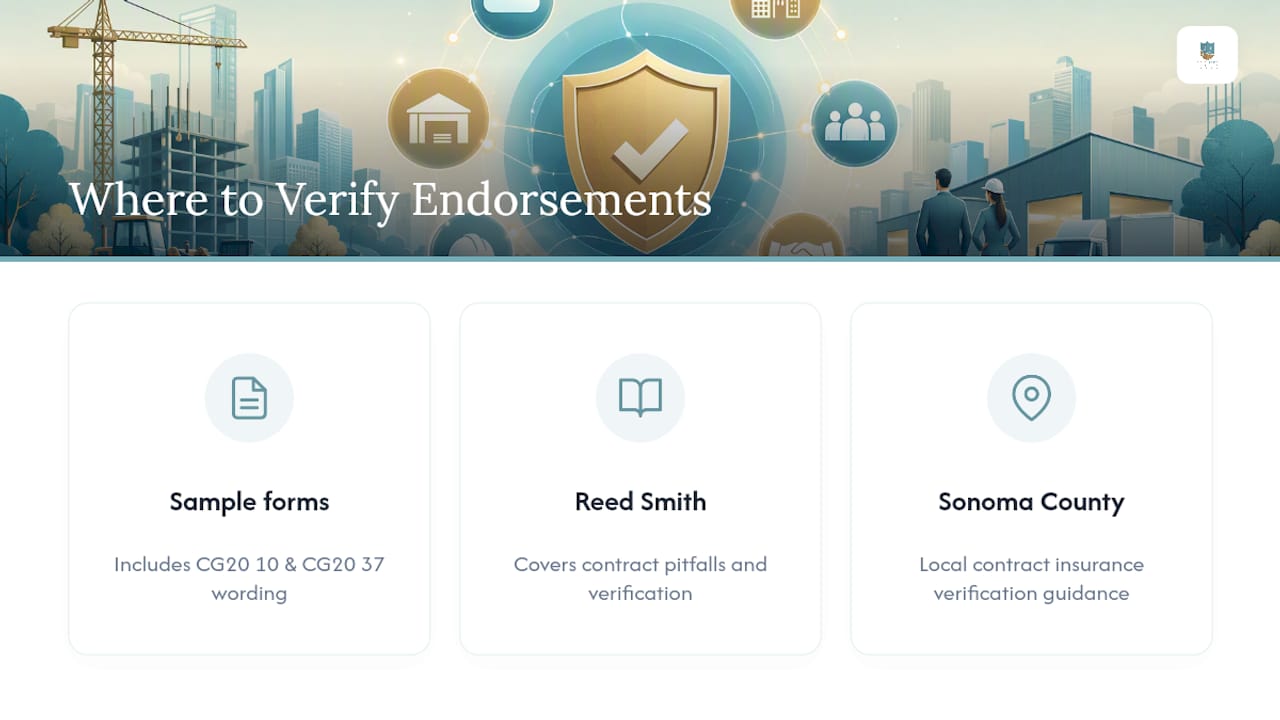
For the actual ISO form language behind CG 20 10 and CG 20 37, consult sample endorsement forms, which show scheduled and completed-operations wording directly. For contract drafting pitfalls and enforcement issues, Reed Smith’s practical guide and Sonoma County’s contract insurance guidance cover verification best practices in detail.
This article is general information, not a substitute for advice from a qualified financial advisor. Consult a qualified financial professional about your own circumstances before acting on anything here.
Sources
Recommended
Comments