




Umbrella Insurance Coverage: What It Is and Who Needs It
- andrew2biscay
- 11 minutes ago
- 13 min read


Umbrella insurance coverage is an extra layer of liability protection that pays after your primary policies’ limits are exhausted. Think of it as a financial backstop: your auto or homeowners policy pays first. When that runs out, the umbrella takes over.
Here is what you need to know right away:
What it covers: Bodily injury to others, property damage you cause, personal injury claims like libel or slander, and legal defense costs that exceed your primary policy limits.
Who should consider it: Anyone with meaningful assets, home equity, investments, rental property, teenage drivers, a pool, or a dog with a bite history. A good rule of thumb is to carry at least as much umbrella coverage as your net worth.
What it costs: A $1 million personal umbrella policy typically runs $200–$300 per year, making it one of the most cost-effective ways to add significant liability protection.
Key Takeaways
A personal umbrella policy is one of the most cost-effective liability tools available, costing $200–$300 per year for $1 million in coverage that protects your assets and future earnings when primary policy limits run out.
Point | Details |
Umbrella pays after primary limits | Your auto or homeowners policy pays first; the umbrella covers the excess up to its limit. |
$200–$300/year for $1M | A $1 million umbrella policy typically costs $200–$300 annually, per Investopedia. |
Underlying limits must qualify | Carriers require $150K–$300K on auto and $250K–$300K on homeowners before issuing an umbrella. |
Business owners need a commercial umbrella | Personal umbrella policies do not cover business liabilities; a commercial umbrella is required. |
South Lake Agency shops 20+ carriers | South Lake Agency Insurance Brokers compares carriers at no broker fee to match your risk profile and limits. |
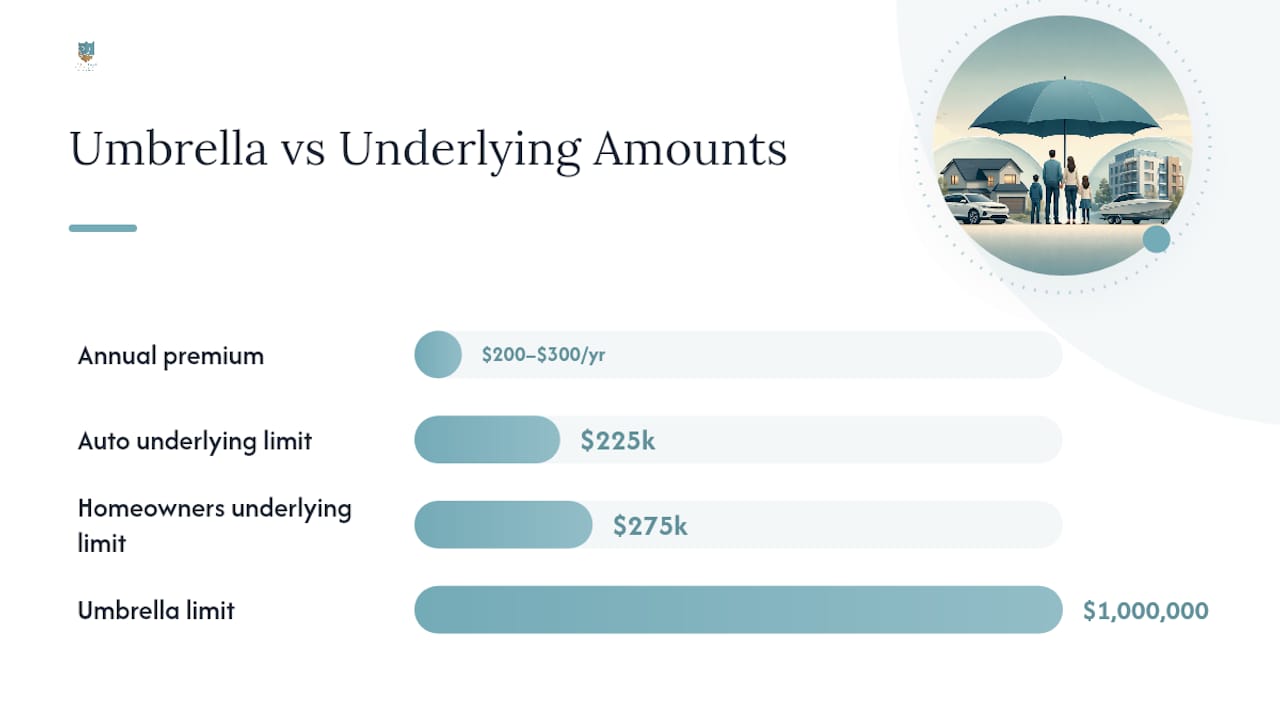
Table of Contents
What umbrella insurance coverage actually is
A personal umbrella policy is an excess liability policy that sits above your existing auto, homeowners, boat, or other underlying policies and pays claims those policies cannot fully cover. It is not health insurance, and it is not property insurance. It does not pay to fix your car or rebuild your home after a loss.
The payment order works like this:
Auto/homeowners liability limit → exhausted → umbrella pays the excess
Say you cause a car accident and the injured party sues for $800,000. Your auto policy has a $300,000 liability limit. Your auto insurer pays $300,000. The remaining $500,000 comes out of your umbrella policy. Without it, that $500,000 comes out of your savings, home equity, and future wages.

According to the NAIC, umbrella policies pay for liability and defense costs that primary insurance does not cover and apply only after underlying limits are exhausted. They do not cover your own injuries or your own property damage. That distinction matters because many people assume umbrella is a catch-all policy. It is not. It is specifically a liability tool.
How an umbrella policy actually pays
The trigger is straightforward: your underlying policy limit must be fully exhausted before the umbrella activates. The umbrella does not share the loss with your primary insurer. It steps in only after the primary policy has paid its maximum.
Step-by-step example:
You are found liable for $750,000 in damages after a serious auto accident.
Your auto liability limit is $300,000. Your insurer pays that amount in full.
The remaining $450,000 exceeds your auto limit.
Your $1 million umbrella policy activates and pays the $450,000 balance.
You pay nothing out of pocket.
Carriers typically require minimum underlying liability limits before they will issue an umbrella policy. Common minimums look like this:
Auto liability: $150,000–$300,000 combined single limit
Homeowners liability: $250,000–$300,000
Watercraft or other underlying policies: varies by carrier
If your current limits fall below those thresholds, you will need to raise them first. That is not a bad thing. Higher underlying limits also reduce your personal exposure before the umbrella even kicks in.
One more timing point: umbrella policies are not retroactive. They cover only claims arising from incidents that occur after the policy effective date. A lawsuit filed today over an accident from two years ago, before you had the policy, is not covered.
Defense costs deserve a separate mention. Many umbrella policies cover legal defense costs on top of the liability limit, not inside it. That means if your defense runs $100,000 and the judgment is $900,000, the umbrella may cover both, depending on the policy language. Always confirm how your specific policy handles defense cost allocation.
What does umbrella insurance cover?
Umbrella policies can cover personal injury liabilities that standard policies often exclude, including libel, slander, and invasion of privacy. Here is the full picture of what a typical personal umbrella covers:
Bodily injury to others: You rear-end a car and injure three people. Medical bills and lost wages exceed your auto limit. The umbrella covers the excess.
Property damage to others: Your teenager accidentally drives into a neighbor’s fence and garage. Repair costs exceed your auto property damage limit. Umbrella pays the difference.
Personal injury (libel, slander, invasion of privacy): You post something online that leads to a defamation lawsuit. Most homeowners policies have limited or no coverage for this. Umbrella often fills that gap.
Legal defense costs: Attorney fees, court costs, and expert witness fees that exceed primary policy limits are typically covered.
Uninsured/underinsured motorist gaps: Some umbrella policies can be endorsed to include UM/UIM coverage. This varies by carrier and state. If you want to understand how uninsured motorist coverage interacts with your umbrella, that is worth a direct conversation with your broker.
Who in your household is covered? Most personal umbrella policies cover you, your spouse, and resident relatives, including children living at home. A college student driving a car registered to you is typically covered. A child who has moved out and established their own household usually is not.
Available policy limits: Umbrellas are commonly sold in $1 million increments, with most carriers offering $1M, $2M, $5M, and $10M options. Some carriers go higher for high-net-worth clients.
What umbrella insurance does not cover
This is where false expectations cause real problems. A personal umbrella policy has clear exclusions, and knowing them prevents unpleasant surprises after a claim.
Standard exclusions include:
Your own bodily injury: If you are hurt in an accident you caused, your umbrella does not pay your medical bills. That is what health insurance and personal injury protection are for.
Your own property damage: Damage to your own car, home, or belongings is a first-party loss. Comprehensive and collision coverage handles your vehicle; homeowners covers your structure.
Intentional or criminal acts: If you deliberately harm someone, no liability policy will cover it. Punitive damages are also excluded under most umbrella policies.
Business liabilities (first-party): A personal umbrella does not cover losses to your business property or business income. It may also exclude liability arising from business activities conducted from your home.
Professional liability: Errors and omissions, malpractice, and professional negligence claims require a separate E&O or professional liability policy.
Workers’ compensation: Injuries to employees are covered under a workers’ comp policy, not a personal umbrella.
Contractual liability: Liability you assume under a contract is generally excluded unless it would have existed without the contract.
When you need something beyond a personal umbrella, the right tools are a commercial umbrella policy, an errors and omissions policy, a directors and officers (D&O) policy, or a standalone professional liability policy. Endorsements can sometimes expand a personal umbrella’s scope, for example, adding coverage for a small watercraft or a short-term rental, but those additions depend entirely on the carrier and your state’s rules.
How much does umbrella insurance cost?
The short answer: not much, relative to what you get. A $1 million umbrella policy typically costs $200–$300 per year. That works out to roughly $17–$25 per month for $1 million in additional liability protection.
$200–$300/year is the typical annual premium for a $1 million personal umbrella policy, according to Investopedia.
Why is it so affordable? Because umbrella policies are excess coverage. The primary policies absorb most claims. The umbrella only pays when losses are catastrophic, which is statistically rare. Insurers can price that risk cheaply.
What drives your premium up or down:
Total assets at risk (higher net worth = more to protect = slightly higher premium)
Underlying liability limits (higher underlying limits reduce umbrella risk)
Household size and number of drivers
High-risk exposures: pools, trampolines, rental properties, dogs with bite history
Driving record and claims history
Bundling with the same carrier that writes your auto and homeowners policies
Coverage Level | Typical Annual Premium | Common Minimum Underlying Limits |
$1 million | $200–$300 | Auto: $150K–$300K; Home: $250K–$300K |
$2 million | $200–$300 (estimated) | Same as $1M |
$5 million | $500–$900 (estimated) | Same as $1M, may vary by carrier |
Premium estimates for $2M and $5M are illustrative ranges based on typical incremental pricing patterns. Actual premiums vary by carrier, state, and individual risk profile.
Each additional $1 million in coverage costs less than the first million, because the probability of a claim reaching $2 million is lower than the probability of one reaching $1 million. That marginal cost efficiency is one reason umbrella coverage is often the most cost-effective way to add large amounts of liability protection compared with raising limits on multiple underlying policies.
Pro Tip: Bundling your umbrella with the same insurer that writes your auto and homeowners policies can lower the total premium and speed up underwriting, since the carrier already has your loss history on file.
Who actually needs umbrella insurance?
Dave Ramsey recommends umbrella insurance for individuals with significant assets because it provides affordable protection against potentially ruinous lawsuits. But “significant assets” is relative. Here is a practical checklist of risk signals that suggest you should consider a personal umbrella policy:
You own a home with meaningful equity
You have investment or retirement accounts
You own rental property
You have a teenage driver on your policy
You own a pool, trampoline, or other attractive nuisance
You own a dog, especially a breed with a history of biting
You coach youth sports, serve on a nonprofit board, or volunteer in a public-facing role
You frequently host guests or contractors at your home
You drive frequently or have a long commute
Your household income is high enough that a large judgment could lead to wage garnishment
Large judgments do not just drain savings. They can result in liens against your home and garnishment of future wages. A personal umbrella protects both what you have built and what you will earn.
Practical rule of thumb: Start with at least $1 million in umbrella coverage, or match your total net worth, whichever is higher. If your net worth is $600,000, a $1 million policy makes sense. If it is $3 million, consider $3–$5 million in coverage.
To get a tailored recommendation, you will want to have your current auto and homeowners declarations pages ready, along with a rough estimate of your total assets. A broker can then match your exposure to the right limit and carrier.
Personal umbrella vs. commercial umbrella: what business owners need to know
A personal umbrella covers you and your household for personal liability. It does not follow you into your business. If a customer slips and falls at your store, or a client sues over work you performed, a personal umbrella policy will not respond to those claims.
Personal umbrella covers:
Personal auto accidents
Incidents at your personal residence
Personal injury claims (libel, slander) in a personal context
Liability from personal recreational activities
Commercial umbrella covers:
Liability arising from business operations
Claims involving employees (in conjunction with general liability and workers’ comp)
Contractual liability assumed in business contracts
Professional services liability (when paired with E&O)
The edge cases are where business owners get tripped up. A landlord renting out a single-family home may find that a personal umbrella covers some residential landlord liability, but a landlord with multiple units or commercial property almost always needs a commercial umbrella. A contractor who works from a home office but performs work at client sites needs a commercial policy. If you run any kind of business, even a side operation, talk to a broker before assuming your personal umbrella has you covered.
For business owners exploring commercial umbrella and general liability options, the right structure usually combines a commercial general liability (CGL) policy with a commercial umbrella sitting above it, plus separate E&O or D&O coverage if professional services or board roles are involved. Business owners looking at broader business insurance options should confirm whether their current commercial policies have adequate underlying limits before adding an umbrella.
How to buy umbrella coverage: a step-by-step checklist
Getting an umbrella policy in place is not complicated, but there is a specific order of operations that makes the process faster and avoids underwriting surprises.
Pull your current declarations pages. You need the liability limits on your auto, homeowners, and any other underlying policies (boat, motorcycle, renters). These are the numbers that determine whether you meet carrier minimums.
Check your limits against typical carrier minimums. Most carriers want at least $150,000–$300,000 on auto liability and $250,000–$300,000 on homeowners liability. If you are below those thresholds, plan to raise them simultaneously.
Estimate your total assets. Add up home equity, investment accounts, retirement accounts, and other assets. That number guides how much umbrella coverage to request.
Gather additional declarations pages for watercraft, rental property, or landlord policies if applicable. Carriers need the full picture of your underlying coverage.
Request bundled quotes first. Buying umbrella coverage from the same carrier that underwrites your auto and homeowners policies can reduce the premium and simplifies underwriting.
Work with a broker to compare across carriers. Not every carrier offers the same endorsements, exclusions, or underlying limit flexibility. A broker can identify carriers with favorable terms for your specific risk profile, including endorsements for watercraft, short-term rentals, or other exposures.
Review the exclusions carefully. Confirm how defense costs are handled, whether UM/UIM coverage is included or available as an endorsement, and whether any business activities are excluded.
Confirm the effective date. Coverage begins on the policy effective date. Incidents before that date are not covered.
Carriers will typically request declarations pages for each underlying policy and will run a driving record and loss history check. If you are a new homebuyer still setting up your underlying policies, the new homebuyer insurance guide from South Lake Agency walks through how to set up the right underlying limits from the start.
Real claim scenarios: seeing the math in action
Scenario 1: Multi-vehicle accident with serious injuries
You run a red light and collide with two vehicles. Three people are injured, one seriously. Total damages, including medical bills, lost wages, and pain and suffering, are assessed at $1.1 million.
Your auto liability limit: $300,000
Auto insurer pays: $300,000
Remaining liability: $800,000
Your $1 million umbrella pays: $800,000
Out-of-pocket cost to you: $0
Without the umbrella, that $800,000 comes from your savings, home equity, and potentially future wages through a court judgment. With it, your assets stay intact.
Scenario 2: Guest injured at your pool
A neighbor’s child dives into your pool, hits the shallow end, and sustains a serious spinal injury. Medical costs and a subsequent lawsuit total $650,000.
Your homeowners liability limit: $300,000
Homeowners insurer pays: $300,000
Remaining liability: $350,000
Your $1 million umbrella pays: $350,000
Out-of-pocket cost to you: $0
In both scenarios, defense costs, attorney fees, and court costs may be covered on top of the liability payout, depending on how your umbrella policy handles defense cost allocation. Confirm that language before you buy.
How South Lake Agency Insurance Brokers helps you get the right umbrella policy
Shopping for umbrella coverage on your own means calling individual carriers, comparing exclusions across policy forms, and figuring out whether your underlying limits qualify. South Lake Agency Insurance Brokers does that work for you.
South Lake Agency shops across 20+ top-rated carriers to match your underlying limits, asset profile, and risk exposures to the right umbrella policy. That includes identifying carriers with favorable endorsements for watercraft, rental properties, or other specific exposures you may have.
Here is what working with South Lake Agency looks like in practice:
No broker fees. South Lake Agency is compensated by the carrier, not by you.
Average client savings of $2,246 across their insurance portfolio.
A 97.3% client renewal rate, reflecting ongoing service beyond the initial sale.
Over 337 five-star reviews from clients across Minnesota and select Midwest states.
Direct coordination with lenders and title companies for clients setting up underlying homeowners policies alongside an umbrella.
Brokers are particularly useful when your situation involves multiple underlying policies, a business exposure, or a high-risk asset like a rental property or watercraft. They can also identify whether raising your underlying limits or bundling policies with a single carrier produces a better total premium than shopping the umbrella separately.
If protecting retirement savings is part of your planning, pairing umbrella coverage with a solid retirement protection strategy is worth discussing with your advisor alongside your insurance review.
The case for buying umbrella coverage sooner than you think
Most people wait until they feel wealthy enough to need umbrella insurance. That is the wrong frame. A lawsuit does not care how much you have today. It can reach into what you will earn for the next twenty years.
The real risk is not losing what you have built. It is losing what you have not built yet. A $500,000 judgment against someone with $200,000 in assets does not stop at $200,000. Courts can garnish wages and place liens on future property. Umbrella insurance is the one policy that protects your financial future, not just your current balance sheet.
The other thing people underestimate is how quickly a standard liability limit gets overwhelmed. A $300,000 auto liability limit sounds like a lot until you are in a serious accident with multiple injured parties, a long hospitalization, and a plaintiff’s attorney who is very good at their job. Medical costs alone can exceed $300,000 for a single serious injury. Add lost wages, pain and suffering, and legal fees, and you are well past the primary limit before the case even settles.
At $200–$300 per year for $1 million in coverage, the math is not close. The question is not whether you can afford umbrella insurance. It is whether you can afford not to have it.
South Lake Agency Insurance Brokers makes umbrella coverage simple
Getting umbrella coverage should not require three phone calls and a spreadsheet. South Lake Agency Insurance Brokers gives you access to 20+ carriers in a single conversation, with no broker fees and a team that already knows how to match underlying limits to umbrella requirements.

Whether you need a personal umbrella to protect home equity and investments, or a commercial umbrella to sit above your business liability policy, South Lake Agency finds the right fit. Clients save an average of $2,246 on their insurance portfolio, and the 97.3% renewal rate reflects the kind of service that keeps people coming back year after year.
Ready to see what umbrella coverage costs for your situation? Get an umbrella insurance quote from South Lake Agency today. No fees, no pressure, just the right coverage at the right price. You can also review your homeowners insurance and auto insurance limits at the same time to confirm you meet carrier minimums before the umbrella is issued.
Sources
This article is general information, not a substitute for advice from a qualified financial advisor. Consult a qualified financial professional about your own circumstances before acting on anything here.
Recommended
Comments