




High vs Low Deductible: A Guide for Minnesota Homeowners


Choose the highest deductible you can pay from liquid cash within 30 days without borrowing. That single rule covers most situations. As a starting point, here are the ranges that make sense for each policy type:
Homeowners: a moderate to high deductible for most households; a lower deductible if your emergency fund is thin
Auto (collision/comprehensive): $500–$1,000 collision; $250–$500 comprehensive if you park in a hail-prone area
Business property: $1,000–$5,000 depending on cash reserves and revenue stability
The logic is straightforward. A higher deductible lowers your premium, and moving from a lower to a higher deductible may significantly reduce your homeowners policy premium. Those savings compound every year you don’t file a claim. The catch is that you need the cash ready when a loss hits, not scrambling for a credit card at 24% interest.
Table of Contents
What exactly is an insurance deductible?
An insurance deductible is the fixed dollar amount or percentage of insured value that you pay toward a covered loss before your insurer pays anything. For home and auto policies, it applies per claim, not annually.
Two formats matter here:
Percentage-based deductible: — Common for wind and hail coverage. Percentage deductibles are calculated against your dwelling coverage limit, so a 1% deductible on a $400,000 home means $4,000 out of pocket before coverage kicks in — and that number rises every time you increase your dwelling limit.
Quick example: A $250,000 home with a 2% wind/hail deductible carries a $5,000 out-of-pocket exposure on storm damage, regardless of what your standard all-perils deductible says.
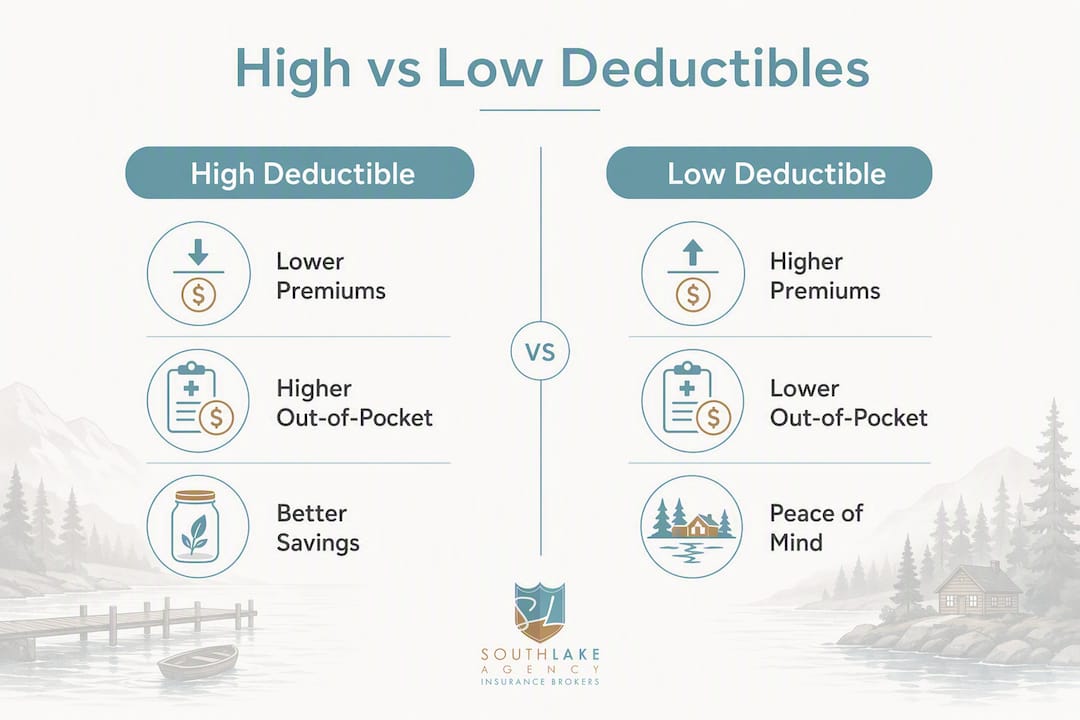
Pros and cons of high vs low deductible insurance
High deductibles
Pros:
Lower monthly and annual premiums, freeing cash for savings or other coverage
Discourages small claims that trigger rate increases or non-renewal
Pairs well with an umbrella policy: you self-insure the small stuff, transfer the catastrophic risk
Cons:
Requires genuine liquidity; a $2,500 deductible is a problem if your savings account holds $800
Multiple claims in one year multiply your out-of-pocket exposure
Can conflict with lender requirements on a new mortgage
Low deductibles
Pros:
Predictable, manageable out-of-pocket cost per claim
Required or preferred by some mortgage lenders at closing
Better fit for households still building an emergency fund
Cons:
Higher premiums every month, whether you file a claim or not
Tempts policyholders to file small claims. Filing small claims often costs more in long-term premium increases and lost claims-free discounts than paying out of pocket
Locks in higher base costs that compound over years
For auto specifically: Collision and comprehensive coverages carry separate deductibles and have different risk profiles. A Minnesota driver who parks outside through hail season may want a lower comprehensive deductible while carrying a higher collision deductible on a paid-off vehicle.
Pro Tip: Think of insurance as catastrophic protection, not a maintenance plan. A $600 fender-bender is worth paying out of pocket. Filing it can follow your policy record for three to five years and push your renewal premium up more than you recovered.

How to choose the right deductible: a practical framework
Work through these steps before your next renewal or new policy purchase.
Run the liquidity test. Can you write a check for your deductible today without touching a credit card or retirement account? If no, that deductible is too high for your current situation.
Estimate your claim frequency. How many claims have you filed in the past five years? A clean record supports a higher deductible. A history of small claims suggests you need to build reserves first.
Calculate the break-even. Divide the deductible increase by the annual premium savings. If raising your deductible from $500 to $1,500 saves $200 per year, you break even in five years. Stay claim-free longer than that and you come out ahead.
Check for sub-deductibles. Ask your agent whether your policy carries a separate wind/hail or sewer-backup deductible. These often appear as percentages and can dwarf the standard deductible.
Consider your umbrella policy. Brokers often recommend pairing a higher deductible with an umbrella policy. You self-insure the small losses; the umbrella handles liability exposure above your underlying limits.
Bring your questions to a broker. Ask: What does my premium look like at $500, $1,000, and $2,500? Do I have any percentage deductibles? Does my lender cap my deductible? What’s my break-even at each tier?
Pro Tip: Automate the premium savings from a deductible increase into a labeled savings account. Once that account reaches your new deductible amount, you’ve eliminated the liquidity risk entirely. Only then does the higher deductible make full financial sense.
The best deductible is the highest amount you can absorb from cash reserves without financial strain, not the highest number on the quote sheet.
Sample deductible calculations for home, auto, and business
Policy Type | Low Deductible (example) | High Deductible (example) | Est. Annual Premium Savings | Break-Even |
Homeowners | $500 | $2,500 | 10–20% of premium | 5–10 years |
Auto (collision) | $500 | $1,000 | depends on carrier | varies |
Auto (comprehensive) | $250 | $500 | depends on carrier | varies |
Business property | $1,000 | $5,000 | depends on coverage | varies |
Premium savings are directional estimates based on industry guidance. Actual figures vary by carrier, location, and risk profile.
A few regional notes for Minnesota and Midwest policyholders:
Hail and wind: Minnesota averages significant hail activity. If your policy carries a 1–2% wind/hail deductible, verify the dollar amount against your current dwelling limit before assuming your exposure is small.
Ice damming and water backup: These are common Midwest losses. Sewer-backup coverage often carries its own deductible, sometimes $1,000–$2,500 separate from your all-perils deductible.
Business property: Commercial deductibles range widely based on industry and policy structure, sometimes reaching tens of thousands of dollars for larger operations. A small business with thin cash reserves should not default to the highest available tier without a liquidity check.
For more on lowering your home insurance premium beyond the deductible lever, South Lake Agency Insurance Brokers has a detailed breakdown of additional tactics.
When the standard rule doesn’t apply
Most policyholders fit the 30-day liquidity rule. Some don’t.
Situations where a lower deductible makes more sense:
Your liquid savings are below your target deductible and you haven’t yet built a deductible fund
You’re closing on a home and the lender caps your deductible. Some mortgage lenders require specific deductible limits or wording for insurance compliance
Your property has a history of frequent small losses that would consistently exceed any savings from a higher deductible
Situations where a higher deductible makes more sense:
Strong cash reserves and a stable income that can absorb a large single loss
You’re pairing the deductible with an umbrella policy and redirecting premium savings into broader coverage
High-value property where the percentage deductible already creates a large floor, making the fixed deductible less relevant
Red flags to verify before finalizing any deductible:
Policies can contain separate deductibles for wind/hail, earthquake, and sewer backup that are much larger than the standard deductible
Percentage-based deductibles scale with your dwelling coverage, so increasing your insured value also increases your out-of-pocket exposure
Business contracts and certificate-holder requirements may specify deductible caps; check before renewal
For a deeper look at how percentage deductibles work, South Lake Agency Insurance Brokers has a dedicated explainer on percentage-based deductibles.
How a broker helps you get the deductible decision right
Running deductible scenarios manually is tedious. A broker does it across 20+ carriers simultaneously. Here’s what that looks like in practice with South Lake Agency Insurance Brokers:
Multi-carrier pricing at multiple deductible tiers: See the actual premium at $500, $1,000, and $2,500 side by side, not just the carrier’s default quote
Sub-deductible verification: Confirm whether your policy carries a separate wind/hail or water-backup deductible and what it costs at each dwelling limit
Break-even calculations: The broker runs the math so you know exactly how many claim-free years it takes to recover the deductible increase
Lender coordination: South Lake Agency Insurance Brokers works directly with mortgage and title companies to confirm deductible compliance before closing
The outcomes back this up. South Lake Agency Insurance Brokers clients save an average of $2,246 per year, the agency holds a 97.3% client renewal rate, and more than 337 five-star reviews reflect consistent service across home, auto, and business lines.
To get a personalized recommendation, bring your current declarations page, your premium at two or three deductible levels if you have them, and a rough sense of your liquid savings. That’s enough for a broker to run the break-even math and flag any sub-deductibles you may have missed.
For Minnesota-specific home insurance costs and how regional factors affect your deductible decision, South Lake Agency Insurance Brokers covers the local picture in detail.
Are insurance deductibles tax deductible?
For most personal policies, no. Homeowners and auto insurance premiums and deductibles are personal expenses and are not deductible on a federal return.
The exceptions are narrow. If you use part of your home exclusively for business, a proportional share of your homeowners insurance may be deductible as a business expense. For business policies, premiums and deductibles paid as ordinary business expenses are generally deductible. Casualty losses on personal property are only deductible in federally declared disaster areas and subject to strict AGI thresholds under current IRS rules.
If your situation involves business property, rental income, or a home office, coordinate your insurance structure with your tax strategy. An estate planning and tax advisor can help you align coverage decisions with your broader financial plan, particularly for higher-net-worth households where coordinating estate and tax strategy affects how you hold and insure assets.
This is general information, not tax or legal advice. Confirm your specific situation with a qualified tax professional or the IRS.
When should you reassess your deductible?
A deductible that fit your life three years ago may not fit it today. Review your deductible whenever one of these applies:
Your savings have grown. If you’ve built a solid emergency fund since your last renewal, you may now qualify for a higher deductible without liquidity risk.
You filed a claim. A recent claim affects your premium trajectory. Understand how it changes your rate before deciding whether to lower your deductible or absorb the higher exposure.
You bought or refinanced a home. Lender requirements change at closing. Verify that your deductible still meets the new lender’s terms.
Your dwelling coverage increased. If your insured value went up, any percentage-based deductible went up with it. Recalculate the dollar amount.
Your income or cash position changed significantly. A job change, a new dependent, or a major purchase can shift your liquidity picture fast.
The practical cadence: review your deductible at every annual renewal, not just when something goes wrong. Carriers adjust rates, your property value changes, and the break-even math shifts. Premium rates change for reasons beyond your control, so locking in the right deductible at renewal is one of the few levers you actually control.
Key Takeaways
The single most effective rule for choosing a deductible is the 30-day liquidity test: pick the highest deductible you can pay from cash within 30 days without borrowing at high interest.
Point | Details |
30-day liquidity rule | Only raise your deductible to an amount you can pay from savings within 30 days, without credit card debt. |
Premium savings range | Moving to a higher deductible can save 10–20% on a homeowners premium; calculate your break-even before deciding. |
Sub-deductibles matter | Wind/hail and sewer-backup deductibles are often separate and percentage-based; verify them at every renewal. |
Seed a deductible fund | Automate premium savings into a dedicated account; raise the deductible only once the fund matches the new amount. |
South Lake Agency Insurance Brokers | Runs multi-carrier deductible scenarios, coordinates with lenders, and averages $2,246 in client savings with no broker fees. |
The deductible decision most people get backwards
Most policyholders pick the lowest deductible available and call it peace of mind. That instinct is understandable, but it usually costs more over time than it saves.
The real risk isn’t a $1,000 deductible. It’s filing a $900 claim, watching your premium climb $150 a year for the next three years, and losing your claims-free discount on top of that. You paid $1,350 in extra premiums to recover $900. The math doesn’t work, and it happens constantly.
What brokers see repeatedly is that clients who carry higher deductibles and treat insurance as catastrophic protection end up with more stable premiums, better renewal terms, and more money in their pocket over a five-year stretch. The discipline of not filing small claims is worth more than the comfort of a $250 deductible.
The one caveat worth stating plainly: none of this works without the liquidity to back it up. A higher deductible on an empty savings account isn’t a strategy; it’s a liability. Build the fund first, then raise the deductible. That sequence matters.
Get a deductible analysis from South Lake Agency Insurance Brokers
Knowing the right deductible range is one thing. Seeing the actual premium difference across 20+ carriers at your specific address, coverage level, and claim history is another.

South Lake Agency Insurance Brokers runs that comparison for you at no cost. No broker fees, ever. Bring your current declarations page, your approximate emergency fund balance, and any recent quotes you’ve received. The team will calculate your break-even at multiple deductible tiers, flag any percentage or sub-deductibles buried in your policy, and coordinate directly with your lender if you’re buying or refinancing.
Clients save an average of $2,246 per year, and the 97.3% renewal rate reflects what happens when the coverage actually fits. Get your homeowners insurance quote or your auto insurance quote and let the numbers make the decision for you.
Useful sources
Insurance Information Institute: Understanding Your Insurance Deductibles — The industry’s standard reference for how deductibles are defined, applied per claim, and structured across policy types.
Experian: What Is a Deductible in Insurance? — Clear consumer-facing explanation of fixed and percentage deductibles across home and auto policies.
Recommended
Comments