




Avoid License Rejection: Minnesota Liquor Liability Insurance & MJUA

Yes. Nearly every retail liquor licensee in Minnesota must show proof of financial responsibility before pouring a drink, and that proof comes as an insurance policy, a bond, or cash and securities. If you don’t have it lined up, check your license class and municipal rules today, then get a broker working on a certificate or an MJUA application before your renewal date arrives.
TL;DR:
Most Minnesota liquor licensees must provide proof of financial responsibility through insurance, bonds, or cash deposits, with local rules often requiring higher coverage than state minimums.
Insurance is preferred for coverage because it also protects against claims, whereas bonds or deposits leave personal exposure if damages exceed the set aside amount.
Private carriers often decline high-risk operations, making the Minnesota Joint Underwriting Association the only option, especially if a previous claim or specialized limits are involved.
Costs depend on revenue percentage from alcohol versus food, event type, claims history, entertainment, and limits, with premiums scaling as limits increase.
A complete application requires current license, detailed liquor sales records, loss history, municipal requirements, and rejection letters or high-rate quotes to avoid delays.
Table of Contents
Who Needs Liquor Liability Insurance Minnesota Law Requires?
Minn. Stat. §340A.409 requires proof of financial responsibility for most retail liquor licenses. That includes on-sale and off-sale license holders, wineries selling for on-site consumption, and businesses operating under temporary liquor licenses for one-off events.
The statute sets minimum limits that function as your compliance floor:
minimum amounts for bodily injury coverage
minimum amounts for property damage
minimum amounts for loss of means of support (pecuniary loss)
an annual aggregate amount that meets or exceeds state minimums
Cities frequently demand more than the state floor. A liquor liability cost Minnesota licensees budget for should always start with your municipality’s actual ordinance, not just the statute.
How Do You Satisfy Minnesota’s Proof of Financial Responsibility Rule?
Most licensees meet the requirement with a standard insurance policy, but the statute also allows a surety bond or a cash/securities deposit held with the city or county. Insurance is the most common path because it also protects your balance sheet if a claim actually happens. A bond or deposit satisfies the licensing requirement on paper, but it leaves you personally exposed if a dram shop claim exceeds what you’ve set aside.
Whichever route you choose, your certificate needs to hold up under a licensing clerk’s review. According to Minneapolis’s liquor liability guidance, a compliant certificate should include:
Your exact legal business name, matching the license application word for word
The policy number and named insurer
Coverage dates matching your license period, or “continuous until cancelled” language
Limits that meet or exceed both state and local minimums
Pull your city’s liquor ordinance before you apply. If it requires an additional-insured listing or higher limits, your broker needs that document in hand, not a guess.
What Is the MJUA and When Do You Need It?
The Minnesota Joint Underwriting Association exists for one reason: to provide liquor liability coverage when the private market won’t. If you run a higher-risk operation, a bar with late hours and live entertainment, for instance, or you’ve had a claim in recent years, standard carriers may decline you outright. That’s where the assigned risk plan steps in.
Qualifying isn’t automatic. The MJUA’s long-term application requires:
A current liquor license or a pending application
Twelve months of monthly liquor-sales detail, broken out by month, not lumped into an annual figure
A written rejection from a private insurer, though a quote exceeding 120% of MJUA’s own rates counts as a qualifying rejection
Full or partial premium payment submitted with the application
Statistic Callout: A private-market quote priced significantly above the MJUA rate schedule satisfies the “written rejection” requirement on its own, according to MJUA’s application rules. That single detail can save weeks if you’re racing a license renewal.
Ask two or three carriers for quotes before you assume you need MJUA. Sometimes the private market comes back with better terms than expected once an underwriter sees your actual sales mix and claims history.
What Drives Liquor Liability Cost in Minnesota?
Underwriters price liquor liability around a handful of variables, and understanding them helps you anticipate the number before a quote lands in your inbox.
Percentage of total revenue that comes from alcohol sales versus food
Classification: a nightclub with a dance floor prices differently than a family restaurant with a small bar
Claims history over the past three to five years
Whether you offer live entertainment, late-night hours, or security staff
The limits and deductibles you select
MJUA’s own rate schedule offers a useful baseline. It publishes a rate table with increased-limit factors, meaning premiums scale up by a specific multiplier as you raise your limits above the state minimum. That’s a plan rate, not a broker quote, but it gives you a starting point for comparison shopping.
Statistic Callout: MJUA and most private liquor liability policies are auditable, according to the same application guidance, meaning your final premium gets adjusted after the fact if your actual liquor sales differ from the estimate you submitted. Underreporting sales can lead to additional premium charges at audit time.
What Does Liquor Liability Insurance Actually Cover?
A liquor liability policy pays for defense costs, settlements, and judgments tied to bodily injury or property damage that stems from serving or selling alcohol. This is the coverage that responds to a dram shop lawsuit, the type of claim general liability policies typically exclude outright. Because general liability so often carves out liquor exposures, an independent broker will often place a separate liquor liability policy or endorsement rather than assume your GL policy has you covered.
Licensing authorities and vendor contracts frequently ask for specific endorsements on top of the base policy:
Additional insured status for the property owner, landlord, or event venue
Waiver of subrogation
Primary and non-contributory wording
Host liquor coverage, which matters if you’re serving at an off-site event rather than your licensed premises
Pay attention to how your aggregate limit interacts with your per-incident limit. A single serious dram shop claim can eat through an aggregate fast, leaving nothing for a second incident in the same policy period.
Your Application Checklist and the Mistakes That Slow It Down
Getting a Minnesota alcohol liability coverage application through underwriting without delays comes down to having your paperwork organized before you call anyone.
Current liquor license or a copy of your pending application
Twelve months of monthly liquor receipts, itemized, not estimated
Three years of loss runs from your current or prior carrier
A copy of your local ordinance if your city requires higher limits or specific certificate language
A documented insurer rejection letter or a quote exceeding 120% of MJUA rates, if you’re headed toward assigned risk
A verbal “no” from an agent won’t satisfy MJUA’s paperwork requirements.
Pro Tip: Keep your legal business name identical across your license, your lease, and your insurance certificate. A mismatched name, even a dropped comma or an old DBA, is one of the most common reasons municipal clerks bounce a certificate back for correction.
Underreported liquor sales cause the second most common headache, since it triggers a premium adjustment at audit. Missing loss history runs a close third, because underwriters price risk on what they can see, and a gap in your claims record reads as a red flag rather than a clean slate.
Why an Independent Broker Makes This Easier
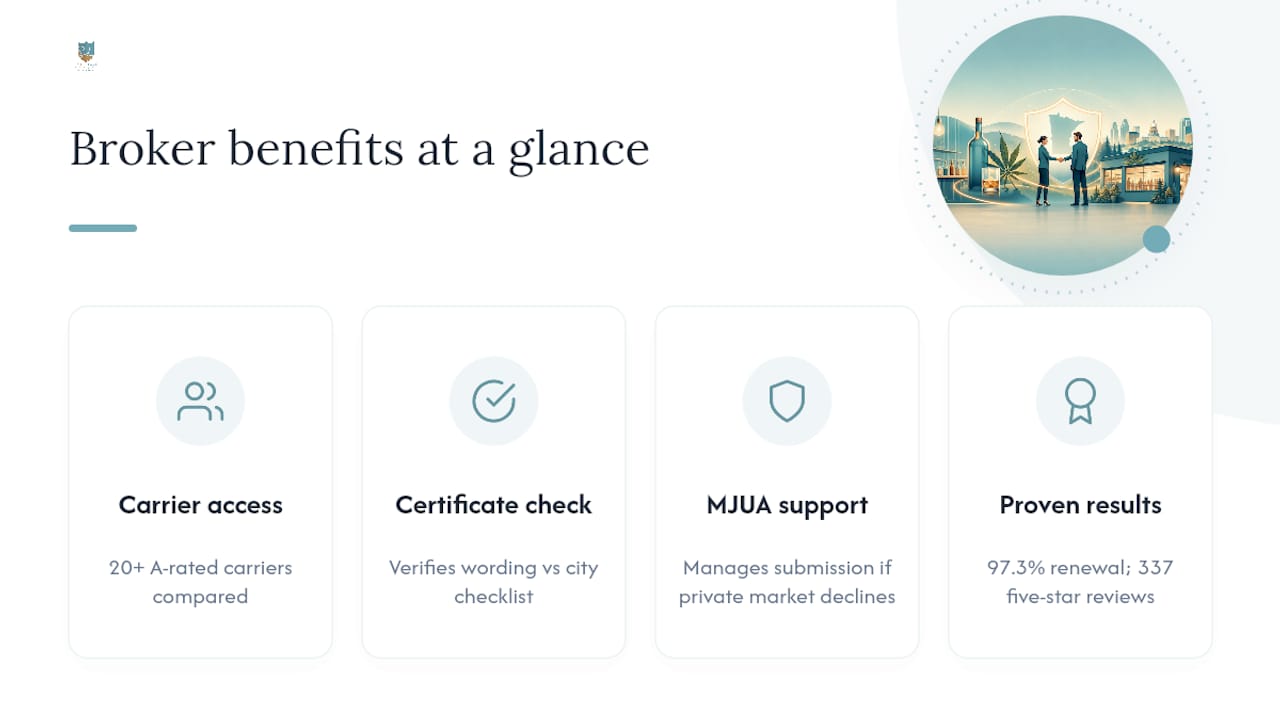
Shopping this coverage alone means calling carrier after carrier, explaining your classification each time, and hoping someone quotes limits that actually match your city’s ordinance. A broker who works multiple A-rated carriers does that comparison in one pass, and checks the certificate wording against your municipality’s checklist before it ever reaches a licensing clerk’s desk.
That’s the work South Lake Agency Insurance Brokers does for Minnesota licensees: comparing quotes across 20+ carriers, verifying certificate language, and managing the MJUA submission if the private market declines you. There’s no broker fee added to your premium, and the agency’s Minnesota client base reflects a 97.3% renewal rate and over 337 five-star reviews. If your operation is straightforward, a low-risk restaurant with modest bar sales, you might get by requesting quotes yourself. If you’ve got a claims history, high-volume bar sales, or a city ordinance demanding non-standard limits, a broker’s carrier relationships tend to save real time and real money.
— Andrew
Get Your Minnesota Liquor Liability Certificate Started
Using an independent broker offers an alternative to calling multiple carriers yourself: one conversation, multiple insurer quotes compared, and a certificate built to match your city’s exact wording before your license deadline hits.
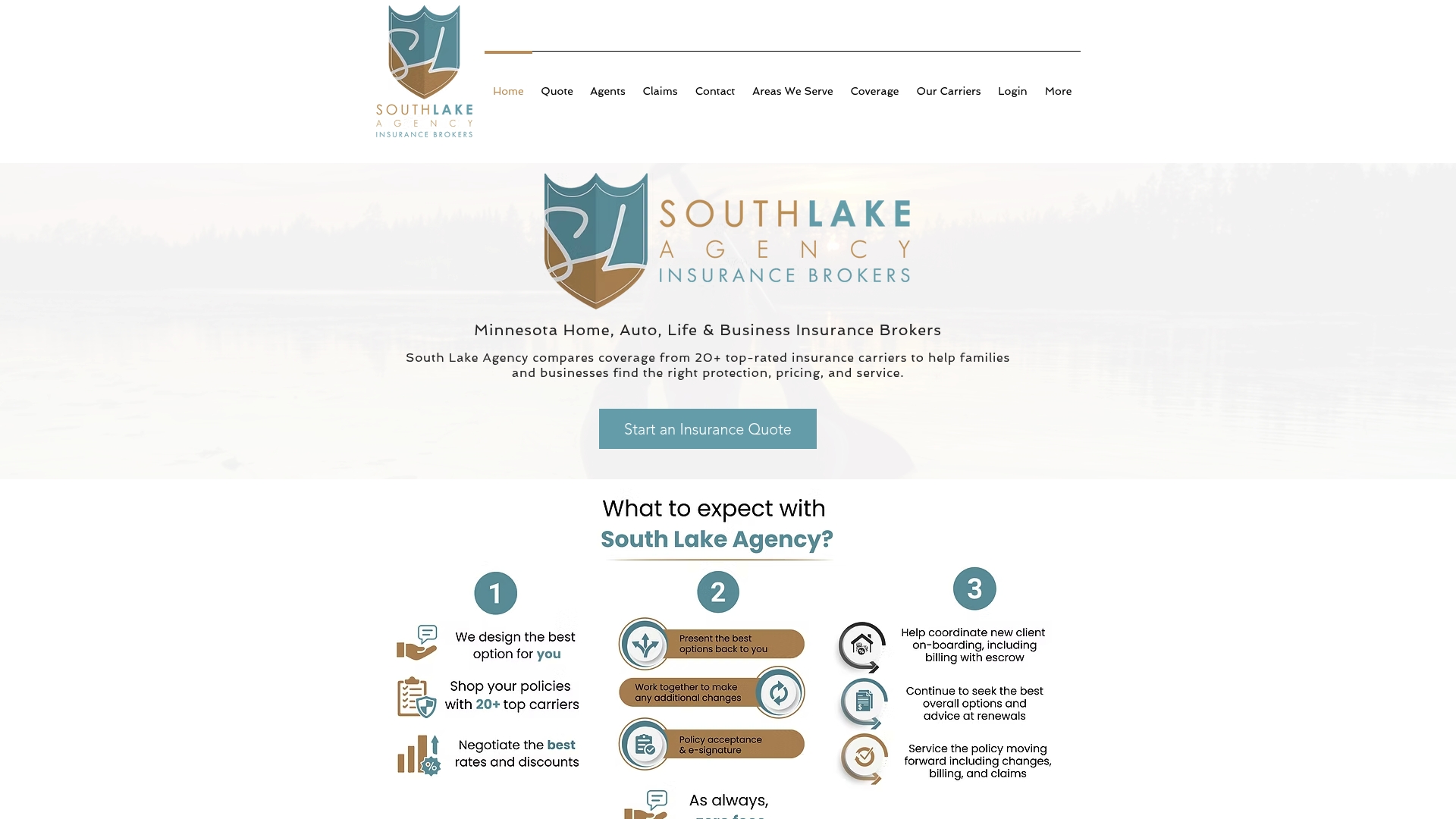
To move quickly, have your license (or pending application), twelve months of monthly liquor sales, and any prior loss runs ready. From there, the broker can handle multi-carrier quoting, issue the certificate with the correct legal name and limits, coordinate directly with your municipality if they require special language, and manage the MJUA application if your risk profile needs the assigned-risk route. Brokers typically do not add a fee on top of your premium.
If you’re renewing a license, opening a new bar, or adding liquor liability for a special event, request a business insurance quote and get a certificate that actually clears your city’s licensing desk on the first try.
Where to Verify the Rules Yourself
Before you sign anything, pull the primary sources. Minn. Stat. §340A.409 is the legal basis for the entire requirement. The MJUA application lays out assigned-risk mechanics, rate tables, and increased-limit factors. Minneapolis’s municipal guidance shows the certificate checklist most cities mirror. Bring all three when you contact a broker or your local licensing authority, and if you’re insuring an off-site event through a venue like Archers Battlefield, ask specifically about host liquor coverage requirements before you sign the venue contract.
This article is general information, not a substitute for advice from a qualified financial advisor. Consult a qualified financial professional about your own circumstances before acting on anything here.
Sources
Recommended
Comments