




Do Insurance Brokers Charge Fees? What to Know Before You Sign


Most insurance brokers get paid by the insurance carrier, not by you. The carrier folds a commission into your premium, usually 2% to 8% of the policy cost, so you often never see a separate broker charge on personal auto or home policies. Direct broker fees are real, though, and they show up more often on commercial accounts, specialty coverage, or consulting work where a broker bills for time and expertise beyond the standard placement.
The one rule that protects you either way: never pay a broker fee without a signed written fee agreement in hand first. If a broker asks you to pay a fee and can’t produce a document spelling out the amount, the services covered, and whether it’s refundable, treat that as a warning sign, not a formality to skip.
Commission is the default. The carrier pays it; it’s baked into the price you already see.
Fees are the exception. They apply mostly to commercial, high-complexity, or advisory work.
A written agreement is your leverage. Many states legally require one before a fee changes hands.
Fee-free brokers exist. Some brokerages, including South Lake Agency Insurance Brokers, work entirely on carrier commission and pass no separate charge to the client.
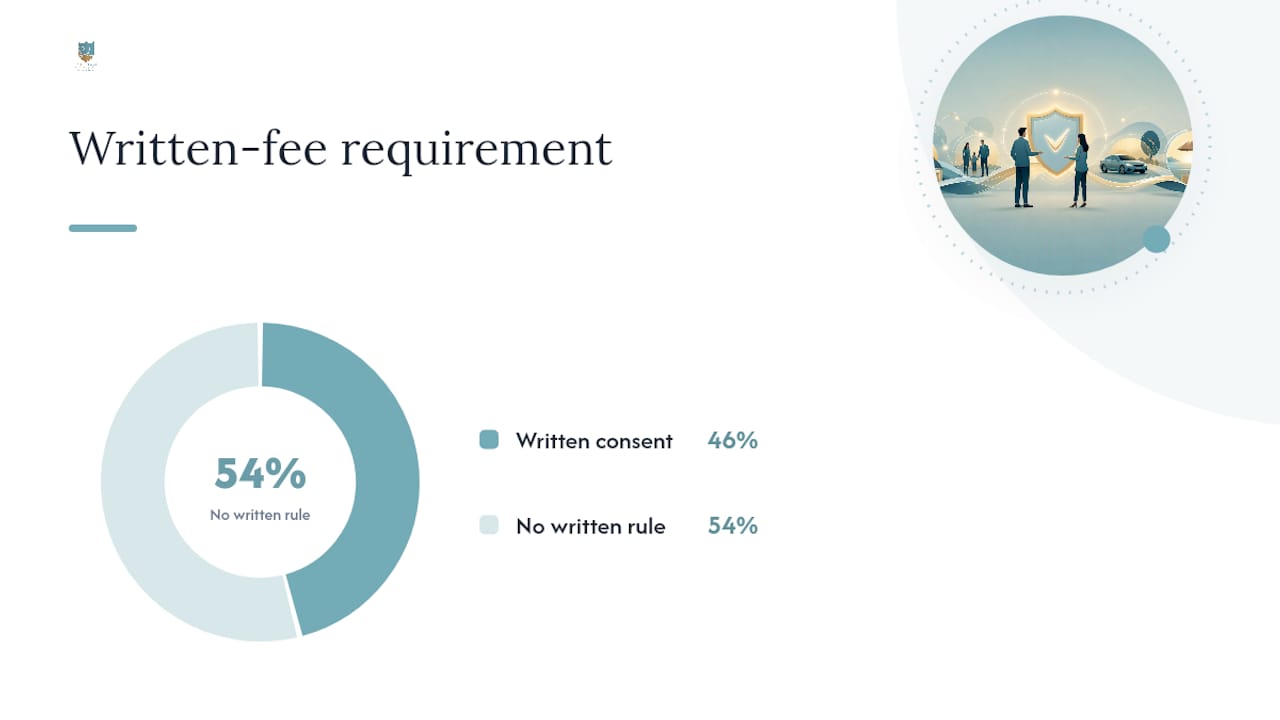
Roughly 23 states require a written fee agreement before a broker can bill you directly, and fee-based compensation itself is legal nationwide as long as it’s disclosed properly. If you’d rather sidestep the question entirely, ask any broker for a net-premium quote, the price with commission built in and no add-on fee, and compare it against whatever fee-plus-premium structure they’re proposing.
Key Takeaways
Insurance broker fees are legal but conditional: a broker can charge one only with proper disclosure, and in many states, only with your signature on a written agreement first.
Point | Details |
Commission is the default | Carriers pay brokers 2% to 8% of premium on most personal lines; you rarely see a separate charge. |
Fees need paperwork | Insist on a signed, written fee agreement before paying any direct broker fee. |
Compare net premium | Ask for a quote with commission removed to judge whether a fee-only arrangement actually saves money. |
Know your remedies | Undisclosed fees can be refunded through a state department of insurance complaint or small-claims court. |
Consider a no-fee broker | South Lake Agency Insurance Brokers charges no direct fees and compares 20+ carriers on commission alone. |
Table of Contents
Insurance Broker Fees vs. Commissions: How the Money Actually Moves
Common Insurance Broker Fee Types and What They Typically Cost
How to Evaluate and Negotiate a Broker Fee Before You Pay It
What to Do If You Were Charged an Undisclosed or Unfair Broker Fee
South Lake Agency Insurance Brokers’s No-Fee Policy Explained
Insurance Broker Fees vs. Commissions: How the Money Actually Moves
A commission is a percentage of your premium that the insurance carrier pays the broker for placing your policy. A fee is money you pay the broker directly, on top of or instead of that commission, for a specific service. Confusing the two is where most disputes start.
Commission is invisible to you in the sense that it’s already priced into the premium quoted on your policy. The carrier sets the rate, pays the broker a cut, and you never write a separate check for it. Fees work differently: they’re itemized, billed to you, and typically require your written consent because you’re paying out of pocket for something beyond the standard sale.
Typical commission structures by line:
Personal lines (auto, home, renters): commissions generally run 2% to 8% of premium, with the broker earning that cut every renewal.
Commercial lines: percentages often run higher, and complex accounts (workers’ compensation, general liability, surplus lines) can carry commission rates well above personal-lines norms because of the underwriting work involved.
Life insurance: commissions are frequently front-loaded, meaning the broker earns a larger share in the first year of the policy and smaller trailing commissions in later years.
Medicare: broker compensation is capped by federal rules that CMS publishes and updates annually, so a Medicare broker can’t simply set their own commission the way a commercial broker might negotiate one.
Fee types vary just as much as commission structures. A placement fee covers the work of shopping and binding a new policy. An administrative fee covers paperwork like certificates of insurance or policy changes. A consulting fee, usually hourly, covers risk assessment or claims advocacy that goes beyond a standard sale. Some brokerages combine models: they collect a reduced commission plus a modest fee, or they waive commission entirely and bill flat fees instead, an approach sometimes called fee-only or fee-offset.
That last structure is where the term net premium matters. If a broker offers to waive their commission and charge you a flat fee instead, ask them to show the premium with commission removed. Comparing that net-premium number against the fee they want to charge tells you, in dollars, whether the fee-only arrangement actually saves you anything or just moves the same cost into a different column.
Pro Tip: If a broker quotes you a fee, ask point blank: “Is this fee in addition to your commission, or instead of it?” A broker collecting both without disclosing it upfront is a red flag, not standard practice.
When Can a Broker Legally Charge You a Fee?
Fee-based compensation is legal in all 50 states, but the paperwork requirements around it are not uniform. The baseline that shows up in most jurisdictions is straightforward: a broker generally needs your signature on a written fee agreement before collecting a direct charge, and that agreement has to spell out what you’re paying for.
Several states go further than a signature requirement. Some mandate that the fee agreement be a standalone document, separate from the application or binder, so you can’t miss it buried in other paperwork. Others require the broker to disclose their commission alongside the fee, so you can see the total compensation picture rather than just the piece you’re writing a check for.
State-by-state specifics worth knowing:
California enforces disclosure rules around broker compensation on commercial accounts and restricts fee practices tied to certain lines.
New York has historically scrutinized dual compensation (fee plus commission) closely, particularly on personal lines.
New Jersey requires clear, itemized fee disclosure as a matter of standard practice for licensed producers.
Washington and Michigan both lean toward requiring written consent before any fee is charged, consistent with the roughly 23-state pattern of written fee agreement requirements.
Ohio permits broker fees on many lines but expects them to be reasonable and disclosed, not buried in fine print.
None of this means you need to memorize your state’s insurance code before buying a policy. It means one question does most of the work: “Can I see the signed fee agreement, and does it show whether you’re also collecting a commission on this policy?” A broker operating within the rules will produce that document without hesitation, because state law in many jurisdictions requires the agreement to exist before the fee is charged in the first place.
The dual-compensation question deserves its own scrutiny. Some states allow a broker to collect both commission and a fee, but only if the fee agreement discloses the commission and the total compensation is reasonable for the work performed. Other arrangements require any commission collected on a fee-based account to offset or reduce the fee, so you’re not effectively paying twice for the same placement. If a broker can’t explain which model applies to your policy, that’s worth pausing over before you sign anything.
Common Insurance Broker Fee Types and What They Typically Cost
Fee amounts vary by state, by line of business, and by how complicated your account is, but the categories are consistent enough to give you real reference points when you’re staring at an invoice.
Administrative and transaction fees tend to run $25 to $150 and cover things like issuing a certificate of insurance, processing a mid-term policy change, or handling routine paperwork. These are the smallest, most common fees you’ll encounter and the ones least likely to raise a red flag.
Placement or one-time policy fees generally fall between $100 and $500, charged when a broker does the legwork of shopping your risk across multiple carriers and binding a new policy, particularly for harder-to-place commercial risks.

Consulting or advisory fees are typically hourly, often $150 or more per hour, and apply to work like risk assessments, claims advocacy, or ongoing account management that goes beyond a standard sale.
Surplus-lines stamping fees are different from the others entirely. These are small, fractional-percentage charges tied to regulatory filing requirements when a risk is placed in the surplus lines market rather than with a standard admitted carrier. They’re pass-through costs the broker collects and remits to a state stamping office. The broker doesn’t keep this money, which is a distinction worth understanding before you assume every line item on an invoice is broker profit.
Which fees you’re likely to see depends heavily on account type. Personal auto and homeowners clients rarely encounter anything beyond an occasional administrative charge. Commercial accounts, especially anything involving workers’ compensation or general liability, see placement and consulting fees more often. Surplus-lines and Medicare accounts follow their own fee structures entirely, with Medicare governed by federal caps rather than state fee rules.
The number on the invoice matters less than the comparison. A $300 placement fee on a complex commercial account might be entirely reasonable if it reflects real work across a dozen carriers. The same fee tacked onto a simple homeowners renewal deserves a harder look.
How to Evaluate and Negotiate a Broker Fee Before You Pay It
Work through this in order, before any money changes hands.
Ask for the fee agreement in writing. Not a verbal explanation, not an email summary, the actual signed document the state requires many brokers to produce before collecting a fee.
Ask whether commission is also being collected on this policy. If both are in play, ask whether the commission offsets or reduces the fee.
Request an itemized list of services covered by the fee. “Administrative services” is not itemized. “Certificate issuance, policy endorsement processing, and claims filing support” is.
Ask directly whether the fee is refundable if you cancel the policy or switch brokers within a set window.
Request a net-premium quote so you can compare the fee-plus-premium total against what the policy would cost with standard commission built in.
Keep a copy of every signed document and email exchange related to the fee, in case you need it later.
Use plain language when you ask. “Can you send me the signed fee agreement before I pay anything?” and “What happens to this fee if I cancel next month?” are both fair, direct questions any licensed broker should answer without friction.
Pro Tip: Ask for the net-premium comparison in the same email where you request the fee agreement. Brokers who are confident their fee adds value will send both without pushback.
Watch for these red flags: a broker who won’t disclose whether they’re also earning commission, refusal to put the fee agreement in writing, service descriptions so vague they could mean anything, or a one-time fee that’s high relative to the size of the policy with no explanation of the work behind it. Any one of these on its own might have an innocent explanation. More than one together is reason to ask harder questions or walk.
What to Do If You Were Charged an Undisclosed or Unfair Broker Fee
Act quickly and in writing, not over the phone, so there’s a paper trail.
Request the fee agreement and disclosure documents immediately. If none exist, say so in writing and ask for a refund on that basis.
Demand a refund if you never consented to the fee in a signed document, since regulators can require refunds when a broker charges a fee without the required written agreement.
Keep every invoice, email, and text message related to the fee. Regulators and small-claims courts both want a timeline, not a memory.
If the broker won’t cooperate, file a complaint with your state department of insurance. Include the invoice, any correspondence, and a clear timeline of what was disclosed and when. Regulators can investigate, order refunds, or take disciplinary action against the broker’s license, and a documented paper trail makes that process faster.
For smaller disputed amounts, small-claims court is often a realistic option without hiring an attorney. For larger commercial disputes involving thousands of dollars in disputed fees, consulting a consumer protection attorney before filing anything makes sense.
South Lake Agency Insurance Brokers’s No-Fee Policy Explained
South Lake Agency Insurance Brokers doesn’t charge clients a direct broker fee. Compensation comes entirely from carrier commissions, the same structure that funds most personal-lines brokerages, which means the shopping, comparing, and placement work happens without a separate line item on your invoice.
That structure lets the agency shop more than 20 carriers for home, auto, life, and business coverage without any incentive to tack on an administrative or consulting charge afterward. Clients working with the agency have saved an average of $2,246 compared to what they were paying before, figures readers can verify directly on the agency’s site.
If you’re evaluating any broker’s compensation, ask for the same thing South Lake Agency Insurance Brokers already provides by default: a written fee disclosure or a net-premium quote you can compare against competing offers.
No direct broker fees charged to clients
20+ carriers compared per client for home, auto, life, and business insurance
Average client savings of $2,246
97.3% client renewal rate and 337+ five-star reviews
The Real Problem With Broker Fee Advice
Most guidance on this topic treats broker fees as a math problem: is the fee reasonable relative to the service? That’s the wrong first question. The right first question is whether the fee was disclosed and agreed to in writing before it was charged, because a reasonable-sounding fee charged without consent is still a compliance violation, and an unreasonable fee that was properly disclosed still gave you the chance to walk away.
Consumers spend far more energy negotiating fee amounts than they spend insisting on paperwork, and that’s backward. A signed agreement is free to demand and costs the broker nothing to produce if they’re operating legitimately. The reluctance to provide one tells you more than the number on the invoice ever will.
The other overlooked point: net-premium comparison isn’t just a negotiating tactic, it’s the only way to know if a fee-only arrangement is actually cheaper than a standard commission-based policy. Most people never run that comparison and just assume “no fee” or “flat fee” is automatically the better deal. Sometimes it isn’t.
Get an Itemized Quote With No Hidden Broker Fees
South Lake Agency Insurance Brokers charges no direct broker fees for the home, auto, life, or business coverage it places, which means the itemized quote you get back shows carrier premium and commission disclosure, not a stack of add-on charges you have to negotiate down.

If you’re buying a home this year, the New Homebuyer Insurance Guide walks through what to request from any broker: a written breakdown of the premium, any commission disclosure, and, if a broker is proposing a fee, the signed fee agreement that should come with it. You can also go straight to request a quote and ask specifically for a net-premium comparison across South Lake Agency Insurance Brokers’s carrier panel of 20-plus insurers. Whether you’re shopping homeowners coverage or auto insurance, the request costs you nothing and gives you the exact numbers you need to compare against any fee-based offer on the table.
Frequently Asked Questions
Do insurance brokers charge fees on every policy? No. Most brokers earn commission from the carrier on standard personal-lines policies like auto and home insurance, so no separate fee applies. Direct fees show up more often on commercial accounts, specialty coverage, or consulting engagements.
Is it cheaper to buy insurance through a broker than directly from an insurer? Often, yes. Independent brokers can save clients money by shopping multiple carriers for the best combination of price and coverage, even when a fee is involved. Comparing the net premium against a fee-based quote tells you whether that holds true in your specific case.
Can a broker charge both a commission and a fee on the same policy? In some states, yes, but the fee agreement should disclose the commission, and several jurisdictions require the commission to offset or reduce the fee rather than stacking both without explanation.
What should I do if a broker won’t provide a written fee agreement? Treat that as a serious warning sign. Ask for the fee in writing before paying anything, and if the broker refuses, consider filing a complaint with your state department of insurance or working with a different brokerage.
Are surplus-lines stamping fees the same as a broker fee? No. Stamping fees are small, fractional regulatory charges the broker collects and remits to a state filing office. They’re pass-through costs, not fees the broker keeps as profit.
Sources
Recommended
Comments