




What Minnesota Rideshare Drivers Need to Know About Insurance

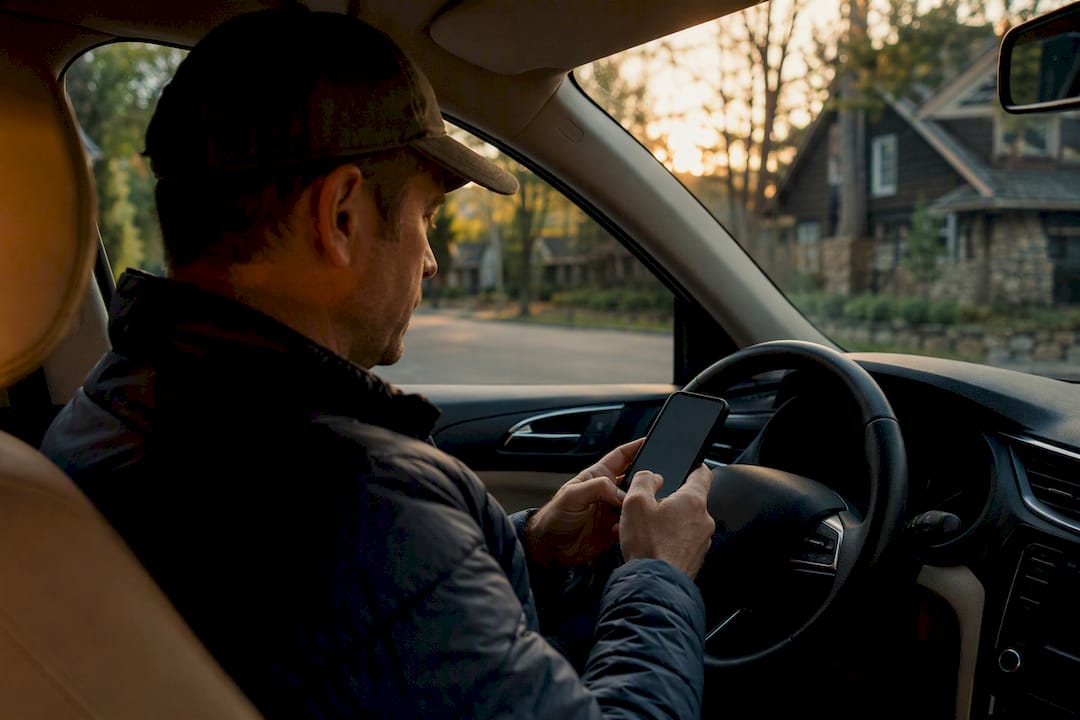
If you drive for Uber or Lyft in Minnesota, your personal auto policy almost certainly stops covering you the moment you go online, and it’s Uber’s commercial policy that carries the load once you’re matched with a rider or have one in your car. Minnesota Statute 65B.472 sets the floor here: transportation network companies must carry at least $1,000,000 in per-incident personal-injury coverage once you’ve accepted a ride, but that same statute lets insurers exclude coverage entirely while you’re just sitting with the app on, waiting for a ping. That waiting period is where drivers get burned.
Check your personal policy today for a “rideshare,” “for hire,” or “commercial use” exclusion clause.
Call a broker like South Lake Agency Insurance Brokers if you’re not sure whether your policy covers app-on time.
Confirm your endorsement covers all three driving phases, not just the ride itself.
The one number to remember: Minnesota requires TNCs to maintain $1,000,000 in per-incident personal-injury coverage during active rides, but that protection doesn’t start until you’ve accepted a fare.
Key Takeaways
Minnesota rideshare drivers need a policy that explicitly covers app-on time, because both state law and most personal insurers allow coverage to lapse the moment you log in without an endorsement.
Point | Details |
Know your phase | P1, P2, and P3 each trigger different insurers, so your coverage depends on your exact app status during a crash. |
$1,000,000 | Uber must carry at least $1,000,000 in per-incident personal-injury coverage during active rides under Minnesota law. |
P1 is the real risk | Most personal policies exclude coverage while you’re logged in and waiting, before you accept a ride. |
Occupational Accident isn’t vehicle coverage | The 2025 update protects your medical bills and income, not your car’s physical damage. |
Get a local broker check | South Lake Agency Insurance Brokers compares 20+ carriers to verify your endorsement actually covers P1 before you need it. |
Primary sources and official links
Sec. 65B.472 MN Statutes: the core statute defining driving phases and insurer exclusion rights.
MN Statutes 2024 PDF: full statutory text on TNC coverage limits.
Minnesota DLI TNC guidance: details on 2025 Occupational Accident requirements.
Uber insurance information: state-specific certificate of insurance details.
NAIC commercial ride-sharing guidance: consumer-facing explanation of coverage categories.
Table of Contents
Understanding Rideshare Insurance Minnesota Law: The Three Driving Phases
What Minnesota’s 65B.472 Law Requires, and What Changed in 2026
The Coverage Gap: Why Your Personal Policy May Deny Your Claim
Filling the Gap: Rideshare Endorsements, Commercial Policies, and What Each Covers
Documents Every Minnesota Rideshare Driver Should Keep Ready
How to Buy the Right Rideshare Policy: A Step-by-Step Checklist
How South Lake Agency Insurance Brokers Helps Minnesota Drivers Get This Right
Ready to Close Your Coverage Gap? Here’s How South Lake Agency Insurance Brokers Helps
Understanding Rideshare Insurance Minnesota Law: The Three Driving Phases
Every accident claim involving a rideshare driver in Minnesota comes down to one question: what was your app status the moment the crash happened? Minnesota Statute 65B.472 splits your driving day into three legally distinct periods, and each one triggers a different insurance answer.
Period 1 (P1) is app on, no ride requested. You’re cruising around Rochester or sitting in a parking ramp in downtown Minneapolis waiting for a ping. Period 2 (P2) starts the second you accept a ride request and covers your drive to pick up the passenger. Period 3 (P3) covers the actual trip, from pickup to drop-off.
Here’s how coverage typically breaks down across those three phases:
Phase | Who’s Typically Primary | Coverage That Usually Applies |
P1 (app on, waiting) | Your personal policy (if it doesn’t exclude TNC use) | Liability, collision, comprehensive, UM/UIM, PIP, if your insurer allows it |
P2 (en route to pickup) | Uber’s commercial policy | Liability up to policy limits, contingent collision/comprehensive, PIP |
P3 (passenger onboard) | Uber’s commercial policy | $1,000,000 liability, contingent collision/comprehensive, occupational protections |
A driver in P1 whose personal insurer has a commercial-use exclusion can get a flat denial after a fender bender, even with no passenger anywhere near the car. A driver in P2 who rear-ends someone en route to a pickup is usually covered by Uber’s liability policy, though physical damage to their own vehicle may depend on whether they carry collision coverage personally. A driver in P3 involved in a multi-car pileup on I-94 with a passenger in the back seat falls under the full $1,000,000 commercial limit, plus whatever contingent coverage kicks in for the vehicle itself.
What Minnesota’s 65B.472 Law Requires, and What Changed in 2026
Minnesota was one of the earlier states to codify rideshare insurance requirements into law, and 65B.472 remains the backbone of every coverage conversation you’ll have with an insurer or broker. The statute requires TNCs to disclose, in writing, what insurance applies during each driving period and to maintain proof-of-coverage documentation that a driver or police officer can access after a crash.
The statute permits insurers to exclude any and all coverage, including liability, uninsured/underinsured motorist, medical payments, personal injury protection, comprehensive, and collision, for losses that occur while a driver is logged into a TNC digital network during P1, P2, or P3, unless the policy expressly provides otherwise.
That’s not boilerplate language. It’s the legal reason your personal insurer can walk away from a claim the instant they see you had a rideshare app open, even if you never picked up a passenger.
The 2024-2025 updates from the Minnesota Department of Labor and Industry added a meaningful layer on top of the vehicle-insurance rules: TNCs must now provide Occupational Accident insurance for eligible Minnesota drivers, automatically, without an opt-in requirement for qualifying drivers.
Occupational Accident coverage pays for medical expenses, lost income, and survivor benefits tied to injuries suffered while driving.
It does not pay to repair your car, and it does not replace liability coverage for damage you cause to someone else.
It layers on top of the existing $1,000,000 personal-injury requirement during P2 and P3, it doesn’t substitute for it.
Drivers who assume the 2025 changes solved their coverage gap are making a costly mistake. The occupational protections address injury to you, not the vehicle exclusion that hits during P1.
The Coverage Gap: Why Your Personal Policy May Deny Your Claim
Most Minnesota drivers buy a standard personal auto policy assuming it covers them anytime they’re behind the wheel. It doesn’t, not once you start using the car to carry paying passengers. Insurers write exclusion language specifically to keep “for hire” or “commercial use” driving off their books, and rideshare work fits that definition the moment you log into the app, according to NAIC’s guidance on commercial ride-sharing.
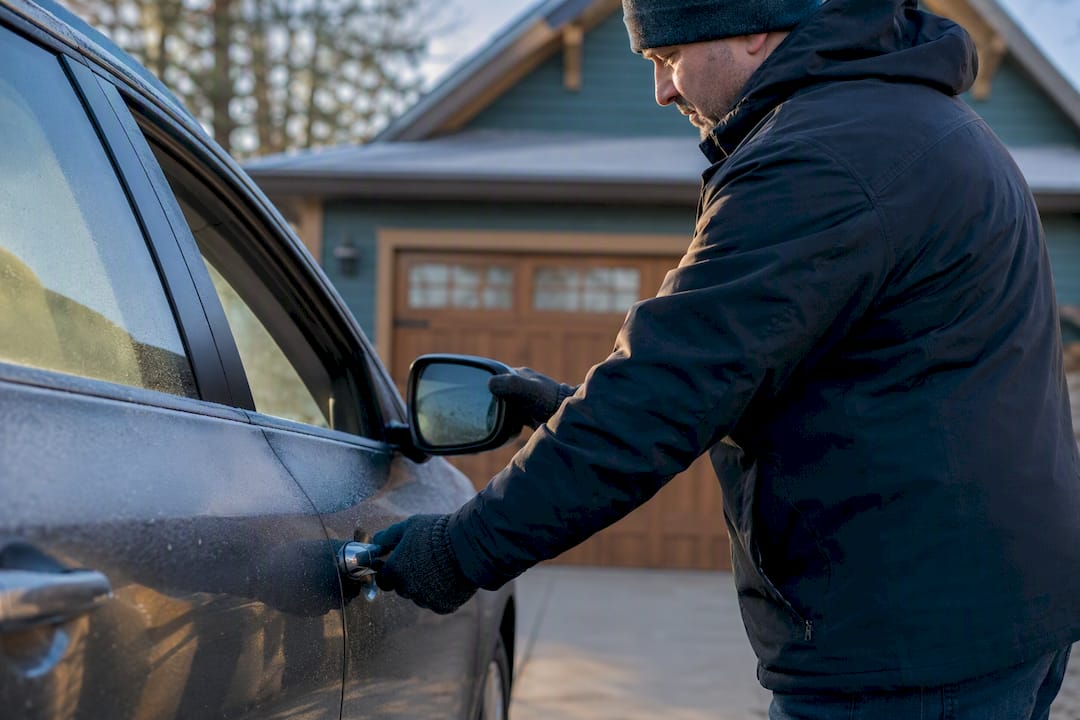
The practical result: if you’re sitting in P1 with the app open, waiting for a ride request, and someone rear-ends you at a stoplight on Snelling Avenue, your personal insurer can deny the entire claim, liability, collision, comprehensive, and uninsured motorist coverage, all of it, based on that exclusion. Uber’s commercial policy generally does not step in during P1 either, which is exactly why this window carries the most risk for Minnesota drivers.
Carriers don’t always deny loudly. Sometimes it shows up as a delayed investigation, a request for your Uber trip history, or a flat rejection letter citing “commercial use” three months after you filed. By then you’ve already paid out of pocket for the tow and the rental car.
Pro Tip: Pull out your policy declarations page and search for the words “livery,” “public or livery conveyance,” “transportation network company,” or “for hire.” If any of those phrases appear in the exclusions section, call your insurer or a broker before you drive another shift, and ask directly: “Does this policy exclude coverage while I’m logged into a rideshare app but haven’t accepted a ride yet?” Get the answer in writing.
Filling the Gap: Rideshare Endorsements, Commercial Policies, and What Each Covers
Minnesota drivers generally have four real options for closing the P1 gap, and picking the right one comes down to how many hours you’re actually driving.
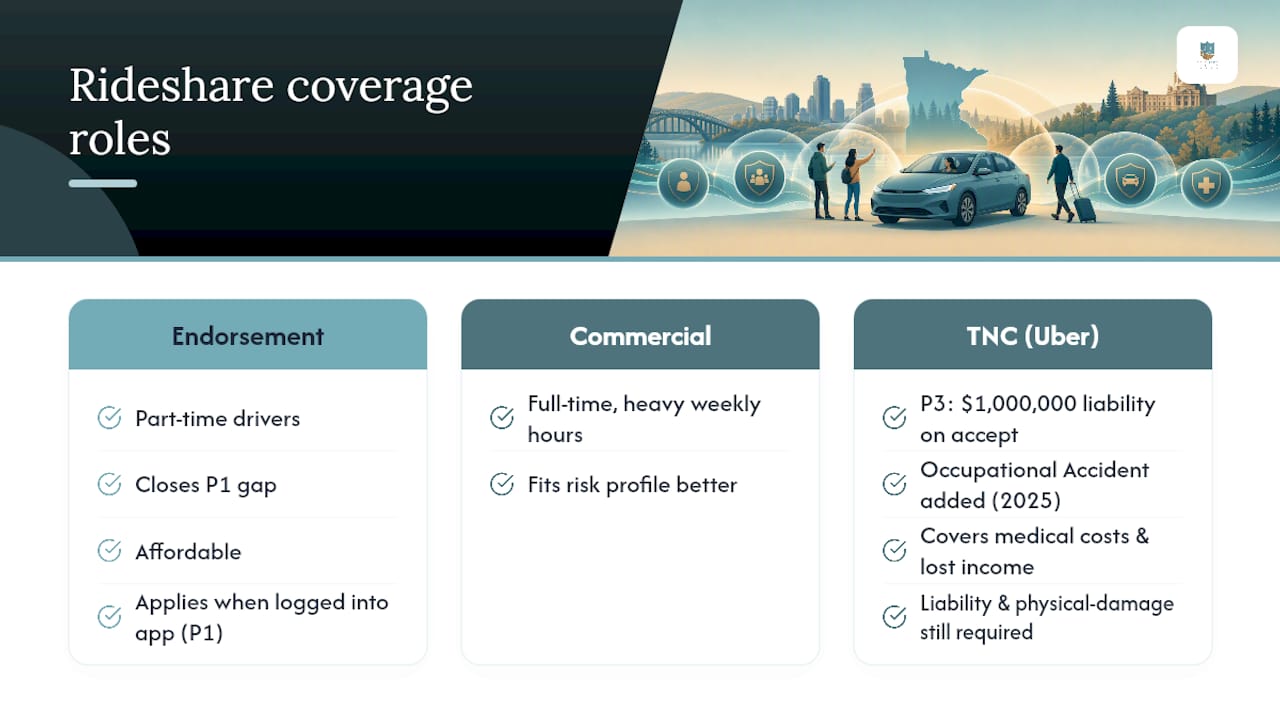
Rideshare endorsement. An add-on to your existing personal auto policy that extends your normal coverage, liability, collision, comprehensive, into P1. This is the most common and usually the most affordable fix for part-time drivers, and industry data suggests endorsements are typically the cheapest path for anyone driving under roughly 20 hours a week.
Commercial or for-hire primary policy. A standalone policy built for livery use. This makes more sense if you’re driving full-time, using a vehicle that’s aging out of personal-policy eligibility, or stacking rideshare income with delivery work.
Hired and non-owned auto (business-use) endorsements. Less common for individual drivers but relevant if you’re running a small fleet or letting family members drive under a business entity.
Maintaining collision and comprehensive on your personal policy. Even with a rideshare endorsement, keeping these coverages active is what allows Uber’s contingent physical-damage coverage to trigger during P2 and P3, per Uber’s own insurance disclosures.
Occupational Accident insurance, the coverage TNCs now provide automatically, handles your medical bills and lost wages if you’re hurt on the job. It says nothing about the car. If you total your vehicle in a P1 accident with no endorsement, Occupational Accident coverage won’t pay a dime toward the repair or replacement.
As a rule of thumb: if you’re driving rideshare on the side, a handful of shifts a week around a day job, a rideshare endorsement usually closes the gap for a reasonable premium bump. If rideshare is your primary income and you’re logging 30+ hours a week, a commercial policy often makes more financial sense once you account for higher mileage, wear, and claim frequency.
What Rideshare Coverage Actually Costs in Minnesota
Pricing varies more than most drivers expect, and the biggest swing factors are things you already control. Your driving record matters more than almost anything else, one at-fault accident in the past three years can push a quote noticeably higher. Where you drive matters too: a driver logging most of their hours in Minneapolis or Saint Paul traffic faces different risk exposure than someone covering rural routes in Greater Minnesota.
Vehicle age and type (newer cars cost more to insure for comprehensive and collision)
Annual mileage and hours logged on the app
Coverage limits and deductible choices
Winter driving exposure, a real factor given Minnesota’s ice and snow season
Whether you choose an endorsement versus a full commercial policy
Pro Tip: When you call for quotes, ask each carrier the exact same question: “What does this policy cover during P1 specifically, and does it require collision and comprehensive to already be active for contingent coverage to apply?” Carriers structure P1 coverage differently, and that one question exposes the real difference between two policies that otherwise look identical on price.
After an Accident: What to Do While Driving for Uber
Your first move never changes regardless of app status: check for injuries, call 911 if anyone’s hurt, and move to safety if the vehicle is still driveable.
Call the police and get an official report, insurers and Uber both require this for any claim involving injury or significant damage.
Photograph everything, vehicle positions, license plates, road conditions, and your phone screen showing your app status at the time of the crash.
Report the incident inside the Uber app immediately, before you close out or restart your shift.
Notify your personal insurer even if you believe Uber’s policy should be primary, delayed notice can complicate a claim later.
Save your trip history and timestamps from the app, this becomes the evidence that determines whether you were in P1, P2, or P3.
If the crash happened in P1 and your personal insurer starts pushing back, that’s the moment to call a broker or attorney rather than negotiate alone. Claims that hinge on app-status timing get contentious fast, and a broker who already knows your policy’s language can usually cut through the back-and-forth faster than you can on your own.
Documents Every Minnesota Rideshare Driver Should Keep Ready
Minnesota’s disclosure requirements mean you need to be able to prove your coverage status on demand, to police, to an insurer, or to Uber’s support team.
Your personal auto insurance ID card
Proof of your rideshare endorsement or commercial policy, if you carry one
A screenshot or saved copy of Uber’s certificate of insurance for Minnesota
Recent trip history showing timestamps for the period around any incident
Pro Tip: Save digital copies of your insurance ID and endorsement paperwork in a cloud notes app, not just your glovebox. If your phone dies at the scene or your car’s totaled, you still need a way to pull up proof of coverage for the officer writing the report.
How to Buy the Right Rideshare Policy: A Step-by-Step Checklist
Getting the right coverage isn’t complicated, but it does take asking the right questions before you sign anything.
Map your driving profile. How many hours a week, what times of day, and what vehicle you’re using.
Pull your app history. Most carriers want to see your typical driving pattern before quoting accurately.
Request two quotes, one for a rideshare endorsement, one for a commercial primary policy, so you can compare real numbers instead of guessing.
Ask how UM/UIM and PIP interact with Uber’s coverage during P2 and P3, since Minnesota’s no-fault system means your PIP benefits may apply differently depending on whose policy is primary.
Confirm claims handling, specifically who investigates and pays first if a P1 accident happens.
When you call an insurer or broker, ask these questions word for word:
“Does this policy exclude coverage for any period while I’m logged into a rideshare app?”
“Will you defend and pay a claim that happens during P1, P2, or P3 specifically?”
“What proof of coverage do I need to carry, and how do I access it if my phone isn’t working?”
Watch for red flags in the answers. If an agent says “we don’t offer anything for rideshare, you’d just need to not disclose it,” walk away, that’s a policy that will deny your claim the moment they pull your Uber trip logs. Any answer describing a “blanket exclusion for all for-hire use with no endorsement option” means that carrier isn’t built for rideshare drivers at all.
How South Lake Agency Insurance Brokers Helps Minnesota Drivers Get This Right
Sorting through endorsement language across a dozen carriers isn’t a great use of your time between shifts. South Lake Agency Insurance Brokers shops more than 20 carriers on your behalf, compares which ones actually write rideshare endorsements for Minnesota drivers, and verifies the fine print before you commit to anything.
Compares personal-policy endorsements against commercial options side by side
Confirms your coverage actually extends into P1, not just the ride itself
Coordinates proof-of-coverage documentation you can show Uber or a police officer
Handles claims paperwork if you’re stuck fighting a denial
If you drive out of the Twin Cities, the Twin Cities insurance brokers page covers your local service area directly.
Author’s note
Every driver I’ve talked to about this assumes their app-on time is covered by somebody. It usually isn’t, and that’s the gap that costs people the most. Read your policy’s exclusion language before your next shift, not after a claim gets denied.
Ready to Close Your Coverage Gap? Here’s How South Lake Agency Insurance Brokers Helps
South Lake Agency Insurance Brokers is the alternative to guessing your way through rideshare exclusions alone. Instead of calling five insurers one by one and getting five different answers about P1 coverage, you get one broker who already knows which of our 20-plus carriers actually write Minnesota rideshare endorsements, and which ones bury a “for hire” exclusion that would leave you exposed.

There’s no broker fee added to your premium, and the process is simple: you tell us your driving hours and vehicle, we compare quotes across carriers for both an endorsement and a commercial policy, we verify the coverage actually applies during P1, and we hand you documentation you can keep in the car. Have your driver’s license, current policy declarations page, and your typical weekly driving hours ready, and we can usually turn a comparison around fast. Request an auto insurance quote today and find out exactly what a properly endorsed policy costs before your next shift.
Frequently Asked Questions
Does my personal car insurance cover me while I’m driving for Uber in Minnesota? Usually not once you’ve logged into the app, unless your policy expressly includes a rideshare endorsement. Most standard Minnesota policies exclude coverage for “for hire” or commercial use.
What is the minimum insurance Uber must provide for Minnesota drivers? Under 65B.472, Uber must maintain at least $1,000,000 in per-incident personal-injury coverage once a driver accepts a ride request through P3.
Is a rideshare endorsement enough, or do I need a commercial policy? For most part-time drivers, an endorsement closes the P1 gap affordably. Full-time drivers logging heavy weekly hours often find a commercial policy fits their risk profile better.
What changed with Minnesota rideshare insurance in 2025? TNCs must now automatically provide Occupational Accident insurance for eligible drivers, covering medical costs and lost income from on-the-job injuries, but this doesn’t replace vehicle liability or physical-damage coverage.
How do I know if my policy has a rideshare exclusion? Check your declarations page for terms like “livery,” “for hire,” or “transportation network company.” If you’re unsure, call your insurer or a broker like South Lake Agency Insurance Brokers and ask directly whether P1 driving is excluded.
This article is general information, not a substitute for advice from a qualified financial advisor. Consult a qualified financial professional about your own circumstances before acting on anything here.
Sources
Recommended
Comments