




Home Insurance Cost in Minnesota: What You Need to Know


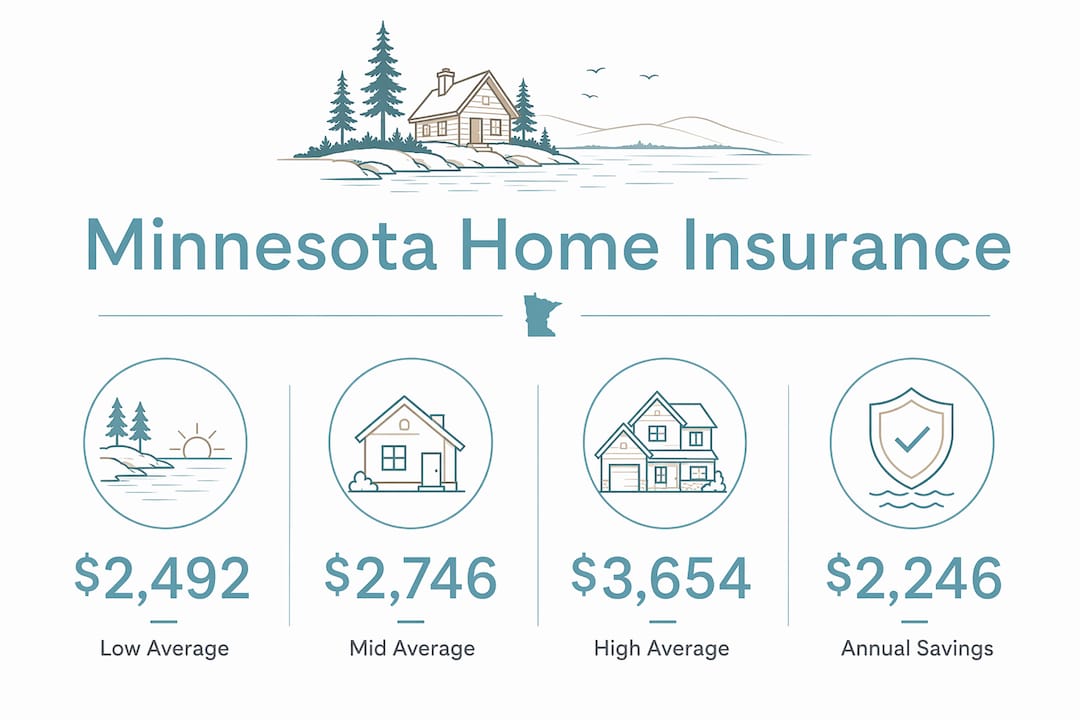
Minnesota homeowners are paying between $2,492 and $2,746 per year for home insurance on a typical home, according to published averages from MoneyGeek and CostPrism. Premiums can vary above or below that range depending on the home’s value, coverage, and recent rate increases. Insurify projects the statewide average will hit roughly $3,654 in 2026, up about 4% from the prior year and part of a 64% surge over a recent multi-year window. The bottom line: if you haven’t reviewed your policy in the past 12 months, you’re likely underinsured and overpaying at the same time.
Three things to do right now:
Verify your dwelling replacement-cost limit. Market value and rebuild cost are not the same number, and the gap has grown with construction inflation.
Get quotes from at least three carriers. Rates vary widely across insurers for the same home, especially in high-hail ZIP codes.
Contact an independent broker. The Minnesota Department of Commerce regulates the market, but navigating it is faster with a broker like South Lake Agency, who shops 20+ carriers on your behalf at no fee to you.
Table of Contents
What does home insurance cost in Minnesota right now?
Published averages for Minnesota homeowners insurance cluster in a fairly tight band, but they’re not identical because each source uses different assumptions about dwelling coverage, deductibles, and sample home values.
The spread from $2,492 to $3,654 isn’t a contradiction. Insurify’s figure reflects projected 2026 rates and a broader sample that includes higher-value homes and recent rate filings. MoneyGeek’s $2,492 is based on a specific coverage profile that may use a lower dwelling limit. CostPrism and U.S. News land in the middle at $2,729–$2,746, which is probably the most useful ballpark for a typical Minnesota home.
What all four sources agree on: rates have been climbing fast. The Insurify data shows Minnesota premiums rising steeply since 2023. A homeowner who locked in a rate three years ago and hasn’t shopped since is almost certainly paying more than necessary or carrying a dwelling limit that no longer reflects actual rebuild costs.
Pro Tip: When comparing published averages, check what dwelling coverage amount the source used. A $2,492 average based on a $200,000 dwelling limit tells you nothing useful if your home would cost $400,000 to rebuild.
Why have Minnesota premiums jumped so sharply?

The short answer is hail. Minnesota sits in one of the most active severe convective storm corridors in the country, and the frequency and intensity of those storms have increased. Hail and high winds, not hurricanes, are now the dominant driver of insured losses in the Midwest.
That shift matters because it changes how insurers price risk. Hurricane losses are concentrated in coastal states and are somewhat predictable by season. Convective storms can hit anywhere in Minnesota, any time from April through October, and a single large hailstorm can generate thousands of roof claims in a single afternoon. Insurers responded by:
Raising reinsurance costs. When carriers buy their own insurance against catastrophic losses, they pay more when those losses are frequent. That cost gets passed to policyholders.
Tightening underwriting. Some carriers have narrowed coverage, added wind/hail deductibles, or stopped writing new policies in high-claim ZIP codes.
Increasing dwelling limits at renewal. Carriers are adjusting replacement-cost estimates upward to reflect construction inflation, which raises the premium even if the rate per dollar of coverage stays flat.
The Minnesota Department of Commerce has taken notice. One emerging response is a pilot program requiring insurers to offer discounts for fortified-roof construction, a mitigation standard that reduces storm damage. That’s worth knowing if you’re planning a roof replacement.
What factors actually determine your premium?
Your individual premium can land anywhere in that $2,492–$3,654 range, or outside it, depending on a handful of specific variables. Here’s what insurers are actually pricing:
Dwelling replacement cost. The single biggest driver. This is what it would cost to rebuild your home from the ground up at current labor and material prices, not what you paid for it or what it would sell for today.
Roof age and material. A roof over 15 years old can trigger a surcharge or a separate wind/hail deductible. Impact-resistant shingles (Class 3 or Class 4) often earn a discount.
Home age and construction type. Older homes with original electrical, plumbing, or HVAC systems cost more to insure because they’re more likely to generate a claim.
ZIP-code risk. Carriers use granular hail and wind frequency data by ZIP code. Two homes with identical specs can carry different premiums based on claims history in their neighborhood.
Claims history. Your personal claims record follows you. A single claim in the past three to five years can raise your premium noticeably; two claims can make some carriers decline to quote you.
Deductible. A higher deductible lowers your premium. Many Minnesota policies now carry a separate wind/hail deductible expressed as a percentage of the dwelling limit (1%–2% is common).
Credit score. Minnesota allows insurers to use credit-based insurance scores as a rating factor. A strong credit history can meaningfully lower your premium.
Coverage limits and endorsements. Higher personal property limits, lower liability limits, or added endorsements (sewer backup, scheduled jewelry) all move the number.
Replacement cost vs. market value
This distinction causes more coverage gaps than any other single issue. Market value includes the land your house sits on, reflects neighborhood demand, and fluctuates with the real estate market. Replacement cost is purely about construction: what would a contractor charge today to rebuild the same structure? In many parts of Minnesota, construction costs have risen faster than home values, meaning a home worth $350,000 on the market might cost $420,000 or more to rebuild. Insuring to market value leaves you short.
Pro Tip: Ask your insurer or broker to run a replacement-cost estimator (carriers use tools like CoreLogic or Marshall & Swift) and compare that figure to your current Coverage A limit. If they don’t match, request a dwelling limit adjustment before your next renewal.
How much does home insurance cost on a $300k or $400k house?
Sample premiums give you a more useful benchmark than statewide averages alone. The figures below are based on published data from CostPrism and Insure.com, using standard assumptions: a $1,000 deductible, $100,000 liability, and a relatively new roof.

Dwelling Coverage | Estimated Annual Premium | Monthly Equivalent |
— | $1,867–$2,200 | — |
$300,000 | $2,200–$2,600 | — |
$350,000 | $2,600–$2,746 | — |
$500,000 | $3,200–$4,256 | — |
Is $200 a month a lot for home insurance in Minnesota? Not anymore. MoneyGeek’s data puts the statewide average at roughly $208 per month. If you’re paying $200/month on a mid-range home with a standard deductible, you’re close to average. If you’re paying that on a $500,000 home, you may be underinsured.
How much for a $300,000 house? Expect $2,200–$2,600 per year in most Minnesota markets, assuming a reasonably new roof and no recent claims. A claim in the past three years can push that figure 15%–25% higher, depending on the carrier.
How much for a $400,000 house? You’re likely looking at $2,600–$3,200 annually under standard conditions. In a high-hail ZIP code or with an aging roof, the upper end of that range is realistic.
These are ranges, not guarantees. City-level variation is real. U.S. News documents meaningful differences across Minnesota cities, with some metro-area ZIP codes running higher than rural areas due to claims density.
What do you need to get an accurate Minnesota quote?
Getting a quote that actually reflects your home, not a generic sample, requires a specific set of inputs. Gather these before you start shopping:
Dwelling replacement cost estimate. Use a contractor’s recent estimate or ask your insurer to run a cost estimator. This is your Coverage A number.
Roof age and material. Know the year your roof was last replaced and the shingle type (standard 3-tab, architectural, impact-resistant Class 3 or 4).
Recent home updates. Year of last HVAC replacement, electrical panel upgrade, and plumbing updates. These affect both pricing and eligibility.
Square footage and construction details. Frame vs. masonry, number of stories, attached garage, finished basement.
Prior claims history. Pull your CLUE report (Comprehensive Loss Underwriting Exchange) if you’re unsure. Insurers will check it anyway.
Mortgage and lender information. If you have a mortgage, your lender needs to be listed as a mortgagee on the policy. Have the lender’s name and loan number ready.
Desired deductible and liability limits. Decide in advance so you’re comparing identical coverage across carriers.
Endorsements you want. Sewer backup, water backup/sump pump, scheduled personal property, ordinance and law coverage.
Once you have this information, request quotes from at least three carriers using the exact same inputs. Changing the deductible or liability limit between quotes makes comparison impossible. If you’re working with an independent broker, they’ll standardize the inputs across all carriers they shop, which saves you the legwork.
Request all quotes within a short window (two to three weeks) so you’re comparing current rates.
Ask each carrier whether they offer a wind/hail deductible option and what the premium difference is.
Confirm that each quote uses the same dwelling replacement-cost figure, not the home’s purchase price.
How can you lower your Minnesota home insurance premium?
Reducing your premium without cutting coverage is possible, but it requires knowing which levers actually move the number. Here are the ones worth prioritizing:
Bundle home and auto. Multi-policy discounts are among the largest available, often 10%–20% depending on the carrier. If your home and auto are with different companies, that’s the first thing to fix.
Increase your deductible. Moving from a $500 to a $2,500 deductible can reduce your annual premium meaningfully. The trade-off: you’re self-insuring smaller losses, so only do this if you have the cash reserves to cover it.
Install an impact-resistant roof. Class 4 impact-resistant shingles can earn a significant discount with many carriers, and they reduce the likelihood of a claim. In a high-hail area, the premium savings over the life of the roof can offset a portion of the upgrade cost.
Maintain a claim-free history. Avoiding small claims is one of the most effective long-term strategies. Filing a $3,000 claim and then paying an extra $400/year for five years is a net loss. Reserve claims for genuine major losses.
Ask about fortified-roof discounts. Minnesota is piloting programs that require insurers to offer discounts for homes built or retrofitted to fortified construction standards. Ask your carrier or broker whether your home qualifies or whether an upgrade would trigger a discount.
Shop multiple carriers at renewal. Loyalty doesn’t pay in insurance. Rates shift year to year, and a carrier that was competitive two years ago may not be now.
Pro Tip: In high-hail areas of Minnesota, upgrading to Class 4 impact-resistant shingles at your next roof replacement is the single mitigation move with the best premium-to-cost payback. Some carriers discount premiums by enough to recover a portion of the cost difference over 10 years. Ask your broker to run the numbers before you commit to a standard shingle.
For a deeper breakdown of cost-reduction tactics, South Lake Agency’s guide on lowering your home insurance premium covers additional strategies specific to Minnesota homeowners.
What does a standard Minnesota homeowners policy cover?
A standard HO-3 policy, which is what most Minnesota homeowners carry, is built around five core coverage sections:
Coverage A (Dwelling). The structure of your home, including attached structures. This is the number that must reflect replacement cost, not market value.
Coverage B (Other Structures). Detached garages, fences, sheds. Typically 10% of Coverage A by default.
Coverage C (Personal Property). Your belongings. Standard policies cover personal property at actual cash value unless you add a replacement-cost endorsement.
Coverage D (Loss of Use). Living expenses if your home is uninhabitable after a covered loss. Usually 20%–30% of Coverage A.
Coverage E and F (Liability and Medical Payments). Covers you if someone is injured on your property or you’re found liable for damage to others.
Common exclusions Minnesota homeowners miss
Flood is not covered. Period. A standard homeowners policy excludes flood damage regardless of the cause, whether it’s a river overflow, a flash flood, or a backed-up storm drain. Separate flood coverage is available through the National Flood Insurance Program or private carriers.
Sewer backup and sump pump failure are also excluded from most base policies. In Minnesota, where spring thaw and heavy rain regularly overwhelm drainage systems, this endorsement is worth adding. Ordinance and law coverage is another one homeowners skip and later regret: if a partial loss triggers a code-required upgrade (new electrical, updated framing), a standard policy won’t pay for the upgrade portion.
The 80% rule matters here too. If your dwelling coverage is less than 80% of the home’s full replacement cost at the time of a loss, your insurer can reduce the claim payment proportionally, even on a partial loss. Staying above that threshold is the minimum; insuring to 100% of replacement cost is better. For more on how to adapt your coverage as conditions change, South Lake Agency’s guide on adapting homeowners insurance is a practical resource.
Why does working with an independent broker actually help?
The practical case for using an independent broker comes down to access and accuracy. A broker who works with 20+ carriers can place your home with the insurer that currently prices your specific risk profile most competitively, which is not always the carrier with the biggest advertising budget.
Working with an independent broker means your replacement-cost estimate gets reviewed by someone who does this every day, not a generic online calculator that doesn’t know your ZIP code’s hail history or your roof’s actual age. That accuracy is what prevents a homeowner from discovering they’re $150,000 underinsured after a total loss.
Here’s where the difference shows up in practice. A broker can identify whether your current dwelling limit reflects actual rebuild costs, surface a fortified-roof discount you’d never find shopping direct, and coordinate directly with your mortgage lender so your closing doesn’t get delayed over a missing mortgagee clause. Online direct shopping gives you a price; a broker gives you a coverage review.
Pro Tip: When you call a broker, ask them to run a replacement-cost estimator on your home before they start quoting. If the number is significantly different from your current Coverage A limit, that gap is the first problem to solve, regardless of which carrier you end up with.
Comparing the two approaches:
Independent broker: Access to multiple carriers, personalized replacement-cost analysis, ongoing policy service, claims coordination, no broker fee to the client.
Direct online shopping: Fast, convenient for simple homes, but limited to one carrier’s products and no independent review of coverage adequacy.
For Minnesota homeowners in cities like Bloomington or Anoka, a local licensed broker who knows the regional hail risk and carrier behavior in those markets adds real value beyond what a national comparison site can offer.
Key Takeaways
Minnesota homeowners insurance averages vary in 2026 depending on the data source, and the most important action is verifying your dwelling replacement-cost limit before your next renewal.
Point | Details |
Current statewide average | Ranges from $2,492 to $2,746 annually depending on source, home value, and coverage level. |
Rate surge is real | Insurify documents a 64% increase over a recent multi-year window, driven by hail and convective storms. |
Replacement cost is the key number | Insure to rebuild cost, not market value; the gap can be substantial on a typical Minnesota home. |
Flood and sewer backup aren’t included | Standard policies exclude both; add endorsements or a separate flood policy if you’re in a risk area. |
South Lake Agency shops 20+ carriers | Independent broker access means better coverage options and an average client savings of $2,246, at no broker fee. |
What Minnesota homeowners should watch for right now
The conversation around home insurance in Minnesota has shifted in a way that most homeowners haven’t fully caught up to yet. The headline numbers get attention, but the real risk isn’t just paying more at renewal. It’s paying more for a policy that still leaves you underinsured because the dwelling limit hasn’t kept pace with construction costs.
Hail-driven losses have changed how carriers underwrite in this state. Some are quietly adding percentage-based wind/hail deductibles at renewal without much fanfare. Others are non-renewing policies in specific ZIP codes. If you haven’t read your renewal declaration page carefully in the past year, you may have coverage changes you’re not aware of.
Mitigation matters more than it used to. A Class 4 roof isn’t just a discount opportunity; in some high-hail corridors, it’s becoming a factor in whether a carrier will write your policy at all. That’s a shift worth taking seriously before your next roof replacement, not after.
The homeowners who come out of this rate environment in the best position are the ones who treat their policy as something to actively manage, not a bill to auto-pay and ignore.
South Lake Agency helps Minnesota homeowners find better coverage
Shopping for home insurance on your own means getting one carrier’s best offer. South Lake Agency gives you access to 20+ top-rated carriers, a licensed broker who reviews your replacement-cost estimate before quoting, and coordination with your mortgage lender if you’re buying or refinancing. No broker fees. Ever.

The proof points are straightforward: South Lake Agency clients save an average of $2,246 per year, the agency holds a 97.3% client renewal rate, and over 337 five-star reviews reflect what happens when someone actually shops the market on your behalf. If you’re in a high-hail area and haven’t had a coverage review recently, that’s the place to start.
Request a personalized quote or reach out directly through southlakemn.com to schedule a replacement-cost review with a licensed Minnesota broker.
Useful sources and further reading
The figures and trends in this guide come from publicly available reports and calculators. Here’s where to go for each job:
Insurify / Star Tribune reporting: Best source for the 2024–2026 rate surge narrative and statewide trend data. Start here if you want the macro picture.
CostPrism Minnesota calculator: Useful for quick premium estimates by home value. Shows ranges from $1,867 to $4,256 depending on dwelling coverage.
MoneyGeek Minnesota calculator: Good for city-by-city comparisons and for understanding how claims history and coverage levels shift your estimate.
U.S. News Minnesota guide: Solid overview of insurer options and city-level averages for 2026.
Insure.com Minnesota calculator: Interactive tool that shows how deductible and liability changes affect your premium in real time.
Minnesota Department of Commerce: The state regulator. Check here for insurer licensing, complaint data, and updates on rate filings or consumer protection actions.
FloodSmart.gov: The official resource for National Flood Insurance Program coverage. Use this if you’re evaluating whether your property needs separate flood insurance.
NOAA Minnesota storm data: For context on the frequency and cost of severe weather events in Minnesota, this is the primary data source.
Recommended
Comments