




Auto Diminished Value in Minnesota: What Owners Should Know


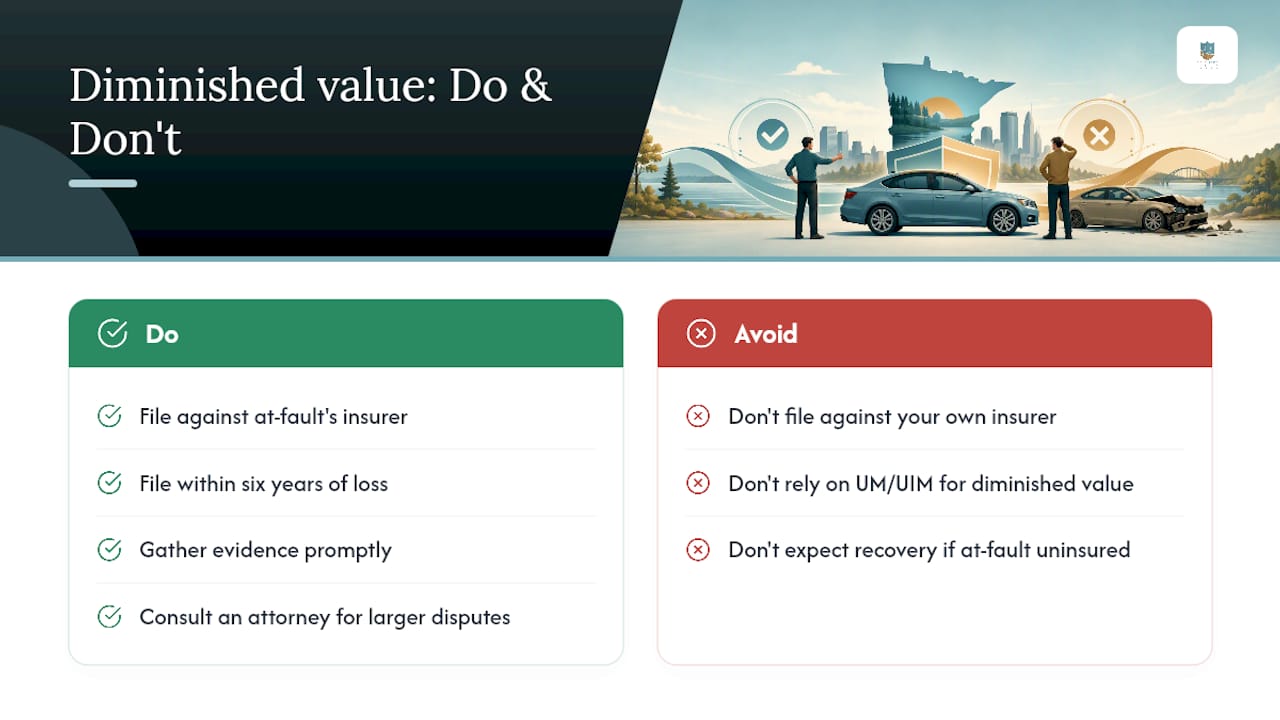
Minnesota drivers can claim diminished value, but only through the at-fault driver’s liability insurer, not through their own collision or UM/UIM coverage. State law treats this as a third-party property damage claim, measured under the Restatement of Torts approach from O’Connor v. Schwartz. You have six years from the date of loss to file, per Minnesota’s statute of limitations.
Pro Tip: File your claim early even with six years on the clock. Comparable-sales data used to prove market loss gets harder to reconstruct the longer you wait.
Before doing anything else:
Confirm the other driver actually carries liability coverage.
Preserve the police report, repair invoices, photos, and a vehicle history report from a source like CARFAX.
Consider ordering an independent diminished-value appraisal before you contact any insurer.
Key Takeaways
Minnesota drivers can recover diminished value from an at-fault driver’s liability insurer, but the claim depends on solid comparable-sales evidence and a timely demand.
Point | Details |
Third-party claims only | Minnesota generally pays diminished value through the at-fault driver’s liability insurer, not your own collision or UM/UIM coverage. |
Six-year filing window | Minnesota’s statute of limitations gives you six years, but gather evidence early while comparable sales are fresh. |
Appraisals anchor the claim | A professional appraisal using local comparable sales typically costs $200 to $600 and carries more weight than insurer formulas. |
Watch for formula anchors | Insurers sometimes cite 17c-style formulas with no legal standing in Minnesota; a market-based appraisal counters that tactic. |
South Lake Agency Insurance Brokers helps you navigate | The brokerage explains which insurance lane applies, confirms coverage, and refers appraisers or attorneys when a claim needs one. |
Table of Contents
An agent’s view on Minnesota diminished value claims
Handling claim questions from Minnesota drivers, one pattern shows up constantly: people assume their own policy will pay diminished value. It usually won’t. Minnesota gives you six years to build a case, but pull comparable-sales evidence right after the crash while local listings still reflect the market. If the at-fault driver was uninsured, there’s often no fallback for diminished value at all, and comparative-fault findings can shrink whatever recovery remains.
How South Lake Agency Insurance Brokers can help after an accident
South Lake Agency Insurance Brokers isn’t an appraisal firm or a law office, but as an independent brokerage working with 20+ carriers across Minnesota, we can help you sort through the confusion that follows a crash. That starts with explaining which insurance lane actually applies to your situation and confirming what the at-fault driver’s policy covers before you spend money on anything else.

For a smaller claim on an older vehicle, a documented demand letter with repair invoices and comparable listings may be enough to settle. For a newer vehicle or a larger dispute, you’ll likely need a USPAP-grade independent appraisal and possibly an attorney if the insurer won’t budge. We can point you toward trusted independent appraisers when a claim calls for one, and we’ll help you gather and submit documentation to the at-fault carrier so nothing gets lost in translation.
If a diminished value situation has you rethinking your coverage, get an auto insurance quote and talk through your options with a licensed local agent.
Where to find Minnesota diminished value resources
Start with the legal basics: Minnesota’s six-year statute of limitations for property damage and the Restatement of Torts standard courts apply. The Minnesota Department of Commerce regulates insurer conduct and takes consumer complaints if a carrier acts in bad faith.
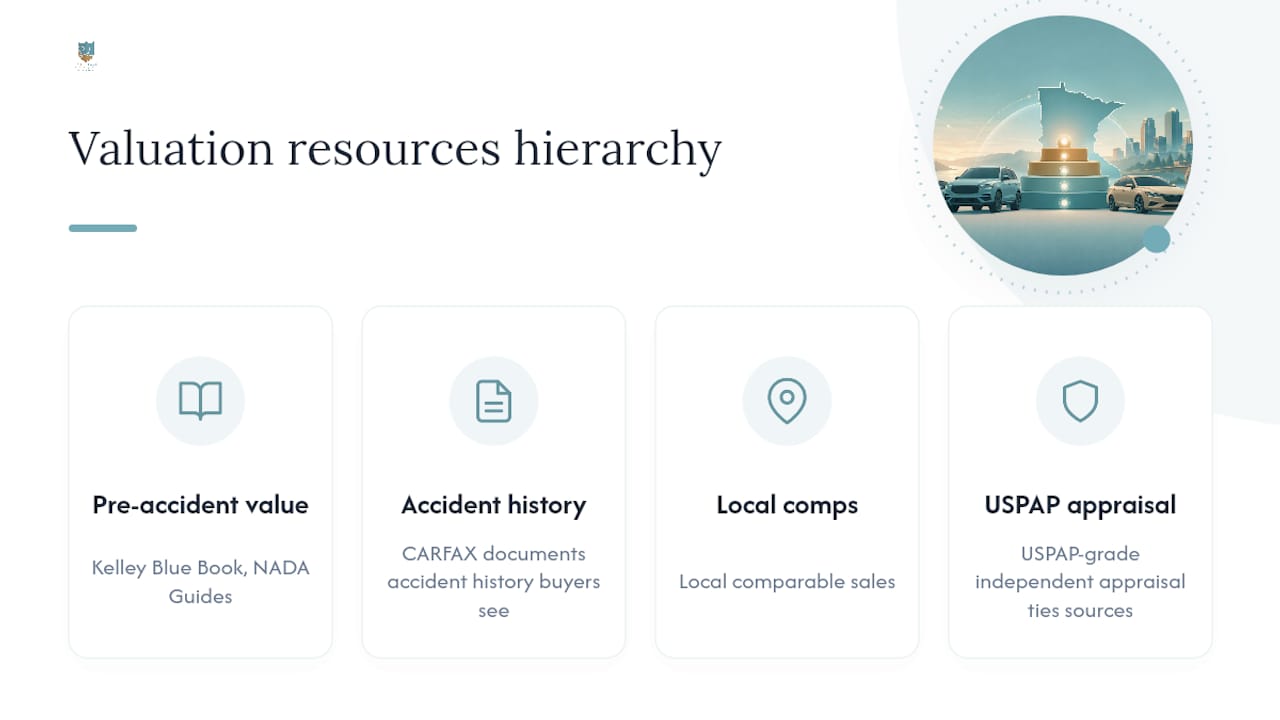
For valuation, Kelley Blue Book and NADA Guides establish pre-accident value, while CARFAX documents accident history that buyers will see. A USPAP-grade independent appraisal ties those pieces together with local comparable sales.
Smaller claims often fit conciliation (small claims) court; larger disputes head to district court. If you’d rather have a local broker walk through coverage questions first, reach out through South Lake Agency Insurance Brokers’s Saint Paul office or its greater Minnesota page.
Frequently asked questions about diminished value in Minnesota
Can I file a diminished value claim against my own insurer in Minnesota? Generally, no. First-party collision policies typically exclude diminished value, and Minnesota offers no UM/UIM backstop for it. Your claim almost always goes through the at-fault driver’s liability insurer.
How long do I have to file a diminished value claim in Minnesota? Minnesota allows six years from the date of loss to bring a property damage claim, though gathering evidence sooner produces a stronger case.
What if the at-fault driver has no insurance? Without liability coverage on the other side, there’s typically no path to recover diminished value, since Minnesota doesn’t treat it as a first-party benefit.
Do I need an attorney for a diminished value claim? Not always. Smaller, well-documented claims often settle through a demand letter and appraisal, or through conciliation court. Larger disputes or outright denials usually call for legal help.
This article is general information, not a substitute for advice from a qualified lawyer. Consult a qualified legal professional about your own circumstances before acting on anything here.
Sources
Recommended
Comments