




Roof Replacement Coverage: What Homeowners Need to Know

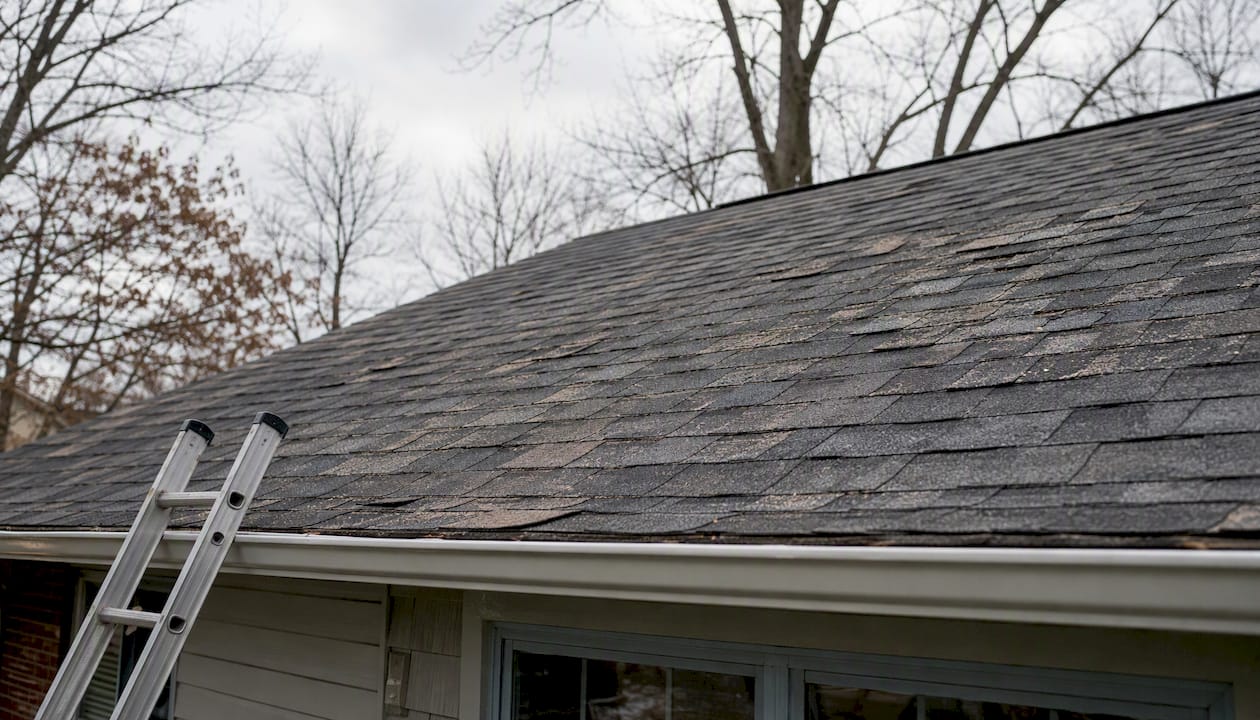
Most homeowners insurance policies pay for roof replacement only when a covered peril like wind, hail, fire, or vandalism causes the damage, not because a roof is old or worn out. How much you actually collect depends on whether your policy settles on replacement cost value (RCV) or actual cash value (ACV), plus your deductible and any roof-specific endorsements.
Before you call anyone, pull your declarations page and check three things:
Does it list your roof coverage as RCV or ACV?
Is there a separate wind/hail deductible?
Are there endorsements attached that could limit or expand your payout?
Then move fast:
Photograph the damage the day you find it.
Arrange a tarp or temporary repair to prevent further loss.
Call your agent or carrier to start the claim before debris gets cleaned up.
Key Takeaways
Roof replacement coverage depends less on the damage itself and more on whether your policy pays RCV or ACV, and on endorsements most homeowners never read.
Point | Details |
Verdict depends on peril | Wind, hail, fire, and vandalism trigger payouts; wear and tear and neglect do not. |
RCV vs ACV changes everything | ACV subtracts depreciation and can cut payouts to a fraction of replacement cost on older roofs. |
Recoverable depreciation has a clock | Complete repairs and submit receipts within your carrier’s window, often around a specific timeframe for repairs, to reclaim withheld funds. |
Matching coverage is often optional | Endorsements may fund replacing undamaged material, but limits and state rules vary widely. |
Get a broker to compare carriers | South Lake Agency Insurance Brokers reviews 20+ carriers to find RCV-eligible options for older roofs. |
Where to Read More on State Rules and Roof Coverage
Check your state insurance department’s roof coverage guidance for local rules.
Review state consumer roof insurance tips before filing.
Watch for post-storm contractor scams and verify credentials first.
Table of Contents
When a Homeowners Policy Pays for Roof Replacement
Insurers pay for roof replacement when damage traces to a covered peril named in your policy form, typically wind, hail, fire, lightning, or vandalism. Storm damage from a hailstorm that dents shingles and exposes the underlayment is a textbook accepted claim. A roof that simply wears out after 25 years of Minnesota winters is not, because that falls under wear and tear, which every standard policy excludes.
The declarations page is the document that actually controls your claim, not the marketing brochure your carrier mailed you at signup. It states your dwelling coverage limit (Coverage A), your deductible structure, and whether roof damage settles on RCV or ACV.
Two quick comparisons:
Accepted: A wind event tears off shingles and an adjuster confirms wind speeds matched storm data for your area.
Denied or limited: An inspector finds granule loss and curling shingles consistent with age, with no storm event tied to the damage.
The gap between those two scenarios is where most claim disputes live.
Why Claims Get Denied or Reduced
Insurers deny or limit roof claims more often than homeowners expect, and the reasons usually fall into a short list.
Wear and tear. Gradual deterioration from sun, age, and weather cycles is excluded almost universally.
Deferred maintenance. Missing shingles you never fixed, clogged gutters causing water backup, or ignored flashing issues can void coverage entirely.
Pre-existing damage. If an adjuster finds evidence the damage predates your policy or a prior claim, expect a denial.
Age-triggered ACV conversion. Many carriers automatically shift older roofs from RCV to ACV once they hit an age threshold, commonly 10 to 20 years, often buried quietly in renewal paperwork.
A 6-year-old roof with hail damage typically gets a full RCV payout. An 18-year-old roof with the same hail damage on an ACV endorsement might get a check that barely covers a fraction of the job.
How Insurers Calculate Your Payout: RCV, ACV, and Matching
This is the section that determines whether you write a small check or a large one. Replacement cost value (RCV) pays what it costs to replace your roof with similar materials today, minus your deductible. Actual cash value (ACV) pays replacement cost minus depreciation, and depreciation on roofing typically runs 2.5% to 4% per year.
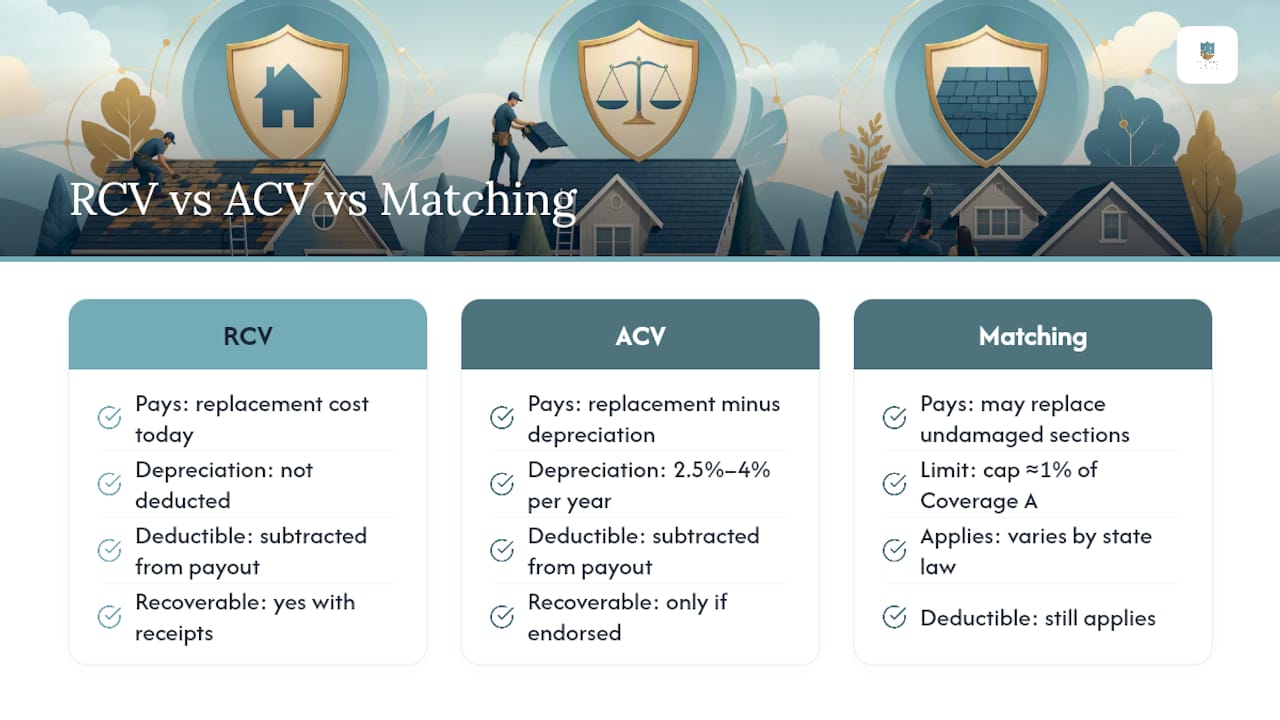
Picture a roof that costs a few thousand dollars to replace. Under RCV, minus the deductible, you’d likely see most of that cost reimbursed. Under ACV, with many years of depreciation stacked on top of the deductible, the check could shrink to a fraction of replacement cost.
If your policy carries recoverable depreciation, you can get that withheld amount back after the work is done. You typically have to complete repairs and submit contractor receipts within a set window, often around a specific timeframe for repairs, or the carrier keeps the depreciation permanently.
Then there’s matching. If your damaged shingles are discontinued and can’t be matched, a matching endorsement may require the insurer to replace undamaged sections too, though many carriers cap that benefit at around 1% of Coverage A. Whether this applies to you often comes down to your state’s rules, since matching requirements vary by state law and case precedent.
Pro Tip: Keep every contractor receipt and payment confirmation in a single folder from day one to understand potential home improvement tax deductions related to your roof repairs. Carriers releasing recoverable depreciation almost always ask for proof of completed, paid work before cutting that second check.*
What to Check on Your Declarations Page Before Filing
Five minutes with your policy documents can save you weeks of frustration later.
Confirm your Coverage A dwelling limit and whether it’s realistic for current rebuild costs in your area.
Identify your deductible type: flat dollar amount, percentage-based, or a separate wind/hail deductible that applies only to storm claims.
Verify whether roof coverage is listed as RCV or ACV, and note any age-based conversion language.
Look for a matching endorsement, an ordinance-or-law (code upgrade) endorsement, or a roof-only ACV rider, since these override your general dwelling terms.
If any of this is unclear, ask your agent for the exact policy form number and a copy of your endorsements schedule. Carriers rarely explain these in plain language on their own, and reviewing your policy each renewal cycle is worth building into a regular home insurance checkup.
How to File a Roof Replacement Claim, Step by Step
The sequence matters almost as much as the damage itself. Move through it in order:
Document the damage with photos and video, including timestamps.
Arrange temporary repairs, like a tarp, to prevent additional loss.
Contact your agent or carrier to open the claim.
Schedule the adjuster inspection.
Get two or three contractor estimates with line-item detail.
Complete repairs and submit receipts to recover any withheld depreciation.
When the adjuster arrives, a few habits protect your payout:
Ask directly whether the roof settles on RCV or ACV and request the depreciation schedule in writing.
Ask specifically about matching coverage and any ordinance-or-law provisions before assuming they don’t apply.
Avoid speculating about cause or age of the roof; stick to facts and let the inspection findings speak.
Insist contractor estimates break out material, labor, and code-upgrade costs separately, since vague lump-sum estimates give carriers room to lowball you.
Watch for post-storm contractors offering “free inspections” out of nowhere. The Better Business Bureau warns these frequently lead to pressure tactics or inflated quotes, so verify licensing and check BBB ratings before signing anything.
When an Independent Broker Can Untangle a Roof Claim
Some roof claims are simple. Others involve a matching dispute, a surprise ACV conversion, or an insurer that’s genuinely wrong about your policy terms, and that’s when outside help pays for itself.
An independent broker can:
Review your policy language and flag endorsements you didn’t know existed.
Advocate directly with the carrier if a settlement looks unreasonably low.
Point you toward carriers that still offer RCV coverage on roofs 15 years or older, since not every insurer converts at the same age.
Coordinate paperwork between your contractor and the claims adjuster so nothing falls through the cracks.
Call a broker when the gap between your estimate and your ACV check feels too large to explain, or when a carrier denies a matching claim you believe your state supports.
A Note on Trust and Experience
Roof claims get contentious because the stakes are financial and the rules are buried in fine print. Helping homeowners decode declarations pages and push back on lowball settlements is core to what an independent brokerage does daily. South Lake Agency Insurance Brokers works across 20+ carriers, maintains a 97.3% client renewal rate, and has earned over 337 five-star reviews from homeowners navigating exactly these situations.

Get a Free Roof Coverage Review From South Lake Agency Insurance Brokers
South Lake Agency Insurance Brokers gives you something a single-carrier agent can’t: a side-by-side look at 20+ insurers to see which ones still offer RCV on your specific roof age, instead of just accepting whatever your current carrier quietly switched you to at renewal.

If you’re staring at a declarations page full of terms like “ACV endorsement” or “matching coverage” and none of it makes sense, that’s exactly the kind of question a broker answers in one phone call, at no cost to you since South Lake Agency Insurance Brokers doesn’t charge broker fees. New homeowners can also start with the homebuyer insurance guide to make sure roof coverage was set up correctly from day one.
Bring your declarations page to a consultation and get a homeowners insurance quote that compares your current roof terms against carriers who might offer better RCV protection for the same premium or less.
Frequently Asked Questions
Does homeowners insurance cover a roof replacement due to age? No. Age-related deterioration falls under wear and tear, which nearly every policy excludes regardless of how the roof looks or how long it’s been since installation.
What’s the difference between RCV and ACV for roof claims? RCV pays what it costs to replace your roof today, minus your deductible. ACV subtracts depreciation on top of that, which can significantly shrink the check on a roof older than 10 to 15 years.
Can I get my depreciation back after an ACV settlement? Only if your policy includes recoverable depreciation. You’ll generally need to complete repairs and submit paid receipts within the carrier’s stated window to collect the withheld amount.
What is matching coverage, and do I have it? Matching coverage, when included as an endorsement, can require your insurer to replace undamaged materials so your roof or siding looks uniform when identical products are unavailable. Check your declarations page and endorsements schedule to confirm whether you carry it.
Should I talk to a broker before filing a roof claim? It helps most when your policy terms are unclear, you suspect an ACV conversion happened without your notice, or a matching dispute arises. A broker can review your coverage and advocate with the carrier on your behalf.
This article is general information, not a substitute for advice from a qualified financial advisor. Consult a qualified financial professional about your own circumstances before acting on anything here.
Sources
Recommended
Comments