




Term vs Whole Life: Which Policy Fits Your Plan?

Updated: Aug 13

For most people who need affordable, temporary protection, term life is the right call. Whole life makes sense when you need coverage that never expires, a guaranteed death benefit regardless of when you die, and a tax-advantaged cash-value component built into the same policy.
Here’s the short version before we go deeper:
Term life usually wins when you:
Have a young family and a mortgage to protect on a tight budget
Need coverage for a specific period (20 years until the kids are grown, 30 years until retirement)
Want maximum death benefit per dollar of premium
Whole life usually wins when you:
Support a lifelong dependent (a child with a disability, for example) who will need coverage regardless of when you die
Have an estate-tax exposure and want to fund an irrevocable life insurance trust
Want a forced-savings vehicle with guaranteed, tax-deferred growth alongside permanent coverage
The sections below walk through how each policy works, a side-by-side comparison table, real cost examples, the “buy term and invest the difference” debate, a decision framework, and the tax rules that really matter.
Table of Contents
How term life insurance works
Term life insurance is temporary coverage for a fixed number of years. If you die during the term, your beneficiaries receive the death benefit. If you outlive the term, the policy simply ends with no payout and no cash returned (unless you added a return-of-premium rider, covered in Section 8).

Standard term lengths and underwriting
Most carriers offer terms of 10, 15, 20, or 30 years. A term length commonly chosen by families with young children or a new mortgage is two decades. Underwriting ranges from full medical exams (which unlock the best rates) to simplified-issue options that skip the exam but cost more and cap coverage amounts.
A simple example
A healthy 35-year-old non-smoker buys a 20-year level-term policy with a substantial death benefit. The premium remains fixed for the entire term. If death occurs during the term, the beneficiaries receive the death benefit income-tax-free. If they’re alive at year 20, the policy ends. At that point, they can:
Let it lapse (most common)
Renew annually at much higher, age-rated premiums
Convert to a permanent policy if a conversion rider is in place
Convertibility matters more than most buyers realize
A conversion rider lets you switch from term to a permanent policy without new medical underwriting, usually up to a specified age or within a set window. That rider is worth having even if you never use it. Getting sick at age 48 and losing your insurability is exactly when you’d want the option to convert.
Level-term locks in the same premium and death benefit for the full term. Best for most buyers.
Annually renewable term (ART) starts cheap but reprices every year. Useful for very short-term needs only.
Convertible term adds the conversion option. Worth the small premium difference.
Pro Tip: If you’re buying term primarily for income replacement, choose a 20- or 30-year level-term with a conversion rider. The conversion window gives you a safety net if your health changes before you’ve built enough assets to self-insure.
How whole life insurance works
Whole life is permanent life insurance. As long as you pay the premiums, the policy stays in force for your entire life and pays a guaranteed death benefit whenever you die, whether that’s at 55 or 95.

The cash-value component
Every premium payment splits into two buckets: the cost of insurance and a cash-value contribution. That cash value grows at a guaranteed minimum rate set in the contract. At mutual insurers, the policy may also earn annual dividends based on the company’s actual mortality experience, investment returns, and expense management. Dividends are not guaranteed, but many large mutual insurers have paid them for over a century. When dividends buy paid-up additions, they generate their own dividends, compounding the effect over decades.
Accessing cash value: loans vs. withdrawals
You can access cash value two ways, and the distinction matters for taxes:
Policy loans: Treated as debt from the insurer. Generally tax-free as long as the policy stays in force and isn’t classified as a Modified Endowment Contract (MEC). Unpaid loan balances reduce the death benefit dollar for dollar.
Withdrawals: Amounts above your cost basis (total premiums paid) are taxable as ordinary income. If the policy is a MEC, even loans can trigger taxes and a 10% penalty.
The MEC warning
A policy becomes a Modified Endowment Contract when you fund it too aggressively relative to the death benefit, violating IRS limits under IRC Section 7702. Once classified as a MEC, the tax treatment changes permanently: distributions are taxed on a last-in, first-out basis, and pre-59½ withdrawals face a 10% penalty. Avoid this by not overfunding in the early years without guidance.
Practical illustration of cash-value growth
Cash value builds slowly at first. In the early years, surrender charges and insurance costs eat into the accumulation. By year 10–15, the compounding effect becomes meaningful. By year 30, a well-structured whole life policy can hold substantial cash value relative to premiums paid, though a well-performing equity portfolio will generally outpace it in raw return terms. The trade-off is the guaranteed death benefit and the tax-deferred growth, which no investment account replicates.
When whole life fits best:
Lifelong dependent care (the coverage can’t expire)
Estate planning and trust funding
Guaranteed final-expense coverage for older buyers
Supplemental tax-deferred savings for high earners who’ve maxed other vehicles
Term vs whole life: key differences at a glance
Dimension | Term Life | Whole Life |
Coverage duration | Fixed term (10–30 years); expires | Permanent; covers your entire life |
Premiums | Low and level for the term | Higher; fixed for life |
Cash value | None | Builds tax-deferred; accessible via loans or withdrawals |
Death benefit guarantee | Paid only if death occurs during the term | Guaranteed as long as premiums are paid |
Flexibility | Choose term length; add riders | Fixed structure; dividends can offset premiums |
Typical use cases | Income replacement, mortgage, education funding | Estate planning, lifelong dependents, forced savings |
Tax treatment | Death benefit income-tax-free; no cash-value component | Cash value grows tax-deferred; loans generally tax-free; MEC rules apply |
Convertibility | Often convertible to permanent (with rider) | N/A; already permanent |
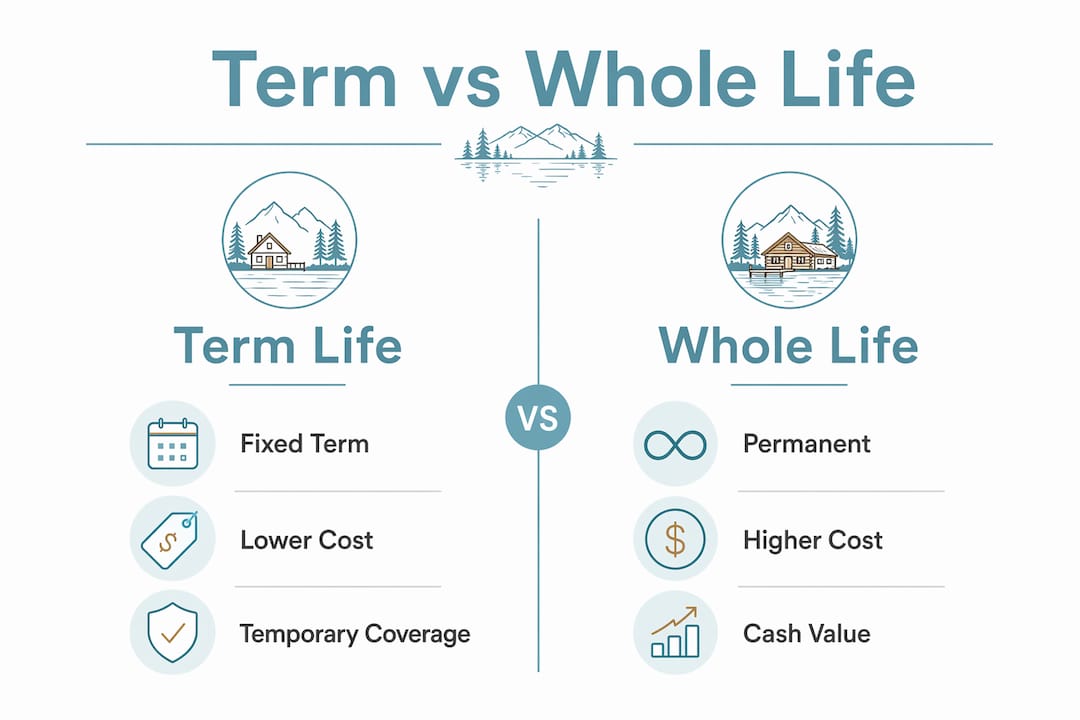
The dominant trade-off is straightforward: term gives you far more death benefit per dollar today, but whole life guarantees coverage forever and builds a cash asset alongside it. Which side of that trade-off matters more depends entirely on your situation.
How much does each type actually cost?
Cost is where the difference between term and whole life becomes concrete. For a 35-year-old, a 20-year term policy with a significant death benefit may cost substantially less per month than a comparable whole life policy, with whole life premiums being multiple times higher depending on sex and underwriting class.
The main cost drivers for both types:
Age: Premiums rise sharply with age. Buying at 30 vs. 45 can cut your term premium in half.
Health: Underwriting class (preferred plus, preferred, standard) drives rate differences of 30–50%.
Gender: Women typically pay less because of longer average life expectancy.
Coverage amount: Face value scales premiums proportionally.
Term length: A 30-year term costs more than a 10-year term for the same face amount.
Underwriting type: No-exam simplified-issue policies cost more than fully underwritten ones.
Sample cost comparison (approximate, for illustration)
Profile | 20-Year Term ($500K) | Whole Life ($500K) |
Healthy 35-year-old male | ~$40/mo | ~$545/mo |
Healthy 35-year-old female | slightly less than male | slightly less than male |
Healthy 45-year-old male | ~$90/mo | several times higher than term |
Figures are illustrative ranges based on published rate studies, such as MoneyGeek analysis. Actual quotes vary by carrier, underwriting class, and state. |
Figures are illustrative ranges based on published rate studies. Actual quotes vary by carrier, underwriting class, and state.
Whole life premiums are typically several times higher than term for the same death benefit. That gap is the engine behind the “buy term and invest the difference” argument.
How premiums behave over time
Term premiums stay level for the full term, then spike dramatically at renewal (if you renew at all). Whole life premiums are fixed for life, which is actually an advantage in later decades when you’re on a fixed income. At mutual insurers, dividends can eventually offset part or all of the premium, though that outcome depends on dividend performance.
Pro Tip: When comparing quotes, always request both a fully underwritten and a simplified-issue option. The exam version almost always wins on price, and the health check often comes back better than buyers expect.
The “buy term and invest the difference” debate
The argument is simple: buy a cheap term policy, take the $500/month you saved versus whole life, invest it in a low-cost index fund, and end up with more money than the whole life cash value would have produced.
The case for it
Over a 20–30 year horizon, a diversified equity portfolio has historically outpaced whole life cash-value growth in raw return terms. If you’re disciplined, the math often favors this approach. You also retain flexibility: you can adjust contributions, change investments, or access funds without affecting an insurance policy.
The case against it
Three things can break the model:
Self-discipline. Most people don’t actually invest the difference. The savings get absorbed into lifestyle spending.
Insurability risk. If your health deteriorates before the term ends, you may not qualify for new coverage at any price. Whole life eliminates that risk permanently.
Market timing near liquidity needs. If you need cash value at 60 and the market is down 30%, your “invested difference” is worth less than planned. Whole life cash value doesn’t drop with the market.
A practical hybrid: the laddering approach
Rather than choosing one or the other, independent experts commonly recommend a ladder: a larger term policy for the high-exposure years (mortgage, kids at home, income replacement) paired with a smaller permanent policy for final expenses, legacy, or a lifelong dependent. This hybrid strategy captures most of the cost efficiency of term while preserving permanent coverage where it genuinely matters.
Example: A 38-year-old with a $400,000 mortgage and two kids buys a 25-year $600,000 term policy plus a $100,000 whole life policy. The term covers the family’s peak financial exposure. The whole life covers final expenses and builds modest cash value for retirement supplementation.
Pro Tip: The hybrid ladder works best when the whole life piece is sized for a specific, permanent need, not as a general savings vehicle. Keep it small and purposeful.
How to decide which fits your situation
Work through these steps before you talk to a carrier or broker.
Define your coverage horizon. Do you need coverage for 20 years (until the mortgage is paid and kids are independent) or for the rest of your life (lifelong dependent, estate planning)? A temporary need almost always points to term.
Set a realistic monthly budget. What premium can you sustain for 20+ years without strain? If the whole life premium would require cutting retirement contributions, that’s a red flag.
Assess your insurability window. The younger and healthier you are, the more options you have. If you’re 50 with a health condition, a guaranteed-issue or simplified-issue permanent policy may be the only realistic path.
Identify permanent needs. Do you have a lifelong dependent? An estate likely to exceed federal estate-tax thresholds? A business buy-sell agreement? These are genuine cases for permanent coverage.
Run a needs calculation. Use a life insurance needs calculator to estimate the death benefit required for income replacement, debt payoff, and future obligations before comparing policy types.
Compare quotes across both types. Get at least three quotes for term and at least one whole life illustration from a mutual carrier. Look at guaranteed columns on whole life illustrations, not just projected figures.
Ask these questions before signing anything:
What is the conversion deadline and which permanent products can I convert to?
What are the surrender charges and in which years do they apply?
What is the guaranteed cash-value growth rate vs. the illustrated (non-guaranteed) rate?
What is the loan interest rate and is it fixed or variable?
Does the policy pay dividends, and what is the carrier’s dividend history?
Are there riders for waiver of premium, accelerated death benefit, or long-term care?
What is the AM Best or Moody’s rating of the carrier?
Watch for red flags. High early surrender charges (years 1–10), illustrations that rely heavily on non-guaranteed dividend assumptions, and “guaranteed” returns that are only guaranteed under specific funding scenarios are all signs to slow down and ask harder questions.
Alternatives worth knowing about
The term vs whole life choice isn’t binary. Several variations sit between or beside these two categories.
Universal life (UL): Permanent coverage with flexible premiums and an adjustable death benefit. Cash value earns interest at a declared rate (with a guaranteed floor, often 2–4%). The flexibility cuts both ways: underfunding can cause the policy to lapse.
Indexed universal life (IUL): Cash value growth is linked to a stock market index (like the S&P 500) with a floor (usually 0%) and a cap. Upside potential is higher than traditional UL; downside is protected. Complexity is high, and illustrations can be optimistic.
Guaranteed universal life (GUL): Permanent coverage with a guaranteed death benefit to a specified age (90, 100, 121) at premiums lower than whole life. Minimal cash-value accumulation. Good for buyers who want permanent coverage without the cash-value component.
Return-of-premium (ROP) term: If you outlive the term, you get all premiums back. Costs roughly 30–50% more than standard term. The math rarely beats simply investing the difference, but it appeals to buyers who hate the idea of “wasting” premiums.
Simplified-issue permanent policies: No medical exam required. Accessible for buyers with health issues, but premiums are higher and face amounts are typically capped.
Hybrid laddering combos: As described in the previous section, combining a large term policy with a small permanent policy replicates the practical benefits of both without fully committing to whole life premiums on the entire death benefit.
An independent broker can access all of these through multiple carriers, which matters because product availability and pricing vary significantly by company. Convertibility windows also differ by carrier, so if conversion is part of your plan, confirm the terms before buying.
Tax rules, policy loans, MECs, and estate planning
Life insurance has a favorable tax profile, but the rules have real teeth if you ignore them.
Death benefits
Death benefits paid to beneficiaries are generally income-tax-free. The exception is when the policy is transferred for value (sold or assigned for consideration), which can make a portion of the proceeds taxable. The income-tax exemption does not automatically mean the proceeds avoid estate tax.
Estate tax exposure
If you own the policy at death, the death benefit is included in your taxable estate. For large policies, this can push an estate over the federal exemption threshold and trigger estate tax. The common solution is an Irrevocable Life Insurance Trust (ILIT): the trust owns the policy, so proceeds pass outside the estate. Getting policy setup right from the start, including ownership and beneficiary designations, matters far more than most buyers realize.
Two-gate tax view
Advisors emphasize that income-tax rules and estate-tax rules operate independently. A death benefit can be income-tax-free to the beneficiary and still be included in the estate for estate-tax purposes. Ownership structure, not just beneficiary designation, determines estate inclusion.
Cash value and policy loans
Cash value grows tax-deferred inside the policy. You pay no annual tax on interest, dividends, or credited gains as they accumulate. Accessing that value via policy loans is generally tax-free as long as the policy remains in force and isn’t a MEC. Withdrawals above your cost basis are taxable as ordinary income.
MEC rules in plain terms
A policy becomes a MEC when it’s funded beyond IRS limits relative to the death benefit (the 7-pay test under IRC Section 7702). Once a MEC, all distributions, including loans, are taxed on a last-in, first-out basis, and pre-59½ distributions carry a 10% penalty. You can’t un-MEC a policy. Avoid it by not dumping large lump sums into a policy in the early years without confirming the 7-pay limit with your broker or advisor.
When to get professional help
For any policy with a face value above $1 million, an estate likely to exceed the federal estate-tax exemption, or a business-owned policy, consult a CPA and an estate attorney before purchasing. The stakes are too high for DIY.
This article is general information, not legal, tax, or financial advice. Confirm current IRS rules and estate-tax thresholds with a qualified professional for your specific situation.
Key Takeaways
Term life is the right starting point for most buyers with temporary needs and budget constraints; whole life earns its higher cost only when permanent coverage, cash-value accumulation, or estate planning is a genuine priority.
Point | Details |
Term for temporary needs | Term life covers a fixed period (10–30 years) at a fraction of whole life’s cost. |
Whole life for permanent needs | Whole life guarantees coverage for life and builds tax-deferred cash value alongside the death benefit. |
Cost gap is significant | A 35-year-old male might pay about $40/mo for term vs. about $545/mo for whole life at the same face amount (actual quotes vary by underwriting class and carrier). |
Laddering often beats either alone | Combining a large term policy with a small permanent policy covers peak exposure years and permanent needs without overpaying. |
Southlakemn shops 20+ carriers | An independent broker at Southlakemn compares both term and whole life across multiple carriers at no broker fee to you. |
A broker’s honest take on this decision
Most clients who come in asking about the term vs whole life question have already read enough to know the basics. What they actually need is someone to pressure-test their assumptions.
The most common mistake I see: buying whole life because it “builds value” without running the numbers on what that value actually costs relative to term plus investing. For a 35-year-old with a $300,000 mortgage and two kids, a 30-year term policy almost always serves the family better than a whole life policy at the same monthly budget. The death benefit is larger, the coverage lasts through the exposure window, and the premium savings can go toward a 401(k) or 529 plan.
But here’s where the conversation gets more interesting. About one in four clients has a situation where whole life genuinely earns its cost: a child with a disability who will need lifelong financial support, a business partner buy-sell agreement, or an estate large enough that a properly structured ILIT makes real tax sense. For those clients, buying term and hoping to convert later is a gamble. Locking in permanent coverage now, while they’re insurable, is the right call.
The estate planning mistakes I see most often aren’t about choosing the wrong policy type. They’re about buying the right policy with the wrong ownership structure, or waiting too long to buy and losing insurability. A broker’s job is to catch those things before they become expensive problems.
When I work through a case, I pull guaranteed columns on every whole life illustration, not projected ones. I compare the true net cost of insurance across at least three carriers. And I always ask: what happens to this plan if the client’s health changes in five years? The answer to that question usually determines whether a conversion rider is worth adding or whether a permanent policy belongs in the mix from day one.
How Southlakemn helps you find the right coverage
Shopping for life insurance across 20+ carriers on your own is time-consuming, and most people don’t know which carriers price favorably for their health profile or age bracket. Southlakemn does. As an independent brokerage, Southlakemn shops Banner Life, Protective Life, Pacific Life, and more than 20 other top-rated carriers to find the combination of price, conversion options, and carrier strength that fits your situation, with no broker fees charged to you.

The average client saves $2,246 by working with Southlakemn rather than going direct to a single carrier, and the 97.3% client renewal rate reflects what happens when people feel they got the right policy at the right price. Over 337 five-star reviews back that up.
Whether you’re leaning toward a 20-year term, a whole life policy for a lifelong dependent, or a hybrid ladder that covers both, the next step is a quote comparison. Request a life insurance quote from Southlakemn and get side-by-side options from multiple carriers in one conversation.
Further reading and authoritative sources
Fidelity: Term vs. Whole Life Insurance — Clear consumer-level explanation of how each policy type works and the core trade-offs.
Forbes Advisor: IRC 7702 and Tax Rules — Detailed breakdown of how the tax code governs life insurance cash value and MEC classification.
MoneyGeek: Term vs. Whole Life Cost Analysis — Sample premium comparisons and cost breakdowns by age and gender.
Paradigm Life: Policy Loan Architecture — Explains how policy loans work and how to preserve tax-advantaged status.
BetterWealth: Are Life Insurance Proceeds Taxable? — Covers the income-tax and estate-tax distinction for death benefits and ownership structures.
Northwestern Mutual: Term vs. Whole Life — Explains dividends, surrender charges, and how to read a whole life illustration.
Southlakemn: Life Insurance Needs Calculator — Use this tool to estimate your coverage amount before comparing term and whole life quotes.
IRS Publication 525 and IRC Section 7702 — Primary authority on MEC rules and the tax treatment of life insurance distributions. Consult directly or through a CPA for current thresholds.
Your state’s Department of Insurance — Regulates carrier licensing, complaint records, and policy form approvals. A useful first stop for verifying carrier standing in your state.
For MEC classification questions, estate-tax planning, or business-owned life insurance, consult a CPA and an estate attorney. The rules are specific to your situation and change with tax legislation.
Recommended
Comments