




How to Switch Insurance Mid-Term Without a Coverage Gap


You can switch insurance companies at any point during a standard auto or homeowners policy term. The one rule that protects you: secure the new policy first, then cancel the old one. Reversing that order creates a coverage gap, and even a single uninsured day can expose you to serious financial risk or trigger a lapse penalty on your next policy.
Before you do anything else, confirm these three things:
Whether your current insurer uses pro-rata or short-rate cancellation (this determines your refund amount)
Whether your lender or mortgage servicer requires advance notice of a policy change
Whether any active claims are open on your current policy
Pro Tip: Request a written cancellation confirmation from your current insurer the same day you activate the new policy. That document is your proof the old coverage ended on your terms, not theirs.
Key Takeaways
Switching insurance mid-term is safe and often financially smart when you follow the correct sequence: new policy active first, old policy canceled second, lender notified before the switch date.
Point | Details |
Sequence is everything | Secure the new binder before canceling the old policy to avoid any coverage gap. |
Refund method matters | Pro-rata returns the full unused premium; short-rate withholds a penalty. Ask your insurer which applies. |
Compare coverage, not just price | Lower premiums often mean lower limits or missing endorsements. Compare declarations pages line by line. |
Special cases need extra steps | SR-22 filers and escrowed policies require additional notifications before cancellation. |
South Lake Agency Insurance Brokers | Licensed agents compare 20+ carriers, coordinate with lenders, and manage the switch at no broker fee to you. |
Table of Contents
When does switching insurance mid-term actually make sense?
Not every reason to switch is equal. A mid-term policy change falls into one of two categories: an endorsement (a modification to your existing policy, like adding a driver or raising your dwelling limit), or a full carrier switch (replacing your insurer entirely with a new policy). Endorsements are routine and take effect immediately. A full carrier switch requires more sequencing.
Most U.S. auto and homeowners policies run on 6- or 12-month terms, and nearly all of them allow cancellation before the term ends. The practical triggers that make switching mid-term worth the effort:
A renewal notice arrives with a significant rate increase
A life event changes your coverage needs (marriage, new home, new vehicle, teen driver)
Your current insurer denied a claim you expected to be covered
You found substantially better coverage at the same price, not just a lower price for less coverage
Your insurer’s customer service has become a problem during an active issue
Timing matters beyond just picking a start date. If your home insurance is escrowed through your mortgage servicer, the servicer needs time to redirect premium payments. U.S. News guidance notes that insurers issue binders as temporary proof of coverage during the transition, and your declarations page from the current policy is the document a new insurer will use to match or beat your existing terms.
What happens to your money when you switch mid-term?
Your refund depends on which cancellation method your insurer uses.
Pro-rata returns the exact unused portion of your premium. If you paid $1,200 for a 12-month policy and cancel partway through, you get a refund for the unused portion, with no deductions under pro-rata cancellation.
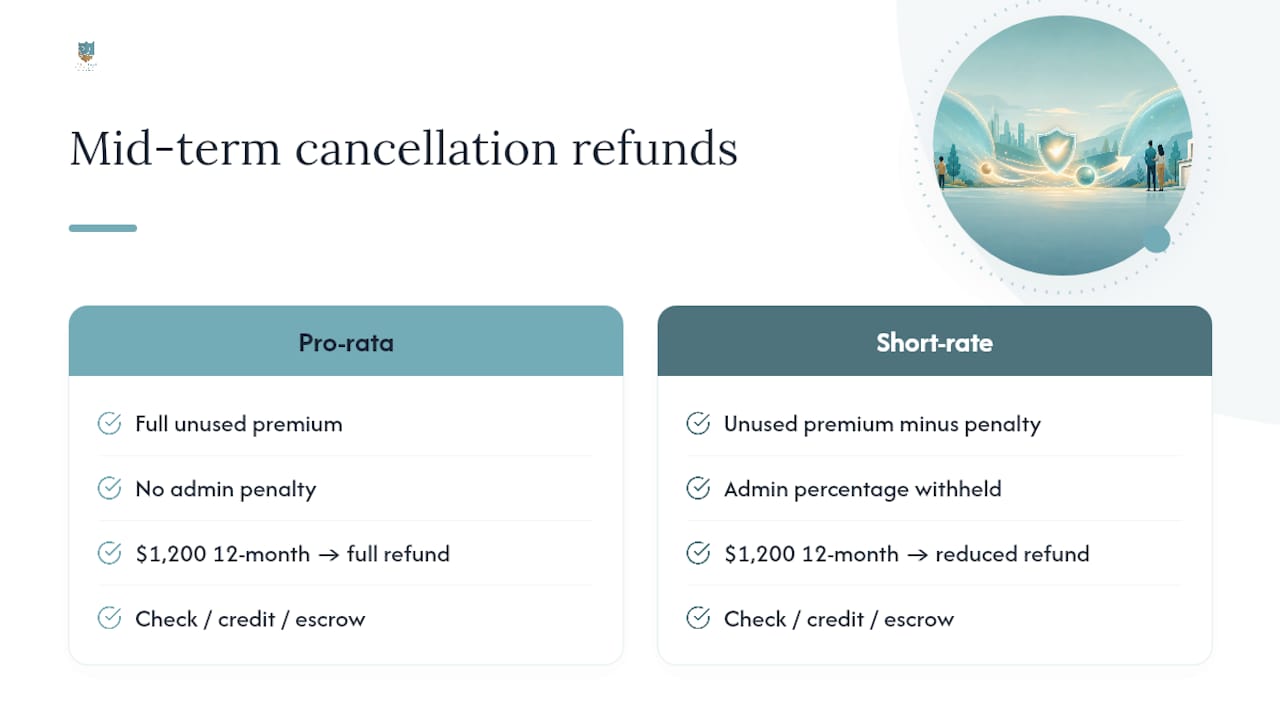
Short-rate applies an administrative penalty, typically a percentage withheld from the unused premium. The same $1,200 policy canceled partway through might return less than the full unused premium under a short-rate cancellation method that applies an administrative penalty. State law and your policy contract determine which method applies; some states prohibit short-rate cancellation entirely for consumer-initiated cancellations.
Refunds are issued as a check, a credit to your payment method, or routed directly to your mortgage escrow account if premiums were escrowed. Processing typically takes 10–30 days. If your escrow account receives the refund, your servicer may apply it to your escrow balance rather than sending you a check directly.
Pro Tip: Before switching, call your current insurer and ask specifically: “Do you use pro-rata or short-rate cancellation?” Get the answer in writing. That one question can affect your net savings calculation on a typical policy.
Loyalty discounts and multi-policy bundles complicate the math further. If you’re bundling home and auto with your current carrier, splitting them to switch one mid-term may raise the rate on the policy you keep. Run the combined numbers, not just the single-policy comparison.
What should you check before you switch?
Price is the easiest thing to compare and the easiest thing to get wrong. Lower premiums often reflect weaker coverage, not a better deal. Before committing to a new carrier, go line by line:
Coverage comparison items:
Dwelling or liability limits (are they identical or lower?)
Deductibles for standard claims vs. wind/hail events
Replacement cost vs. actual cash value for personal property
Endorsements: water backup, equipment breakdown, scheduled jewelry, umbrella attachment
Exclusions that your current policy covers but the new one doesn’t
Non-price factors:
Claims handling reputation (check your state’s Department of Insurance complaint ratios)
Underwriting differences that affect future renewals
Whether your no-claims discount transfers or resets with a new carrier
How the new insurer handles billing and automatic payments
Administrative items to prepare:
Notify your mortgage servicer before the switch date if premiums are escrowed
Confirm your lienholder is listed correctly on the new auto policy
Cancel automatic payments on the old policy only after written cancellation confirmation
Warning: Do not switch mid-term if you have an open claim on your current policy. Switching mid-claim can complicate the settlement and, in some cases, delay payment. SR-22 filers face an additional risk: if the new insurer doesn’t file the replacement SR-22 before the old policy cancels, your state’s DMV may suspend your license.
How to switch insurance mid-term without a gap: step by step
Follow this sequence exactly. The order is not optional.
Gather your current declarations page, VINs for all vehicles, mortgage/lienholder account numbers, and any SR-22 filing details.
Get quotes from multiple carriers using your current coverage limits as the baseline, not a lower limit that produces a cheaper quote.
Secure a binder from the new insurer before touching your current policy. A binder is temporary proof of coverage that protects you while underwriting finalizes.
Set the new policy’s effective date to the exact day you want the switch to happen, not a day later.
Cancel the old policy in writing, requesting written confirmation of the cancellation date and refund amount. This step always comes last.
Notify your lender or mortgage servicer with the new policy’s declarations page and binder. For escrowed home insurance, give your servicer at least 5–10 business days to update their records.
Track your refund and confirm it arrives within 30 days. If it doesn’t, follow up in writing.
Documents to have ready:
Current declarations page
Proof of most recent premium payment
Lienholder name, address, and loan number
SR-22 filing confirmation (if applicable)
New policy binder and effective date confirmation
Pro Tip: Screenshot or save every email and confirmation number from both insurers. If a billing dispute arises later, that paper trail resolves it in minutes.
Special situations that need a different approach
Some circumstances make a mid-term switch genuinely risky. Here’s how to handle the most common ones.
Situation | Risk | Correct Sequence |
Active claim on current policy | Settlement complications, delayed payment | Wait until the claim closes before switching |
SR-22 filing required | License suspension if filing lapses | New insurer files replacement SR-22; confirm DMV acceptance before canceling old policy |
Mortgage escrow pays premiums | Escrow shortfall or duplicate payment | Notify servicer first; confirm refund routing before cancellation |
Financed vehicle (lienholder) | Lender force-places coverage if gap detected | Provide new binder to lienholder before cancellation date |
For SR-22 situations specifically: the replacement filing must be accepted by your state DMV before you cancel the old policy. Confirm acceptance in writing from the DMV, not just from the new insurer.
Escrowed home insurance adds another layer. Your mortgage servicer controls the premium payment from your escrow account. If you switch without notifying them, they may pay the old insurer’s renewal anyway, creating a duplicate payment situation that takes months to unwind. Notify your servicer in writing, provide the new policy number and carrier contact, and ask them to confirm the update in writing before your switch date.
Pro Tip: For escrowed policies, call your servicer and your new insurer on the same day. Confirm both sides have each other’s contact information. One call prevents weeks of back-and-forth.
Switching mid-policy during an active claim is the scenario most likely to cause real financial harm. The old insurer handles the claim; the new insurer has no obligation to pick it up. If the claim is minor and nearly resolved, waiting two to four weeks is almost always the right call.
How South Lake Agency Insurance Brokers helps you switch safely
Switching carriers involves more moving parts than most people expect: binder timing, lienholder notifications, escrow coordination, SR-22 filings, and refund tracking. South Lake Agency Insurance Brokers handles all of it.
As an independent brokerage working with 20+ top-rated carriers, South Lake Agency compares coverage options across the market on your behalf, at no broker fee to you. Their licensed agents manage the paperwork, coordinate directly with mortgage servicers and title companies, and confirm effective dates so nothing falls through the cracks.
What clients get:
Coverage comparisons across 20+ carriers with no broker fees
Help securing a binder before the old policy cancels
Direct coordination with lenders and escrow companies
SR-22 replacement filing assistance
Average client savings can be significant
Client renewal rates are high and 337+ five-star reviews
Whether you’re switching auto insurance or homeowners coverage, the process is the same: one conversation with a licensed agent, and they handle the sequencing.
Pro Tip: If you’re also reviewing life insurance during a broader coverage overhaul, term life options are worth comparing at the same time. Bundling a full review into one conversation saves time and often surfaces additional savings.

A broker’s honest take on when to switch mid-term
There’s a version of this conversation I have regularly: someone calls frustrated after a rate increase, ready to cancel immediately. Sometimes that’s exactly right. Sometimes it costs them more than they realize.
Switch mid-term when your rate jumped at renewal without a claims history change, when a life event genuinely changed your coverage needs, or when your current insurer has failed you during a claim. Those are legitimate triggers, and the math usually works in your favor.
Wait when you have an open claim, when you’re within 60 days of renewal anyway, or when the “savings” come from lower limits rather than a better rate for the same protection. I’ve seen families switch to save $80 a month and discover at claim time that their new policy paid actual cash value instead of replacement cost. That’s a $15,000 difference on a kitchen fire.
The coordination piece matters too. When a mortgage or lienholder is involved, the sequencing has to be exact. Getting that wrong doesn’t just cause paperwork headaches; it can trigger a force-placed insurance policy from your lender, which costs significantly more than anything you’d have saved by switching.
South Lake Agency Insurance Brokers: compare 20+ carriers with no broker fee
Switching insurance mid-term is straightforward when someone manages the details for you. South Lake Agency Insurance Brokers gives Minnesota and select Midwest residents access to 20+ top-rated carriers, compares coverage options side by side, and handles lender coordination, binder timing, and escrow notifications, all at no broker fee.
Clients often save substantially and renew their policies at a high rate, backed by 337+ five-star reviews. Whether you need a homeowners insurance quote or want to compare auto coverage options before canceling your current policy, a licensed agent walks you through every step. Get your quote today at Southlakemn.
Sources
State insurance rules vary, particularly around short-rate cancellation, refund timelines, and SR-22 procedures. These sources let you verify the rules that apply to your specific situation:
If you’re switching because you’re moving between states, check both states’ Department of Insurance websites. Coverage requirements, minimum liability limits, and cancellation rules differ significantly across state lines.
Recommended
Comments