




No-Fault Insurance in Minnesota: What Drivers Must Know


Yes, Minnesota is a no-fault state. After a crash, your own auto policy’s personal injury protection (PIP) pays your medical bills, a portion of lost wages, and certain other economic losses first, regardless of who caused the accident. You do not need to prove the other driver was at fault to access these benefits.
Here is what to do immediately after a crash:
Get medical care first. Even if injuries seem minor, see a doctor and keep every record. PIP pays for accident-related treatment, but documentation is everything.
Notify your insurer promptly. Contact your own insurance company, not the other driver’s. PIP is a first-party benefit, meaning your policy responds first.
Preserve your records. Collect the police report, all medical bills, employer wage statements, and any receipts for services you could not perform because of your injuries.
Table of Contents
How no-fault insurance in Minnesota actually works
PIP is simple in concept: your policy pays certain losses after a crash without any need to establish who was at fault. If you rear-end someone on I-494, your own PIP covers your medical bills. If someone rear-ends you, your PIP still responds first for your losses. The at-fault driver’s liability coverage becomes relevant for losses that exceed your PIP limits or for damages PIP does not cover at all.
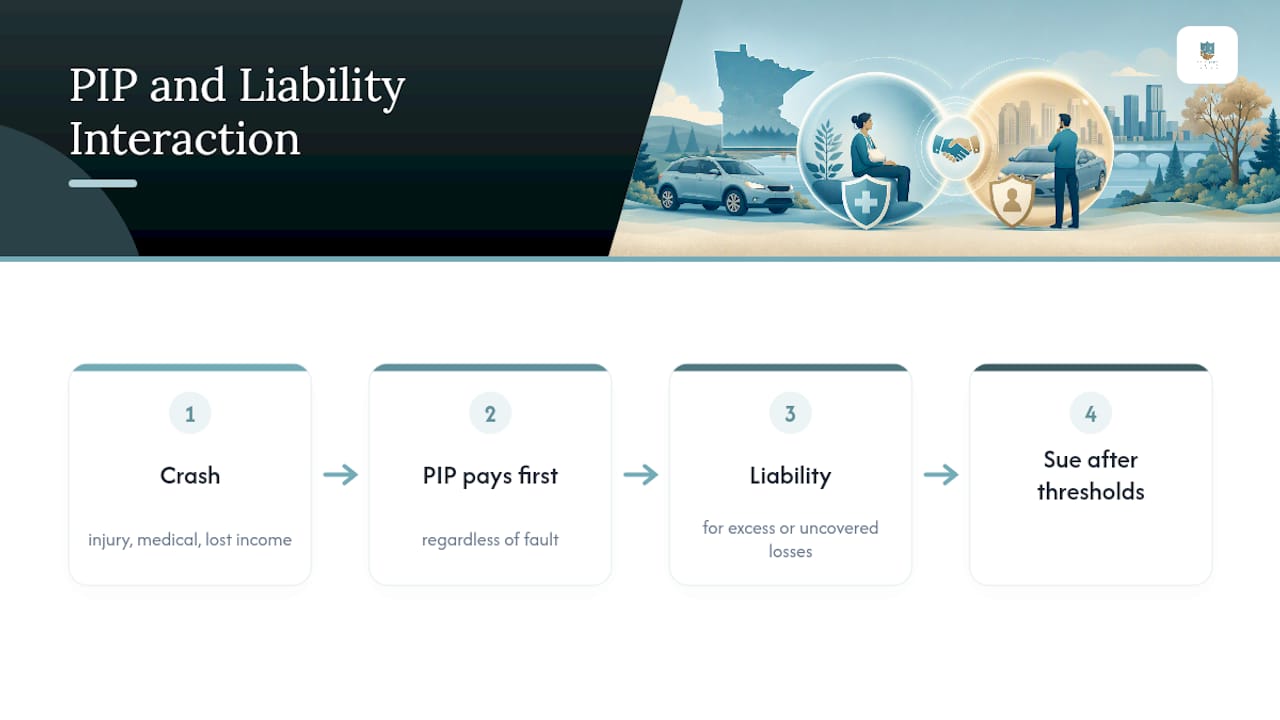
A quick example: two cars collide on Highway 36. Driver A runs a red light; Driver B is injured. Driver B’s PIP pays Driver B’s emergency room visit, follow-up care, and a portion of missed work income. Driver B does not need to wait for a fault determination or file against Driver A’s liability policy to get those benefits paid. That speed is the point of the no-fault system.
PIP is not a substitute for a liability claim when injuries are serious. Minnesota law lets injured drivers step outside the no-fault system and sue an at-fault driver once specific thresholds are met. That distinction matters practically, and it is covered in detail below.
Minnesota statutes that govern your PIP rights
Minnesota’s No-Fault Automobile Insurance Act is codified at Minn. Stat. §§ 65B.41 through 65B.71. The Act’s stated purpose is to ensure prompt payment of basic economic loss benefits without requiring injured people to prove fault first.
Several statutory definitions directly affect whether and how PIP applies to you:
“Motor vehicle” under the Act means a vehicle with four or more wheels designed for use on public roads. Motorcycles and vehicles with fewer than four wheels are excluded from the no-fault system.
“Insured” includes the named policyholder, household relatives, and in many situations lessees and permissive users of a covered vehicle.
“Maintenance or use” is the trigger phrase. PIP benefits apply to injuries arising out of the maintenance or use of a motor vehicle, a phrase courts have interpreted broadly to include loading and unloading in some circumstances.
Mandatory offer requirement: Under Minn. Stat. § 65B.49, insurers must offer basic economic loss (PIP) benefits on every policy covering a vehicle registered or principally garaged in Minnesota. You cannot waive this coverage.
If you want to track any legislative changes to these statutes, Minnesota legislative activity is publicly monitored and searchable.
What PIP covers and the limits that apply
Minnesota PIP covers four main categories of loss:
Medical expenses. Reasonable and necessary treatment for injuries caused by the accident, including emergency care, surgery, physical therapy, and prescription medication.
Wage loss. A portion of income lost because the injury prevents you from working. The statutory benefit is typically 85% of gross lost income, subject to a weekly maximum.
Replacement services. Costs for household tasks you cannot perform because of your injuries, such as cleaning, yard work, or childcare. This benefit is subject to a daily limit.
Funeral expenses. A death benefit and funeral expense coverage when a crash results in a fatality.
Minnesota consumer materials commonly present the basic PIP structure as separate medical and non-medical benefits for wage loss and replacement services, with typical coverage amounts referenced in consumer guidance. The Minnesota Department of Commerce auto insurance guide summarizes these required minimums and the components of a standard policy.
Pro Tip: If your medical bills approach the $20,000 PIP medical limit, that is often the practical signal that your injuries may meet the threshold to pursue a liability claim against an at-fault driver. Talk to a broker or attorney before your PIP runs out, not after.
When you can step outside no-fault and sue an at-fault driver
Minnesota’s no-fault system limits your right to sue for pain and suffering in most crashes, but it does not eliminate that right. You can step outside the no-fault system and pursue a liability claim against an at-fault driver when any one of these thresholds is met:
Medical expense threshold. Your reasonable medical expenses exceed a statutory dollar amount (set by the No-Fault Act and periodically adjusted).
Disability threshold. Your injury causes disability for at least 60 days.
Permanent injury or disfigurement. The crash causes permanent injury, permanent disfigurement, or death.
Once you cross one of these thresholds, you can claim non-economic damages, including pain and suffering, emotional distress, and loss of enjoyment of life, directly from the at-fault driver’s liability policy. PIP benefits you already received offset what you can recover, so the liability claim covers the gap above what PIP paid, not a double recovery.
A practical example: a driver suffers a herniated disc requiring surgery and misses three months of work. Medical bills exceed the threshold. That driver can file a liability claim against the at-fault driver for pain and suffering, future medical costs, and additional wage loss beyond what PIP covered. The controlling sections are found within Minn. Stat. §§ 65B.41–65B.71.

Which vehicles and situations Minnesota no-fault rules cover
Not every vehicle or situation falls under the no-fault system. The most common questions:
Motorcycles are excluded. Minnesota’s No-Fault Act does not apply to motorcycles or vehicles with fewer than four wheels. Motorcycle riders injured in crashes must pursue fault-based claims.
Commercial vehicles. Trucks and commercial vehicles are generally covered when registered in Minnesota, but specific policy terms and endorsements matter. Verify coverage with your broker.
Leased vehicles. Lessees are typically treated as insureds under the Act, so PIP applies to a leased car the same way it applies to an owned vehicle.
Trailers. Trailers are generally excluded from the definition of motor vehicle for PIP purposes.
Out-of-state incidents. If a Minnesota-registered vehicle is involved in a crash in another state, Minnesota PIP may still apply depending on the policy terms and the other state’s laws. The reverse is also true: if you are driving a vehicle registered elsewhere in Minnesota, that vehicle’s home-state rules may govern.
Who counts as an “insured.” The named policyholder, household relatives, and permissive drivers of a covered vehicle are all typically covered. Passengers in a covered vehicle may also have access to PIP benefits under the policy.
How to file a PIP claim in Minnesota after a crash
Filing correctly and promptly protects your benefits. Follow these steps:
Seek medical treatment immediately. Go to the emergency room or your doctor the same day if possible. Delayed treatment creates documentation gaps that insurers scrutinize.
Report the crash to police when required. Minnesota law requires reporting crashes involving injury, death, or significant property damage.
Notify your own insurer promptly. Call your insurance company and tell them you were in an accident. PIP is a first-party claim, so you file with your own carrier.
Complete the application for PIP benefits. Your insurer will send you a formal application. Fill it out accurately and return it quickly.
Gather and submit documentation. Itemized medical bills, treatment records tied to the accident, employer wage statements, and receipts for replacement services are all required. The Minnesota Department of Commerce consumer page outlines what documentation insurers typically require.
Attend any required medical examination. Insurers may request an independent medical exam (IME) to evaluate the necessity of treatment. Refusing can jeopardize your claim.
Track all expenses and keep copies of everything. Lost wage calculations, mileage to medical appointments, and out-of-pocket costs all belong in your claim file.
If you were injured and no insurance policy is available to cover you, contact the Minnesota Automobile Assigned Claims Bureau (MAACB). MAACB is a statutory safety net that provides PIP benefits to eligible injured people when no private policy applies.
What PIP does not pay for and what else you should carry
PIP is not a complete safety net. It does not cover:
Vehicle damage. Collision coverage on your own policy pays for your car repairs. PIP covers people, not property.
Pain and suffering. Unless you meet a serious-injury threshold and file a liability claim, non-economic damages are not available through PIP.
Out-of-pocket costs not listed in the statute. Some incidental expenses fall outside PIP’s defined benefit categories.
Losses above the policy limits. Once PIP is exhausted, you are responsible for costs unless you have other coverage or a viable liability claim.
Coordination with health insurance: PIP pays first for accident-related medical expenses. Once PIP is exhausted, your health insurance typically picks up remaining costs, subject to its own deductibles and copays. If you have Medicare or Medicaid, coordination rules are more complex, and your insurer is required to follow federal guidelines on which payer goes first. Insurers may also seek subrogation, meaning they can recover PIP payments from a liable third party after settling your claim.
Coverages every Minnesota driver should carry beyond PIP:
Liability coverage above the state minimum protects you if you cause a crash that injures others.
Uninsured/underinsured motorist (UM/UIM) coverage pays when the at-fault driver has no insurance or not enough to cover your losses. This is one of the most underused protections in Minnesota.
Collision and comprehensive cover your vehicle regardless of fault.
Do PIP claims raise your insurance premiums?
Not automatically. A PIP claim filed after a crash where you were not at fault typically does not trigger a premium increase on its own, though insurer underwriting practices vary. Minnesota does not have a blanket prohibition on rate increases after not-at-fault claims, so your specific carrier’s rules matter.
Common triggers that can raise your rate:
Being found at fault in the accident
Filing multiple claims within a short period, regardless of fault
A pattern of claims that signals elevated risk to the underwriter
Fraud or misrepresentation on a claim
Pro Tip: Before filing a small PIP claim, ask your broker to run the numbers. If the claim amount is close to your deductible or the potential rate impact outweighs the benefit, paying out of pocket may be the smarter move. A broker who shops multiple carriers can also find you accident-forgiveness options before a claim hits your record.
Claim deadlines and the statute of limitations
Timing is one of the most common ways drivers lose PIP benefits they are entitled to. The key rules:
Six-month filing guideline. Under Minn. Stat. § 65B.55 and related sections, there is a six-month guideline for starting a PIP claim. Courts have held that late claims are not automatically denied, but only if the insurer cannot show it was prejudiced by the delay. Do not test this rule.
Statute of limitations for lawsuits. If you are pursuing a tort (liability) claim against an at-fault driver, Minnesota’s general personal injury statute of limitations applies. Consult an attorney promptly if you think you may have a lawsuit.
Practical effect of delay. Even when a late claim survives legally, delayed medical reporting creates gaps that insurers use to dispute whether treatment was accident-related. Early filing protects both your legal rights and your evidentiary record.
If you missed the six-month window, contact a broker or attorney immediately. Do not assume the claim is lost without getting a professional opinion first.
Common claim problems and how to avoid them
Myth vs. fact:
Myth: PIP pays for my car repairs. Fact: PIP covers bodily injury losses only. Vehicle damage goes through collision coverage.
Myth: I have to sue the other driver to get my medical bills paid. Fact: PIP pays regardless of fault. You file with your own insurer.
Myth: If I don’t feel hurt right away, I don’t need to file. Fact: Some injuries, like whiplash or soft-tissue damage, appear days later. See a doctor and file anyway.
Common processing problems:
Missing documentation. Insurers routinely delay or deny claims when medical records are incomplete or bills are not itemized. Submit everything in one organized package.
Late medical reporting. Treatment sought weeks after the crash is harder to tie to the accident. Insurers will question the connection.
Disputes over medical necessity. If an insurer denies a treatment as unnecessary, you can request an internal appeal. The Minnesota Department of Commerce handles consumer complaints and can intervene when insurers act improperly.
Pro Tip: The best evidence package includes: a police report, an accident scene photo, a same-day or next-day medical visit record, itemized bills from every provider, and a signed employer statement for wage loss. Collect these within the first week after the crash, not the first month.
Minnesota law also protects no-fault claimants from certain managed-care-style restrictions that insurers might otherwise try to impose through health plan contract terms, a protection codified within Minn. Stat. § 65B.44.
A local broker’s perspective on PIP limits and what actually matters after a crash
The clients who call after an accident and are in the best position are almost never the ones with the cheapest policy. They are the ones who sat down with a broker before the crash and asked two questions: “What happens if my PIP runs out?” and “What if the other driver has no insurance?”
Most Minnesota drivers carry the statutory minimum PIP limits and think they are covered. They are, until a serious injury pushes medical bills past $20,000 or a disability stretches past 60 days. At that point, the quality of their liability and UM/UIM coverage determines whether they recover financially or spend years managing medical debt.
Signs a claim needs broker or attorney involvement: the insurer has denied or delayed benefits without a clear explanation, medical bills are approaching PIP limits, the other driver was uninsured, or liability is genuinely disputed. In any of those situations, a broker can help you understand your policy’s full scope and connect you with the right resources, including MAACB when no policy is available. For complex liability or serious injury, an attorney who handles Minnesota no-fault cases is the right call.
Reviewing UM/UIM and liability limits at renewal costs nothing and takes 15 minutes. Discovering the gap after a crash costs far more.
South Lake Agency Insurance Brokers: get the right auto coverage for Minnesota roads

Minnesota’s no-fault rules are specific, and the difference between a $20,000 PIP limit and a properly structured policy with higher medical, UM/UIM, and liability coverage can be thousands of dollars after a serious crash. South Lake Agency Insurance Brokers shops auto insurance quotes across 20-plus top-rated carriers to find you the right combination of PIP limits, liability protection, and UM/UIM coverage, with no broker fees charged to you. The agency’s licensed agents serve drivers across Minnesota and can review your current policy, identify coverage gaps, and walk you through your options in plain language. Call or request a quote online to get a side-by-side comparison of your current coverage against what Minnesota roads actually demand.
Key Takeaways
Minnesota’s no-fault system means PIP pays your medical and economic losses first after any crash, but serious injuries that cross the statutory thresholds open the door to a full liability claim for pain and suffering.
Point | Details |
Minnesota is a no-fault state | Your own PIP coverage pays medical and economic losses first, regardless of who caused the crash. |
Basic PIP limits are modest | Standard coverage is $20,000 for medical and $20,000 for non-medical losses; buy-up options are available and often worth the cost. |
Serious injuries unlock liability claims | Crossing the disability, medical expense, or permanent-injury threshold lets you sue an at-fault driver for pain and suffering. |
File within six months | The statutory guideline under Minn. Stat. § 65B.55 protects your PIP benefits; late claims risk denial if the insurer can show prejudice. |
South Lake Agency Insurance Brokers | Shops 20-plus carriers with no broker fee to find Minnesota drivers the right PIP, liability, and UM/UIM coverage before a crash happens. |
Sources
Recommended
Comments