




New Construction Home Insurance: What Homebuyers Need

Updated: Aug 13

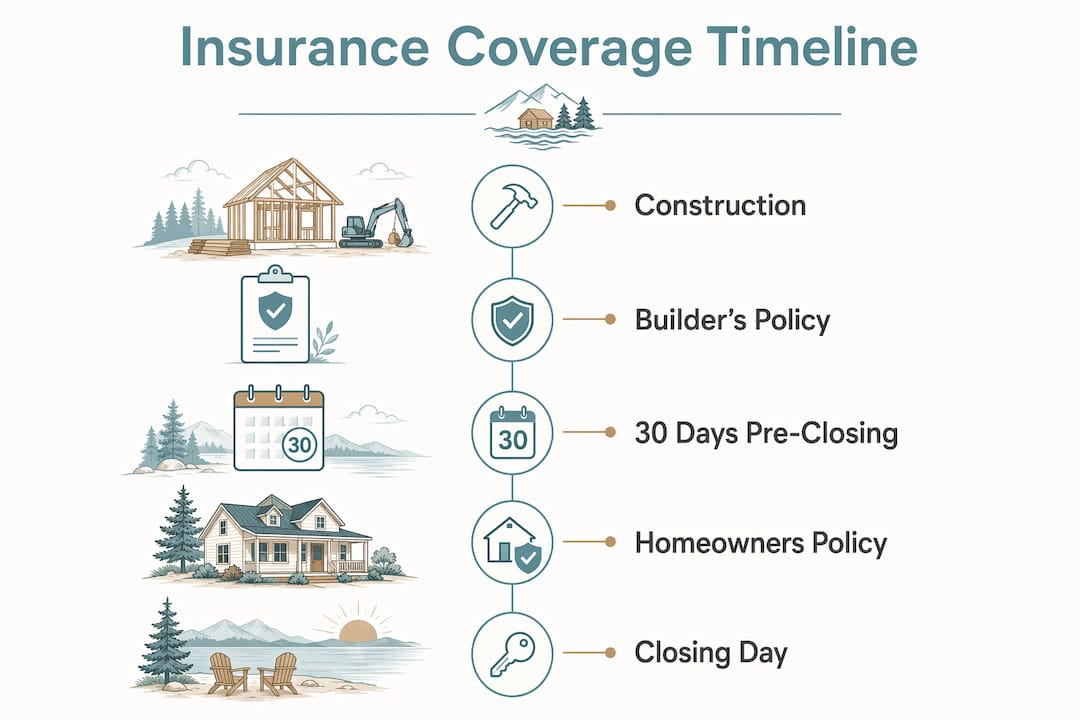
During construction, a builders risk policy (also called a course-of-construction policy) protects the structure and materials. Once you close and take ownership, you need a homeowners policy — typically an HO-3 or HO-5 — in place before the lender releases funds. Those are two separate policies, two separate timelines, and missing the handoff between them is the most common and costly mistake new-build buyers make.
Three actions to take right now:
Confirm whether your builder carries builders risk coverage and when it expires — get that date in writing.
Start shopping for a homeowners policy at least 30 days before closing so your agent can issue a binder on closing day.
Ask specifically about endorsements for sewer backup, service line protection, equipment breakdown, and ordinance or law coverage — standard policies often omit all four.
Quick rules:
A builder’s warranty covers workmanship defects. It is not insurance and does not cover fire, theft, or liability.
Your dwelling limit should be based on rebuild cost, not purchase price. Those two numbers are often very different.
Table of Contents
What new construction home insurance actually covers at each phase
To insurers and lenders, a “new build” is a home that has never been occupied or was completed within the past year or two. That distinction matters because the coverage you need shifts dramatically between the construction phase and the day you move in.
Builders risk insurance (also written as “course-of-construction” coverage) is a temporary policy that protects the physical structure, building materials on-site, and sometimes equipment during active construction. It is usually held by the builder or general contractor, though owners can purchase their own if the builder’s policy is thin or has gaps. The policy ends when construction is complete or when the home is occupied, whichever comes first.
Homeowners insurance (HO-3 or HO-5) takes over at closing. An HO-3 covers the dwelling on an open-perils basis and personal property on a named-perils basis. An HO-5 extends open-perils coverage to personal property as well, which matters if you’re moving high-value items into a brand-new home. Some insurers offer a “dwelling under construction” endorsement that can be added to an existing homeowners policy if you already own the land and are building, but this is less common than a standalone builders risk policy.
A builder’s warranty and a homeowners policy are not the same thing. A structural warranty covers workmanship and defects for a defined period. It does not cover fire, theft, storm damage, or liability — all of which a homeowners policy addresses from day one of occupancy.
Pro Tip: Ask your builder for a copy of their builders risk policy declarations page. Confirm the coverage limit equals the full projected build cost, not just the land value or a rough estimate.
What each policy covers and what it leaves out
The gap between what builders risk covers and what a homeowners policy covers is wide. Here’s how they compare:
Builders Risk | Homeowners (HO-3/HO-5) | |
Policy type | Temporary / construction phase | Permanent / post-occupancy |
Perils covered | Fire, wind, hail, theft of materials, vandalism, lightning | Fire, wind, hail, theft, vandalism, falling objects, water damage (sudden), and more |
Key exclusions | Liability, personal property, contractor negligence, flood, earthquake | Flood (separate policy), earthquake (separate), normal wear, intentional damage |
Policy term | Duration of construction (months to years) | Annual, renewable |
Who holds it | Builder/contractor or owner | Homeowner (required by lender) |
Typical endorsements | Off-site materials, soft costs | Sewer backup, service line, equipment breakdown, ordinance/law, flood |

Builders risk policies have meaningful gaps beyond the table. Theft of your personal belongings on-site is not covered — only building materials. If a subcontractor causes damage through negligence, that typically falls on the contractor’s general liability policy, not the builders risk policy. And if local building codes have changed since the original plans were drawn, the cost to bring the structure up to current code during a rebuild is usually excluded unless you add ordinance or law coverage.
Once you move in, a homeowners policy fills most of those gaps. It adds personal liability (if someone is injured on your property), personal property coverage, and additional living expenses if a covered loss makes the home temporarily uninhabitable. For significant construction projects, builders risk policies can also be written to include off-site materials and soft costs — confirm with your builder whether their policy covers those items or whether you need a supplemental owner’s policy.
When to buy each policy — a timeline that prevents gaps
The biggest coverage mistake at closing is not a wrong policy choice. It’s a timing error: the builder’s policy expires, the homeowners policy hasn’t started yet, and the home sits uninsured for days or weeks.
Before breaking ground:
Confirm the builder carries builders risk coverage for the full construction period.
Get the policy’s expiration date and the named insured in writing.
If you’re an owner-builder or the builder’s coverage is limited, purchase your own builders risk policy.
During active construction: 4. Keep your builder’s certificate of insurance on file. 5. Track any change orders or upgrades — these increase the rebuild value and may require a coverage limit adjustment. 6. If construction loan interest rates shift your timeline, update your broker so policy dates stay aligned.
30 days before closing: 7. Start shopping for homeowners insurance and request quotes based on rebuild cost, not purchase price. 8. Confirm your lender’s minimum coverage requirements (most require dwelling coverage equal to at least the loan amount or the rebuild cost, whichever is higher). 9. Ask your agent to prepare a binder — a temporary proof-of-insurance document — that can be issued on closing day.

At closing / move-in: 10. Verify the homeowners policy effective date matches the closing date exactly. 11. Confirm the lender is listed as the loss payee on the policy. 12. Collect all policy documents and store them with your closing paperwork.
Aligning your homeowners policy effective date with the day the builder’s insurance ends is the single most important timing step — agents often use a binder to guarantee coverage starts on closing day and satisfy lender requirements simultaneously.
How much does new construction home insurance cost?
New-build homes are genuinely cheaper to insure than older ones. New construction homeowners insurance averages about $2,379 per year for $250,000 in dwelling coverage (roughly $198 per month). Rates can be lower in some locations or with certain carriers, but the $2,379 figure is the most widely cited benchmark.
The age advantage is real. Insurers offer lower premiums for new construction because newer materials and updated systems reduce expected claim frequency, with some data showing rates roughly 34% lower for recently built homes versus much older ones. Rates typically increase as homes age beyond 10 years.
What drives your specific premium:
Rebuild cost and square footage. This is the dominant factor. High-end finishes, custom cabinetry, and smart-home systems all raise the cost to rebuild and therefore the dwelling limit.
Location risk. Flood zones (FEMA-designated), wildfire interface areas, and coastal wind corridors push premiums up significantly. Check FEMA’s flood map before you close.
Deductible structure. A flat dollar deductible (e.g., $1,000 or $2,500) is predictable. A percentage deductible (common in hurricane and hail zones) can mean a much larger out-of-pocket cost on a high-value home.
Credit score and claims history. Most states allow insurers to use credit-based insurance scores. A clean record and strong credit can meaningfully lower your rate.
Security and mitigation features. Central monitoring, fire suppression systems, storm shutters, and impact-resistant roofing all qualify for discounts at most carriers.
Builders risk insurance is priced differently. It typically costs between 1% and 5% of the total construction budget, so a $400,000 build could carry a builders risk premium anywhere from $4,000 to $20,000 for the construction period.
One critical point: new-build buyers frequently underinsure by setting dwelling limits to the purchase price rather than the rebuild cost. On a new construction, those numbers can be close — but upgrade costs, change orders, and local labor rates can push the true rebuild cost well above the contract price. Use a rebuild-cost estimator or ask your agent to run a replacement-cost valuation before finalizing your dwelling limit.
How new-build buyers save on premiums
New construction comes with a built-in pricing advantage, but there are additional ways to reduce what you pay without cutting coverage where it counts.
Common discounts for new builds:
New-construction discount. Many carriers apply this automatically, but confirm it’s included in your quote.
Multi-policy bundling. Combining home and auto insurance with the same carrier typically saves several hundred dollars annually. Bundling home and car insurance saves about $268 per year on average.
Security and monitoring systems. Central station monitoring, smart smoke detectors, and video doorbells all qualify at most carriers.
Claims-free discount. If you have no prior claims history, that’s a pricing advantage worth asking about explicitly.
Fire-resistant or impact-resistant materials. Metal roofing, fiber cement siding, and Class 4 impact-resistant shingles can each reduce your premium, sometimes substantially in hail-prone areas.
Pro Tip: Raising your deductible from $1,000 to $2,500 can cut your annual premium noticeably — but only do it if you have that amount liquid in an emergency fund. A deductible you can’t actually pay defeats the purpose of the policy.
For a deeper list of ways to trim your premium without sacrificing protection, the top 10 ways to lower your home insurance premium covers strategies that apply directly to new builds.
Endorsements your new build probably needs but may not have
Standard homeowners policies are written for average homes. Modern new builds — especially those with integrated smart systems, finished basements, and new municipal connections — often have exposures that fall outside the standard form. These are the endorsements worth discussing with your agent before you bind coverage.
Sewer and drain backup. Standard policies exclude water that backs up through a drain or sewer line. In suburban areas where new developments tie into aging municipal infrastructure, this is a real risk.
Service line protection. Covers the cost to repair or replace underground utility lines (water, sewer, electric, gas) between the street and your home. New construction means new lines, but they can still fail.
Equipment breakdown. Covers mechanical or electrical failure of built-in systems — HVAC, smart panels, integrated appliances. If your new home has a high-efficiency heat pump or a whole-home automation system, this endorsement is worth the modest additional premium. The rise of smart home systems has made this coverage increasingly relevant.
Ordinance or law coverage. If a partial loss requires rebuilding to current code, standard policies pay only to restore what was there. Ordinance or law coverage picks up the difference. On a new build, this matters most if local codes change between construction and a future claim.
Inflation guard / extended replacement cost. Construction costs have risen sharply. An inflation guard automatically adjusts your dwelling limit annually; extended replacement cost pays a percentage above your limit if rebuild costs exceed it at claim time.
Flood endorsement or separate NFIP policy. Standard homeowners policies exclude flood. If your new build is in or near a FEMA-designated flood zone, a separate flood policy through the National Flood Insurance Program or a private carrier is not optional.
Endorsement checklist to bring to your agent:
[ ] Sewer/drain backup
[ ] Service line protection
[ ] Equipment breakdown
[ ] Ordinance or law (code upgrade)
[ ] Inflation guard or extended replacement cost
[ ] Flood coverage (if applicable)
What documents lenders and insurers will ask for
Getting accurate quotes and satisfying your lender’s requirements both depend on having the right paperwork ready. Pulling these together before you start shopping saves time and prevents last-minute delays at closing.
Document checklist:
Builder contract (with total project cost and completion date)
Building permits and inspection records
Architectural plans or specifications
Certificate of occupancy (or projected issuance date)
Upgrade receipts and change orders (these affect rebuild cost)
Builder’s warranty documentation
Lender’s insurance requirements letter (specifying minimum coverage amounts and loss payee language)
Photos of the completed or in-progress structure
Set your dwelling limit to the rebuild cost, not the purchase price. Use a rebuild-cost estimator or ask your agent to run a replacement-cost valuation. Include change orders and upgrades — they add to the true cost to reconstruct the home and are frequently left out of initial estimates.
Questions to ask every carrier or agent when shopping:
Is coverage written on a replacement cost or actual cash value basis?
Does the policy include ordinance or law coverage, or is it an add-on?
Who is listed as the named insured, and can the lender be added as loss payee before closing?
What is the exact effective date, and can you issue a binder for the lender by closing day?
How do you handle a new address that your quoting system doesn’t yet recognize?
That last question matters more than most buyers expect. Insurers and quoting systems can lag for brand-new addresses — a broker can manually verify the address with an underwriter or issue a binder directly to prevent a missed closing deadline. It’s a surprisingly common problem on new developments where the street address was assigned only weeks before closing.
Pro Tip: Use a builder loan calculator to reconcile your total construction budget before requesting insurance quotes — knowing the final build cost makes it much easier to set an accurate dwelling limit.
How an independent broker simplifies coverage for new builds
Picture this: closing is scheduled for Friday morning. The builder’s policy expired at the end of the prior month. The lender needs a binder by Thursday afternoon or the closing gets pushed. A buyer working directly with a single carrier hits a wall when the carrier’s online system doesn’t recognize the new street address. An independent broker picks up the phone, calls the underwriter directly, and has a binder issued by end of business Thursday.
That scenario plays out regularly on new construction closings. Brokers who specialize in new builds know the pressure points and have the carrier relationships to resolve them quickly.
Here’s what Southlakemn brings to a new construction closing specifically:
Shops 20+ carriers to find the best combination of price and coverage for your specific build, location, and risk profile.
No broker fees. Southlakemn earns a commission from the carrier, not from you.
Coordinates directly with lenders and title companies to deliver binders, loss payee endorsements, and proof of insurance on the lender’s timeline.
Quotes specialty endorsements — sewer backup, service line, equipment breakdown, ordinance or law — as part of the initial quote, not as afterthoughts.
Resolves address recognition issues by working directly with underwriters when carrier systems lag behind new development addresses.
Southlakemn’s clients save an average of $2,379 per year and renew at a 97.3% rate — numbers that reflect what happens when someone actually shops the market on your behalf rather than defaulting to the first quote that comes back.
Key Takeaways
Builders risk covers the construction phase; a homeowners policy (HO-3 or HO-5) must be bound to start on closing day to prevent a coverage gap and satisfy lender requirements.
Point | Details |
Confirm builders risk holder | Get the builder’s policy expiration date in writing before construction starts. |
Bind homeowners policy at closing | Set the effective date to match closing day exactly; request a binder 30 days out. |
Use rebuild cost, not purchase price | Dwelling limits based on purchase price often underinsure; run a replacement-cost estimate. |
Add key endorsements | Sewer backup, service line, equipment breakdown, and ordinance/law are frequently omitted from standard policies. |
Use Southlakemn to coordinate | Southlakemn shops 20+ carriers, charges no broker fees, and handles lender binder coordination directly. |
What most new-build buyers get wrong at closing
The three mistakes I see most often are not exotic. Buyers set their dwelling limit to the contract price and discover at claim time that the rebuild cost is $80,000 higher. They skip ordinance or law coverage because it sounds abstract, then face a $30,000 code-upgrade bill after a partial loss. And they assume the builder’s policy is still active on closing day without verifying the expiration date.
The habit that prevents all three: write everything down. When you confirm the builder’s policy details, the binder date, and the effective date of your homeowners policy, put it in an email. That paper trail is what keeps a closing from turning into a coverage gap, and it’s what gives you leverage if there’s ever a dispute about when coverage started.
Southlakemn makes new construction coverage straightforward
Getting the right coverage for a new build involves more moving parts than a standard home purchase — two policy types, a precise timing handoff, lender requirements, and a list of endorsements most buyers don’t know to ask for. Southlakemn handles all of it.

As an independent broker licensed across Minnesota and select Midwest states, Southlakemn shops more than 20 top-rated carriers to find coverage that fits your build, your budget, and your lender’s requirements. There are no broker fees — ever. The agency coordinates binders directly with lenders and title companies, quotes specialty endorsements upfront, and resolves address recognition issues that stall closings. Clients save an average of $2,379 per year, and the 97.3% renewal rate reflects what consistent, attentive service actually looks like.
If you’re closing on a new build or currently in the construction phase, get a quote from Southlakemn before your closing date — not the week of.
This article is general information, not professional legal or insurance advice. Confirm current coverage requirements and policy terms with a licensed insurance professional for your specific situation.
Useful sources and further reading
NAIC (National Association of Insurance Commissioners) — The primary U.S. insurance regulatory body. Use it to verify state-specific requirements, consumer guides, and complaint data on carriers.
MoneyGeek — Homeowners Insurance Cost for New Construction — Detailed premium data by dwelling limit for new construction, including the $2,379 annual average for $250,000 in coverage.
Bankrate — Homeowners Insurance for New Construction — Covers rebuild-cost framing, the new-construction discount, and common mistakes buyers make at closing.
NerdWallet — Builder’s Risk Insurance: How It Works — Clear explanation of builders risk pricing (1%–5% of construction budget), what it covers, and how it differs from a homeowners policy.
Hippo — New Construction Home Insurance — Practical guidance on binder timing, effective dates, and coordinating coverage at closing.
South Lake Agency Blog — Related guides on homeowners insurance, coverage adjustments, and how to adapt your policy as your home and risk profile change.
How to adapt your homeowner’s insurance to a changing environment — Explains how climate and environmental risk affect coverage decisions for new and existing homes.
Recommended
Comments