




Insurance Binder for Closing: What Homebuyers Need

Updated: Aug 16

An insurance binder for closing is a temporary, legally binding proof of homeowners coverage your lender accepts at funding before the full policy is issued. If your closing date is approaching and the policy isn’t finalized yet, contact your insurance agent or broker now, request a binder, and ask them to deliver it directly to your lender and title company. South Lake Agency Insurance Brokers can arrange this same day in most cases. Binders commonly run 30–90 days, which is enough time to cover the gap between signing and policy issuance.
Table of Contents
What is an insurance binder and how does it differ from a declarations page?
What must a home insurance binder include to satisfy a mortgage lender?
Common reasons binders delay closing and how to prevent each one
Annotated sample binder text and a mortgagee clause template
How South Lake Agency Insurance Brokers helps buyers get valid binders
South Lake Agency Insurance Brokers can get your binder to the lender on time
What is an insurance binder and how does it differ from a declarations page?
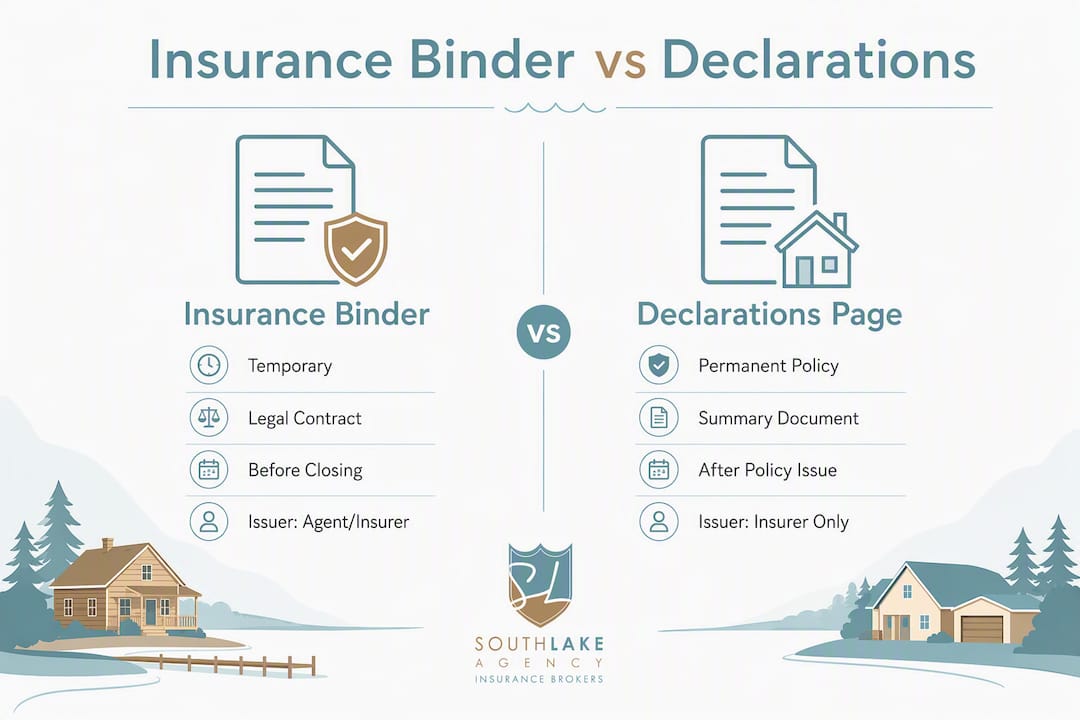
A binder is a temporary legal contract delivered by the insurer or an authorized agent before the permanent policy issues. It stands in for the full policy while underwriting is still pending, meaning you are covered from the moment the binder takes effect. Lenders accept it at closing because it carries the same legal weight as the policy for that window of time.
Only authorized agents or the insurer itself can legally issue a binder. An agent issues one under binding authority granted by the carrier; an insurer-issued binder comes directly from the company. Either way, the document is enforceable.
The declarations page (dec page) is different. It is a concise summary of an already-issued policy: policy number, coverage amounts, effective and expiration dates, and property location. The dec page lives at the front of your policy packet and is what lenders typically accept after the full policy has been issued. A binder comes first; the dec page follows.
Document | Purpose | Typical timing | Who issues it | Lender acceptance |
Binder | Temporary proof of coverage | Before policy issues | Agent or carrier | Accepted at closing when policy is pending |
Declarations page | Summary of issued policy terms | After policy issues | Carrier | Accepted once policy is active |
Full policy | Complete contract of insurance | Days to weeks after binding | Carrier | Accepted anytime |
The key practical difference: if your policy is already issued before closing day, you can hand the lender the dec page and skip the binder entirely. If underwriting is still in progress, the binder is what gets the deal funded.
What must a home insurance binder include to satisfy a mortgage lender?
Lenders check specific fields before they release funds. A binder missing even one of these will stall the closing. Here is every field your binder must contain, and why each one matters:
Named insured: Your full legal name, exactly as it appears on the purchase contract.
Property address: The insured property’s street address, including unit number if applicable.
Effective date and time: The date and exact time coverage begins. Most lenders require this to be on or before the closing date.
Expiration date: When the binder lapses. Confirm this extends past your expected policy issuance date.
Policy type: Homeowners (HO-3 is the most common form for owner-occupied single-family homes).
Dwelling coverage limit: The replacement cost value of the structure. Lenders typically require this to equal at least the loan amount or the full replacement cost, whichever is greater.
Deductible amounts: Both the standard deductible and any separate wind or hail deductible.
Covered perils: Confirmation of open-perils or named-perils coverage, as required by the lender.
Mortgagee / loss payee clause: The lender’s full legal name, address, and loan number. This is the field most likely to cause a delay if it is wrong.
Carrier name and identifier: The insurance company’s full legal name. Some lenders also request the NAIC code.
Agent contact information: Name, phone, and email so the lender or title company can verify coverage quickly.
Binder or authorization number: The reference number that ties the binder to the pending policy file.
Mortgagee clause: what it looks like and why lenders are strict about it
The mortgagee clause protects the lender’s financial interest in the property. A standard mortgagee clause reads:
“ISAOA/ATIMA” stands for “Its Successors and/or Assigns as Their Interests May Appear.” Lenders want this exact language because it protects them even if the loan is sold to another servicer. Get the lender’s exact legal name and address from your loan officer before your agent prepares the binder.

When do you actually need a binder for closing?
The short answer: you need a binder when the insurer cannot issue the full policy before your funding date. That gap is common. Underwriting can take days to weeks, and closing dates rarely wait for it.
The most common scenarios that trigger a binder request:
You are purchasing with a mortgage and the policy is still in underwriting.
You are refinancing and the new policy’s effective date hasn’t been confirmed.
Your existing policy renews after the closing date, creating a coverage gap.
The carrier needs an inspection before issuing the full policy.
If the carrier can issue the full policy before closing, you usually don’t need a binder at all. Hand the lender the dec page and you’re done. When that’s possible, it is often simpler. As a practical rule: ask your agent whether the policy will be issued before funding. If the answer is yes, request a future effective date on the full policy that matches closing day. If the answer is uncertain, request a binder immediately.
Lenders will also accept a dec page from an already-issued policy. The limitation there is timing: if the policy isn’t issued yet, there is no dec page to provide.
How to request and receive a binder before closing
Getting a binder is straightforward when you have the right information ready. Here is the process:
Choose your coverage and pay the first premium (or authorize payment). Most carriers require premium payment or a binding commitment before issuing a binder. Confirm with your agent whether a down payment or full first-term payment is required.
Provide property and mortgagee details. Give your agent the property address, the lender’s full legal name and address, the loan number, and the title company’s contact information.
Confirm the effective date. The binder’s effective date must be on or before closing day. If closing is scheduled for March 15, the binder should be effective no later than March 15 at 12:01 AM.
Request the binder and ask for direct delivery. Ask your agent to email the binder to both the lender and the title company. Do not rely on forwarding it yourself.
Verify receipt. Call or email the title company to confirm they received the binder at least 24 hours before closing.
Documents and information to have ready before you call your agent:
Signed purchase contract (shows closing date and property address)
Lender’s full legal name, mailing address, and loan number
Title company name and closing agent contact
Desired effective date
Prior policy information if you are replacing existing coverage
Email template to send your agent
How to read and verify your binder before closing
When the binder arrives, don’t file it away. Read it against this checklist before the closing date:
Effective date: Does it match or precede your closing date?
Expiration date: Does it extend past the expected policy issuance date?
Named insured: Is your name spelled exactly as it appears on the purchase contract?
Property address: Does it match the address on the closing disclosure?
Dwelling limit: Is it at or above the lender’s required minimum?
Mortgagee clause: Is the lender’s full legal name, address, and loan number correct? Does it include ISAOA/ATIMA?
Deductibles: Are both the standard and any wind/hail deductibles listed?
Carrier and agent contact: Are the insurer’s name and agent’s phone/email present?
Red flags that cause funding delays:
Wrong lender name or address in the mortgagee clause (the most common problem)
Dwelling limit below the loan amount or lender’s required minimum
Binder expiration date before the policy is expected to issue
Missing agent contact information
Effective date after the closing date
Treat the binder as if it were the policy itself. Experts advise verifying limits and deductibles and resolving any discrepancy immediately because the binder dictates coverage on closing day, not the policy that follows.
Common reasons binders delay closing and how to prevent each one
Most closing delays tied to insurance are preventable. Here are the problems that come up most often, and the fix for each:
Wrong mortgagee clause. The lender’s name is misspelled, the address is outdated, or ISAOA/ATIMA is missing. Fix: get the exact mortgagee wording from your loan officer in writing before your agent prepares the binder. Missing or incorrect mortgagee clauses are a top cause of funding delays.
Binder expires before the policy issues. Underwriting runs long and the binder lapses. Fix: track the binder expiration date and request an extension from your agent at least five business days before it expires.
Underwriting conditions not met. The carrier flags a roof age issue, a prior claim, or a property condition that requires inspection before binding. Fix: disclose property details upfront and ask your agent about common underwriting triggers like roof condition and prior loss history. Addressing these before the binder is issued prevents last-minute surprises.
Missing payment proof. The carrier hasn’t received premium payment and won’t issue the binder. Fix: pay the first premium or authorize payment before requesting the binder, and keep the payment confirmation handy.
Carrier cancels before policy issues. Underwriting declines the risk after the binder is issued. Fix: ask your broker to confirm that underwriting conditions are met before the binder is delivered to the lender. If a carrier declines, your broker should have a backup carrier ready.
Pro Tip: Ask your broker to send written confirmation of binder delivery to the title company and request the binder be emailed at least 24 hours before closing. A phone call is not enough. Written delivery creates a paper trail that protects everyone at the table.
If underwriting holds up the policy and your closing date is firm, ask your agent whether a closing extension is possible or whether rebinding with a different carrier is faster. Some mortgage underwriting timelines overlap with insurance underwriting, and a few extra days can resolve both.

How long does a binder last, and what replaces it?
Binders commonly run 30–90 days, but that range is an industry convention, not a federal rule. The carrier sets the expiration, and it varies. Some carriers issue 30-day binders; others go to 60 or 90 days. State insurance codes add another layer: cancellation notice rules and statutory form requirements differ by state, so confirm the exact expiration date with your agent rather than assuming.
When the full policy issues, it replaces the binder automatically. The carrier sends the policy documents and the dec page, which the lender will want on file. At that point, the binder is functionally retired.
If the binder is about to expire before the policy issues:
Contact your agent immediately and request an extension.
Confirm whether any outstanding underwriting requirements are holding up the policy.
Pay any remaining premium balance if that is the hold-up.
If the carrier declines the policy entirely, your broker should rebind with a new carrier and issue a fresh binder to the lender before the original expires.
One detail worth noting: the valuation basis on the binder (replacement cost vs. actual cash value) carries through to the issued policy. If the binder shows actual cash value and you intended replacement cost coverage, fix it before the policy issues. That distinction affects your settlement if you ever file a claim.
Annotated sample binder text and a mortgagee clause template
Here is a de-identified sample binder excerpt showing the fields a lender will check:
INSURANCE BINDERBinder Number: HO-2026-00412 Issuing Agent: [Agent Name], [Agency Name] Agent Phone/Email: (555) 000-0000 / agent@example.com
Named Insured: Jane A. Homebuyer Property Address: 4521 Maple Street, Phoenix, AZ 85001
Effective Date: March 15, 2026 at 12:01 AM Expiration Date: June 13, 2026 at 12:01 AM
Policy Type: HO-3 Homeowners Carrier: [Insurance Company Name]
Coverage Summary:
Dwelling (Coverage A): $425,000 replacement cost
Other Structures (Coverage B): $42,500
Personal Property (Coverage C): $212,500
Loss of Use (Coverage D): $85,000
Liability (Coverage E): $300,000
Medical Payments (Coverage F): $5,000
Deductibles:
All Peril: $1,000
Wind/Hail: $2,500
Mortgagee / Loss Payee: First National Mortgage Bank, ISAOA/ATIMA P.O. Box 12345, Phoenix, AZ 85002 Loan Number: 0098765432
Annotated callouts for each lender-checked field:
Binder number: Ties this document to the pending policy file. The lender uses it to verify coverage with the carrier.
Effective/expiration dates: Lender confirms effective date is on or before closing; expiration date must clear the expected policy issuance date.
Named insured: Must match the borrower’s name on the loan documents exactly.
Dwelling limit ($425,000): Lender checks this against the loan amount and required minimum. Replacement cost basis is preferred.
Mortgagee clause: The most scrutinized field. Lender verifies their exact legal name, address, and ISAOA/ATIMA language.
Deductibles: Both figures must be present. Some lenders cap the wind/hail deductible as a percentage of dwelling value.
Mortgagee clause template
Copy and paste this into your binder request to your agent, filling in the lender’s details:
Get the exact legal name and address from your loan officer. Lenders sometimes have multiple entities (the originating bank vs. the servicer), and the wrong name will require a correction before funding.
How South Lake Agency Insurance Brokers helps buyers get valid binders
South Lake Agency Insurance Brokers works with 20+ carriers and handles lender and title company coordination directly, which is the part most buyers find stressful. When you contact them before closing, they shop coverage options across carriers, confirm underwriting conditions are met, prepare the binder with the correct mortgagee clause, and email it to your lender and title company. They follow up until the full policy issues.
A few things that set the process apart:
No broker fees. South Lake Agency earns a commission from the carrier, not from you. You get full brokerage service at no added cost.
High client renewal rate. Most clients stay because the coverage and service hold up over time, not just at closing.
Significant savings per client. Shopping across numerous carriers produces notable price differences, especially for new homebuyers comparing their first policy.
Direct lender and title coordination. They send the binder to the right contacts, in the right format, before the deadline.
To get a binder issued quickly, have this ready when you contact South Lake Agency Insurance Brokers:
Signed purchase contract with closing date
Lender’s full legal name, mailing address, and loan number
Title company name and closing agent email
Property address and any known details (year built, roof age, square footage)
Desired effective date
Key Takeaways
A valid insurance binder for closing requires the correct mortgagee clause, a dwelling limit that meets the lender’s minimum, and delivery to the title company at least 24 hours before funding.
Point | Details |
Binder duration | Binders typically run 30–90 days; confirm the exact expiration with your carrier. |
Mortgagee clause | Include the lender’s full legal name, address, loan number, and ISAOA/ATIMA language. |
Delivery timing | Ask your agent to email the binder to the lender and title company at least 24 hours before closing. |
Binder vs. dec page | A binder is used when the policy isn’t issued yet; the dec page replaces it once the full policy is active. |
South Lake Agency | South Lake Agency Insurance Brokers shops 20+ carriers, handles lender coordination, and charges no broker fees. |
What most buyers get wrong about the binder
The binder gets treated like a formality. It isn’t. It is the legal document that governs your coverage on closing day, and if something goes wrong between signing and policy issuance, the binder is what your claim gets paid against.
The field I see cause the most last-minute chaos is the mortgagee clause. Buyers assume the agent has the lender’s correct information. Agents assume the buyer gave them the right details. Nobody confirms with the loan officer. The lender’s legal name on file is often different from the name on the website or the name the buyer typed from memory. That mismatch shows up at the title company the morning of closing, and suddenly everyone is scrambling to get a corrected binder issued and re-delivered before the wire goes out.
The fix is simple: get the mortgagee clause wording directly from your loan officer in an email, copy it character for character into your binder request, and ask the title company to confirm receipt 24 hours before funding. That one step eliminates the most common delay. Everything else on the checklist matters, but nothing causes more last-minute problems than a mortgagee clause that doesn’t match what the lender has on file.
Working with a broker who handles lender coordination as part of the process, rather than leaving it to the buyer to forward documents, removes most of the risk. It is a detail that sounds minor until it isn’t.
South Lake Agency Insurance Brokers can get your binder to the lender on time
Closing on a home with a mortgage means your lender needs proof of insurance before funds are released. South Lake Agency Insurance Brokers handles that process from start to finish: shopping coverage across 20+ carriers, preparing the binder with the correct mortgagee clause, and delivering it directly to your lender and title company. No broker fees, no chasing documents yourself.

Buyers who come prepared move faster. Before you reach out, pull together your purchase contract, your lender’s full legal name and mailing address, your loan number, and your closing date. That’s all the team needs to get started.
This article is general information, not legal or financial advice. Confirm current requirements with your lender, title company, or a licensed insurance professional.
Useful sources
Insurance Binder: Everything You Need to Know | Chase — Explains lender acceptance requirements and why mortgagee clause errors cause funding delays.
What is an insurance binder for a homeowners policy? | Rocket Mortgage — Covers when a binder is needed vs. a full policy and how underwriting timing affects the decision.
binder | Wex | LII / Legal Information Institute — Primary legal definition of a binder as a temporary insurance contract.
What is a Dec Page? | Office of Public Insurance Counsel — Explains the declarations page, what it contains, and when lenders accept it.
How to Prepare for Mortgage Closing: 2026 Guide — Practical closing checklist covering lender and title company expectations.
South Lake Agency Insurance Brokers — Independent brokerage offering homeowners insurance binders, lender coordination, and coverage across 20+ carriers with no broker fees.
Recommended
Comments