




High Value Home Insurance: What Affluent Homeowners Must Know


High value home insurance is specialized homeowners coverage sized to a property’s full replacement cost and to the collections, liability exposures, and custom features that standard policies routinely undervalue. Before you do anything else, take three steps: (1) verify your replacement-cost estimate with a professional appraisal, (2) schedule high-value items like jewelry, fine art, and wine collections separately, and (3) contact a specialist broker such as South Lake Agency Insurance Brokers to shop multiple carriers and confirm your limits are built for your actual home, not a median one.
Standard homeowners policies are written for median construction costs and median contents. A luxury home with hand-carved millwork, a wine cellar, and a guest cottage on two acres is a different underwriting problem entirely. Getting the coverage right starts with accurate valuation and a broker who has placed policies like yours before.
Table of Contents
Do high-value homes need a separate policy or just endorsements?
What core coverages should every high-value homeowner review?
How can you reduce premiums and meet underwriting requirements?
Why a specialist broker changes the outcome for luxury homeowners
South Lake Agency Insurance Brokers can secure your high-value coverage
What qualifies as a high value home for insurance purposes?
According to Forbes Advisor, most carriers set their threshold for high-value programs at a replacement cost of roughly $750,000 to $1,000,000, though the exact number shifts by carrier and region. That figure is replacement cost, not market price. A $900,000 home in a competitive real estate market might cost $1.4 million to rebuild from scratch with the same materials and craftsmanship.
Several factors push replacement cost well above what a standard estimating tool will calculate:
Custom finishes and millwork: Hand-carved cabinetry, plaster medallions, and imported stone tile cost far more to replicate than their mass-produced equivalents.
Artisan and specialist labor: Restoration plasterers, historic masonry contractors, and custom metalworkers charge rates that standard cost databases do not capture.
Historic elements: Homes with original architectural details may require salvage methods or period-appropriate materials that add significant cost.
Detached structures: Carriage houses, pool houses, and guesthouses each carry their own replacement value and are often underinsured on standard forms.
Acreage and site work: Retaining walls, landscaping, and private driveways are frequently excluded or sublimited.
Geography matters too. Coastal exposure, wildfire zones, and markets with a shortage of skilled contractors all push replacement costs higher and can shift which carriers will write the risk at all. In Minnesota, for example, home insurance costs are shaped by severe weather exposure and local labor markets in ways that national cost calculators miss.
Do high-value homes need a separate policy or just endorsements?
There are two practical paths, and the right one depends on your home’s complexity and your total risk profile.
Specialty high-value programs are purpose-built products offered by carriers that focus on affluent households. They typically include:
Guaranteed or extended replacement-cost coverage that can pay substantially above stated limits when reconstruction costs exceed estimates
Agreed-value settlements on scheduled personal property, so there is no depreciation argument at claim time
Deductible waivers for large losses, commonly triggered when a single claim exceeds a high threshold
Proactive loss-prevention services: wildfire mitigation programs, water-leak monitoring technology, and property risk reports
Post-loss concierge services including contractor coordination and a dedicated member advocate for complex restorations
Enhanced standard HO-3 or HO-5 forms with endorsements are the alternative. A well-structured standard policy with extended replacement-cost, scheduled-property, and umbrella endorsements can cover most luxury homes adequately, particularly when the home is newer, construction is conventional, and the owner’s collection needs are modest.
Pro Tip: A specialty program is worth the underwriting requirements when your home has historic elements, custom finishes, or a significantly high replacement cost. Below that threshold, a carefully endorsed standard policy from a strong carrier may deliver comparable protection at a lower premium.

What core coverages should every high-value homeowner review?
The coverage sections that matter most for luxury homes are not the same ones that matter for a $300,000 ranch house. Here is where the gaps typically appear.
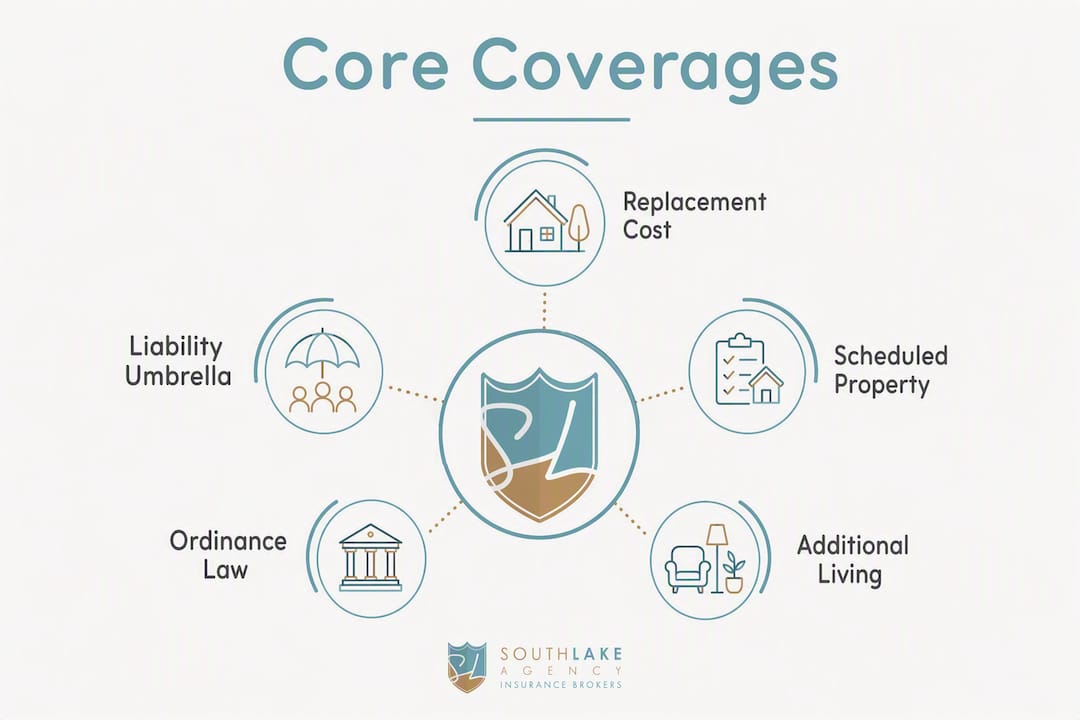
Dwelling coverage at true replacement cost. Market value and replacement cost diverge sharply for custom homes. A guaranteed replacement-cost provision removes the ceiling entirely; an extended replacement-cost provision adds a percentage buffer (often 25%–50%) above your stated limit. Either is preferable to a standard replacement-cost provision with no buffer, because construction cost inflation and post-disaster labor shortages can push rebuild costs well above pre-loss estimates.
Scheduled personal property. Standard policies apply sublimits to categories like jewelry (often $1,500–$2,500), fine art, and silverware. Scheduling individual items with agreed or appraised values eliminates those sublimits and removes depreciation from the settlement calculation. Wine collections, antiques, musical instruments, and firearms all warrant separate scheduling.
Item category | Typical standard sublimit | Scheduled coverage benefit |
Jewelry | $1,500–$2,500 | Agreed value, no depreciation |
Fine art | $2,500–$5,000 | Appraised value, mysterious disappearance covered |
Wine/spirits | Often excluded | Agreed value, breakage included |
Silverware/goldware | $2,500 | Agreed value |
Firearms | $2,500 | Agreed value, broader perils |
Liability and umbrella. High-net-worth households face elevated liability exposure from pools, home staff, frequent entertaining, and ownership of recreational vehicles. A standard $300,000 liability limit is inadequate. Most advisors recommend a personal umbrella policy of at least $1 million, and households with significant assets or public profiles often carry $5 million or more.
Ordinance and law coverage pays the added cost of rebuilding to current building codes after a covered loss. Older luxury homes are particularly exposed: a partial loss can trigger a full code-compliance rebuild of the undamaged portion, a cost that base dwelling coverage does not touch.
Additional living expenses (ALE) should be sized to your actual lifestyle. A family accustomed to a 6,000-square-foot home cannot live in a standard hotel for 18 months of reconstruction. Specialty programs typically offer higher ALE limits and more flexible temporary housing arrangements.
Which coverages usually require a separate policy?
Flood and earthquake are excluded from virtually every standard homeowners policy and from most specialty programs. They require separate placement, and the decision of when to buy them is not always obvious.
Coverage | Standard exclusion? | Primary options | When to prioritize |
Flood | Yes | NFIP or private market | Any FEMA flood zone; lender requirement; basement finish |
Earthquake | Yes | State programs or private market | Pacific Coast, Intermountain West, New Madrid zone |
Excess liability/umbrella | Not excluded, but underlimited | Personal umbrella policy | Net worth above $1M; pools, staff, public profile |
Cyber/identity theft | Usually excluded | Standalone or endorsement | High-profile households, frequent travel |
For high-value homes, private-market flood and earthquake policies are often preferable to the National Flood Insurance Program (NFIP). NFIP caps building coverage at $250,000, which is inadequate for most luxury properties. Private carriers can write higher limits, cover contents at replacement cost, and include additional living expenses that NFIP does not.
Pre-placement property risk reports from specialty carriers can surface flood risk indicators, past unpermitted work, and prior claims that affect both insurability and pricing. Running one before you list a property for sale or purchase is worth the effort.
How do insurers actually value a high-value home?
Valuation accuracy is the single most critical underwriting input for luxury homes. A stale replacement-cost model means your limits are wrong before a loss ever occurs, and no amount of good coverage language fixes an inadequate stated value.
Standard estimating tools use regional cost averages that do not reflect custom finishes, artisan labor rates, or historic salvage methods. A professional replacement-cost appraisal for a luxury home explicitly accounts for:
Custom millwork, plaster, and specialty tile at current contractor rates
Artisan labor premiums for period-appropriate or bespoke work
Premium mechanical and electrical systems (radiant heat, smart-home infrastructure, whole-house generators)
Detached structures, outbuildings, and site improvements
Pro Tip: When documenting a renovation for underwriting purposes, include the contractor’s itemized invoice, the building permit, and a written description of the specific materials and finishes used. A photo record tied to those documents is what an adjuster needs to settle a partial loss accurately.
After any major renovation, replacement-cost valuations must be updated because specialized materials and artisan labor materially increase rebuild costs. Carriers can and do deny or reduce claims when the stated value was not updated to reflect known improvements. If you financed renovations through your mortgage, the loan documentation provides a ready-made paper trail for your insurer.
What drives premiums for high-value homes?
Published industry figures put the average annual premium for $1 million in dwelling coverage at approximately $4,636, though actual premiums vary widely based on location, construction, and coverage selections. That figure is a starting point, not a ceiling.
Premium driver | Direction of effect | Notes |
Insured dwelling limit | Higher limit = higher premium | Largest single driver |
Location/hazard zone | Coastal, wildfire, flood zones add cost | Can affect carrier availability |
Construction and materials | Custom/historic = higher premium | Artisan labor rates drive this |
Age and systems | Older systems (wiring, plumbing) add cost | Updates reduce exposure |
Claims history | Prior claims raise premium | Loss-free discounts available |
Security and mitigation | Sprinklers, monitoring reduce premium | Carrier credits vary |
Scheduled items | Each scheduled item adds premium | Agreed-value benefit offsets cost |
Deductible choices have an outsized effect on luxury home premiums. Raising a deductible from $1,000 to $5,000 or $10,000 can reduce annual premium meaningfully, and for a household with significant liquid assets, self-insuring small losses is often the rational choice. Some specialty programs waive the deductible entirely for catastrophic losses above $50,000–$100,000, which means a higher voluntary deductible carries less downside risk than it would on a standard policy.
How can you reduce premiums and meet underwriting requirements?
Carriers writing luxury homes expect documentation that standard homeowners rarely provide. Arriving at an underwriting conversation prepared shortens the placement timeline and often produces better pricing.
Underwriting requirements for high-value homes typically include a recent home inspection, a professional replacement-cost appraisal, a personal property inventory with photographs, and proof of mitigation systems. Wildfire-zone properties may require documentation of defensible space, ember-resistant vents, and Class A roofing. Coastal properties may need wind-mitigation reports.
Ways to reduce premiums without reducing coverage:
Install a UL-listed central-station alarm and water-leak detection system. Most carriers offer credits, and specialty programs may provide the monitoring technology directly.
Add a whole-house automatic sprinkler system. The premium reduction often approaches the amortized cost of installation over a policy period.
Raise voluntary deductibles on dwelling and personal property, particularly if the specialty program includes a large-loss deductible waiver.
Bundle auto, umbrella, and watercraft with the same carrier or program. Multi-policy credits are common and can be substantial.
Commission a professional personal property inventory. Scheduled items with documented appraised values reduce settlement disputes and can lower the cost of the scheduled-property endorsement.
For more premium-reduction tactics that apply across home insurance, the approach is the same: mitigation investments and documentation pay dividends at renewal.
How do you choose the right broker for a high-value home?
Not every licensed agent has placed a $3 million home with a wine cellar and a guest cottage. The broker selection process for a luxury property deserves the same rigor you would apply to choosing a contractor for a major renovation.
Step-by-step vetting process:
Ask how many high-value homes the broker has placed in the past 12 months and at what dwelling limits.
Request the names of the specialty markets and carriers they have access to.
Ask to see a sample policy or coverage comparison so you can evaluate language, not just price.
Confirm their valuation process: do they order professional replacement-cost appraisals, or do they rely on automated tools?
Ask how they handle claims: do they advocate on your behalf, or do they hand you off to the carrier?
If you are purchasing a home, confirm they coordinate directly with your lender and title company.
Red flags that indicate insufficient expertise:
Quoting only one carrier without explanation
No mention of replacement-cost appraisals or scheduled personal property
Unwillingness to discuss sublimits or policy language in detail
No loss-prevention guidance or mitigation review
Treating umbrella coverage as optional for a high-net-worth household
Broker-led placement that includes multiple-carrier shopping and lender coordination simplifies both the initial placement and any future claims. For Minnesota homeowners, working with a licensed agent who understands local construction costs and weather exposures matters as much as carrier access.
Key Takeaways
High-value home insurance works only when replacement-cost valuation is accurate, high-value items are scheduled, and a specialist broker shops the market on your behalf.
Point | Details |
Verify replacement cost first | Standard estimating tools miss artisan labor and custom finishes; order a professional appraisal before binding coverage. |
Schedule valuables individually | Jewelry, fine art, wine, and antiques face low standard sublimits; agreed-value scheduling removes depreciation from claims. |
Buy flood and earthquake separately | Both perils are excluded from homeowners policies; private-market options offer higher limits than NFIP for luxury properties. |
Document renovations immediately | Update your replacement-cost valuation after any major renovation with invoices, permits, and material specifications. |
South Lake Agency Insurance Brokers | Shops 20+ carriers with no broker fee, and coordinates directly with lenders for new placements. |
Why a specialist broker changes the outcome for luxury homeowners
Most affluent homeowners I speak with have the same blind spot: they assume their current policy is adequate because the premium is high. A high premium does not mean the limits are right. It often means the home is in a hazard zone and the carrier is pricing for that exposure, not for the actual replacement cost of the structure or the value of what is inside it.
The placement value a specialist broker delivers is not just carrier access. It is the discipline to order a professional appraisal before binding, the knowledge to identify which sublimits will matter at claim time, and the willingness to push back on a carrier’s valuation model when it underestimates custom construction. For a home worth $2 million or more, the difference between a well-placed policy and a standard one is not a few hundred dollars in premium. It is whether you can actually rebuild your home after a total loss.
South Lake Agency Insurance Brokers works with over 20 carriers, charges no broker fees, and has a 97.3% client renewal rate across more than 337 five-star reviews. Those numbers reflect what happens when placement is done right the first time.
South Lake Agency Insurance Brokers can secure your high-value coverage
Placing luxury home insurance correctly means shopping carriers who actually write high-value risks, coordinating a professional replacement-cost appraisal, and making sure your collections, liability, and separate-peril needs are all addressed before you sign. South Lake Agency Insurance Brokers does exactly that, with no broker fees and direct lender coordination built into the process.

When you engage South Lake Agency Insurance Brokers, here is what to expect: a licensed agent reviews your current coverage and identifies gaps, shops your risk across 20+ carriers including specialty high-value programs, coordinates valuation if needed, and delivers a side-by-side comparison you can actually read. Clients save an average of $2,246 per placement. Bring your most recent appraisal, a list of scheduled items, and any renovation documentation you have. If you are in Minnesota or the broader Midwest, request a quote through South Lake Agency Insurance Brokers and get a policy built for the home you actually own.
Useful sources and further reading
The claims and figures in this guide draw from the following sources. Each is worth reading in full if you want to go deeper on a specific topic.
Best High-Value Home Insurance Companies Of 2025 (Forbes Advisor) — source for the $750K–$1M threshold range and the $4,636 average annual premium figure for $1M dwelling coverage.
High-Value Home Insurance (WTW) — explains why replacement-cost accuracy is the critical underwriting input and the documentation required after renovations.
What Is High-Value Home Insurance? (U.S. News) — accessible overview of policy types and coverage differences for affluent homeowners.
NAIC Homeowners Insurance Report (content.naic.org) — regulatory and market data on homeowners insurance coverage and claims trends in the United States.
This article provides general information about high value home insurance and is not a substitute for professional insurance or legal advice. Coverage terms, limits, and availability vary by carrier, state, and individual risk profile. Confirm current rules and coverage options with a licensed insurance professional.
Recommended
Comments