




Escrow Homeowners Insurance: What You Need to Know

Updated: Jul 30

Yes, an escrow account commonly pays your homeowners insurance premium on your behalf. Your mortgage servicer collects a portion of your monthly payment, holds it in a dedicated account, and sends the full annual premium directly to your insurer when it comes due. The CFPB defines this as a reserve account established by your lender to cover annual home-related expenses, including homeowners insurance and property taxes. For most buyers, this arrangement runs quietly in the background, but understanding it prevents costly surprises like unexpected payment increases or, worse, a lapse in coverage.
The practical effect on your cash flow is real. Instead of writing a single check for $1,200 or more once a year, you pay $100 a month as part of your mortgage. South Lake Agency works with homeowners through exactly this process, coordinating with lenders and servicers to make sure coverage stays current and premiums are accurate.
Table of Contents
How does escrow pay your homeowners insurance each month?
The mechanics are straightforward, though the details matter.
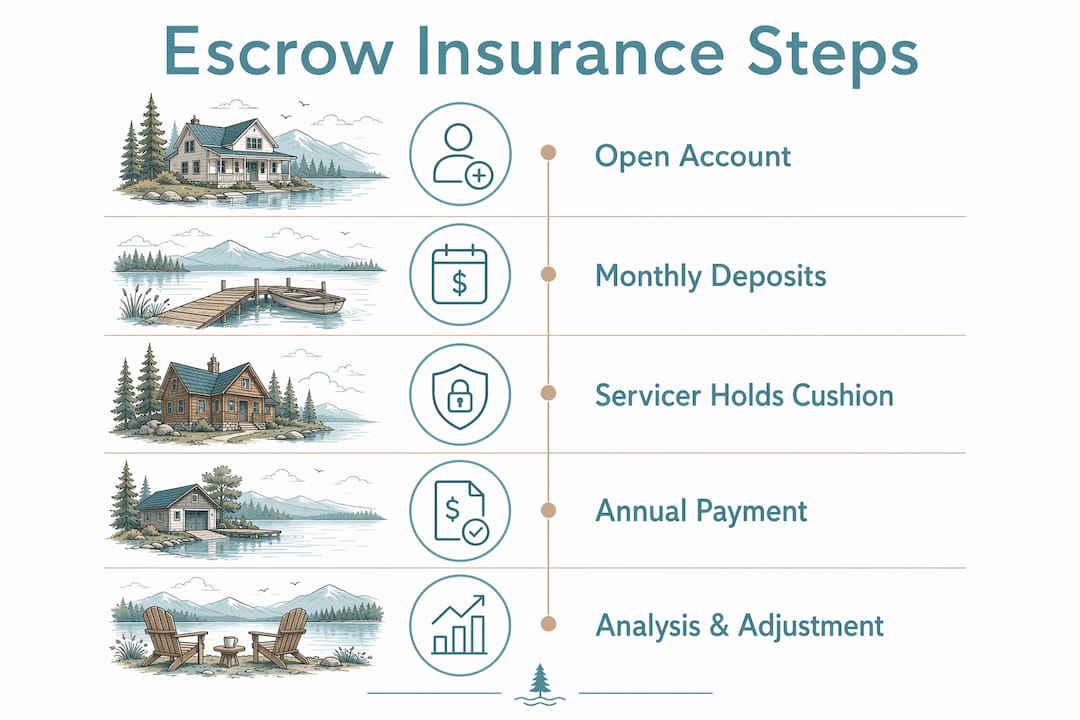
Monthly collection. Each mortgage payment includes a portion earmarked for escrow. Your servicer calculates this by dividing your annual insurance premium (plus property taxes and any other escrowed items) by 12, then adding a cushion.
Funds held in a dedicated account. The servicer acts as custodian. The money sits in your escrow account until your insurer’s billing date arrives.
Disbursement to the insurer. When the premium is due, the servicer pays your insurer directly. You typically receive no separate bill.
Annual escrow analysis. Once a year, your servicer reconciles the account, comparing what was collected against what was actually paid. If your premium went up, you may owe a shortage. If it dropped, you get a refund or a credit.
The cushion is worth understanding. Under federal rules, lenders may hold up to two months of escrow payments as a buffer. That cushion covers timing gaps and unexpected premium increases, but it also means your escrow balance can look higher than you’d expect.
Property taxes, PMI, and flood insurance can all share the same escrow account. Each item gets its own line in the annual analysis statement, so you can see exactly what was collected and paid for each one.

Pro Tip: Request your annual escrow analysis statement and compare the servicer’s projected insurance premium to the renewal bill from your insurer. Discrepancies happen, and catching them early prevents a shortage from blindsiding you mid-year.
Who is required to use escrow, and when can you pay insurance directly?
Escrow is not optional for every borrower. Lenders typically require an escrow account when your down payment is under 20% or when you have a government-backed loan such as an FHA or VA mortgage. The logic is straightforward: the lender has a financial stake in the property, and an uninsured loss would be their problem too.
Beyond those standard triggers, individual lender policies vary. Some servicers require escrow regardless of down payment size. Others allow waivers for well-qualified borrowers. It pays to ask.
Three common scenarios:
New buyer with 5% down. Escrow is almost certainly mandatory. You have no choice here, and that is not necessarily a bad thing.
Refinancer with significant equity. You may qualify for a waiver, but the lender may charge a small fee or a slight rate adjustment for the privilege. Run the numbers.
Homeowner with a paid-off mortgage. No lender, no escrow requirement. You pay your insurer directly and manage the timing yourself.
The CFPB’s guidance on lender escrow practices outlines homeowner rights and the conditions under which servicers can require or waive escrow. If you believe your servicer is applying escrow requirements incorrectly, the CFPB is the right place to start.
Pro Tip: Before requesting an escrow waiver, ask your lender for the exact fee or rate impact in writing. Some lenders charge 0.25% of the loan amount annually, which can easily exceed any interest you’d earn by holding the funds yourself.
How your monthly escrow payment for insurance is calculated
The formula is simple. What trips people up is the cushion.

Formula: (Annual insurance premium + annual property taxes + required cushion) ÷ 12 = monthly escrow deposit
Here is what that looks like with real numbers:
Item | Annual Amount | Monthly Portion |
Homeowners insurance premium | $1,200 | $100 |
The cushion in this example covers two months of the insurance premium, which is the maximum a lender may hold under federal guidelines. Your servicer spreads that cushion across 12 payments, so it adds a small amount each month rather than hitting you all at once.
On timing: insurers typically bill annually, and servicers schedule disbursements to arrive before the policy renewal date. If your policy renews in March, expect your servicer to send payment in late February. When you review your escrow analysis, the disbursement schedule will show the projected payment dates for each item.
Escrow vs. paying insurance directly: which makes more sense for you?
Escrow is a payment mechanism, not a discount. Paying through escrow does not lower your premium; your insurer sets the rate regardless of how the bill gets paid.
Reasons to keep escrow
No lapse risk. The servicer pays on time, every time. Missing an annual premium payment yourself can trigger a coverage gap, and if your lender discovers it, they can purchase force-placed insurance on your behalf, which typically costs far more and covers far less.
Easier budgeting. One predictable monthly payment covers housing, taxes, and insurance together.
No large annual outlay. You never need to have $1,200 or more sitting in a checking account on renewal day.
Reasons to pay directly
Liquidity. The money stays in your account until you need it. If you can earn interest on those funds, you keep that return rather than leaving it in a non-interest-bearing escrow account.
Control. You choose when and how to pay, and you can time premium payments to align with cash flow.
Factor | Escrow | Pay Directly |
Lapse risk | Very low | Depends on your discipline |
Monthly cash flow | Predictable | Requires self-management |
Interest on funds | None (escrow earns little or no interest) | You keep any earned interest |
Force-placed insurance risk | Low | Higher if payment is missed |
Best for | Most buyers, tight cash flow | Disciplined savers, equity-rich borrowers |
Pro Tip: If you’re considering ways to lower your home insurance premium, do it before your policy renews. A lower premium reduces your escrow deposit, which means a smaller monthly payment going forward.
How to manage your escrow account and handle common problems
Most homeowners never touch their escrow account until something goes wrong. A little proactive attention prevents most problems.
Read the annual escrow analysis. Check the projected premium against your actual renewal bill. Verify the cushion amount and confirm the disbursement dates. If the numbers don’t match your insurer’s records, call your servicer before the shortage compounds.
Handle shortages promptly. When your analysis shows a shortage, you usually have two options: pay the full amount at once, or spread it across the next 12 monthly payments. The spread option is more manageable but increases your payment for the year.
Change insurers the right way. You can switch carriers while keeping escrow in place. Buy the new policy first, then immediately provide your servicer with the new policy’s declaration page, the insurer’s name, the policy number, and the premium amount. Do this before your old policy expires.
Avoid force-placed insurance. If you fail to provide proof of a new policy, your servicer may purchase force-placed coverage. It protects the lender’s interest, not yours, and the cost gets added to your loan balance.
Follow up in writing. After notifying your servicer of a policy change, call to confirm receipt and ask for written confirmation. Keep copies of the new declaration page and any correspondence.
When notifying your servicer of an insurer change, include: the effective date of the new policy, the new insurer’s name and billing address, the policy number, the annual premium amount, and your loan number. A short cover letter with those five details is all most servicers need.
Pro Tip: Keep a folder, physical or digital, with your current policy declaration page, the most recent escrow analysis, and any servicer correspondence. If a dispute arises, you’ll have everything in one place.
Key Takeaways
Escrow pays your homeowners insurance automatically, but you still need to verify the numbers annually and act quickly when your coverage or premium changes.
Point | Details |
Escrow pays insurance for you | Your servicer collects monthly, then pays your annual premium directly to your insurer. |
Cushion adds to your payment | Lenders may hold up to two months of escrow payments as a buffer, which increases your monthly deposit slightly. |
Shortages and surpluses are normal | Annual escrow analysis reconciles collected vs. paid amounts; shortages can be paid at once or spread over 12 months. |
Switching insurers requires fast action | Provide your servicer with the new policy details immediately to avoid force-placed insurance. |
South Lake Agency coordinates for you | South Lake Agency shops 20+ carriers, delivers proof of coverage to servicers, and helps avoid coverage gaps during transitions. |
The case for keeping escrow (and when to question it)
Most homeowners with a down payment under 20% or a government-backed loan have no choice about escrow, and honestly, for that group, it is usually the right default. The risk of a missed annual premium is real, and force-placed insurance is expensive enough to wipe out any interest you might have earned by holding the funds yourself.
Where the calculus shifts is for equity-rich homeowners who have paid down their mortgage significantly, maintain strong cash reserves, and have confirmed their lender’s waiver terms in writing. For those borrowers, paying directly and keeping the funds in a high-yield account until renewal day is a legitimate strategy. But it requires genuine discipline, not just good intentions.
The piece most people overlook: changing insurers near a renewal date is where things go sideways. The timing window between buying a new policy, notifying your servicer, and having the old policy expire is tight. A broker who coordinates directly with your lender and title company, the way South Lake Agency does during closings, removes most of that friction. For a routine mid-cycle switch, the steps in the section above are manageable on your own. For a purchase closing or a refinance, having someone handle the coordination is worth it.
South Lake Agency helps you get coverage right the first time
Sorting out escrow and homeowners insurance on your own is doable, but the coordination between your insurer, servicer, and lender leaves room for gaps. South Lake Agency takes that off your plate.

As an independent brokerage with access to 20+ top-rated carriers, South Lake Agency shops your coverage, delivers proof of insurance directly to your mortgage servicer, and explains exactly how your premium affects your escrow deposit. Clients save an average of $2,246, and a 97.3% renewal rate reflects what happens when coverage actually fits. No broker fees, ever.
Whether you’re buying a home, switching carriers, or trying to make sense of a shortage on your escrow analysis, the licensed agents at South Lake Agency handle the details.
Useful sources and references
The sources below are the primary references used throughout this guide.
Source | What It Covers |
CFPB: What is an escrow or impound account? | Federal definition, cushion rules, force-placed insurance, and homeowner rights |
CFPB: Escrow Requirements Under TILA / Regulation Z | Regulatory framework for when lenders must require escrow |
Wells Fargo: What is an escrow account and how does it work? | Calculation methodology and annual escrow analysis explanation |
Progressive: How Does Escrow & Homeowners Insurance Work? | Insurer perspective on escrow as a payment mechanism; pricing neutrality |
American Family Insurance: Paying homeowners insurance through escrow | Switching insurers while escrowed; direct-pay interest opportunity |
Experian: Is Homeowners Insurance Included in My Mortgage Payment? | Down payment thresholds and escrow waiver eligibility |
This article is general information, not legal or financial advice. Escrow requirements and lender policies vary. Confirm the current rules with your mortgage servicer or a qualified professional for your specific situation.
Recommended
Comments