




Comprehensive vs. Collision: Which Coverage Do You Need?

Updated: Aug 13

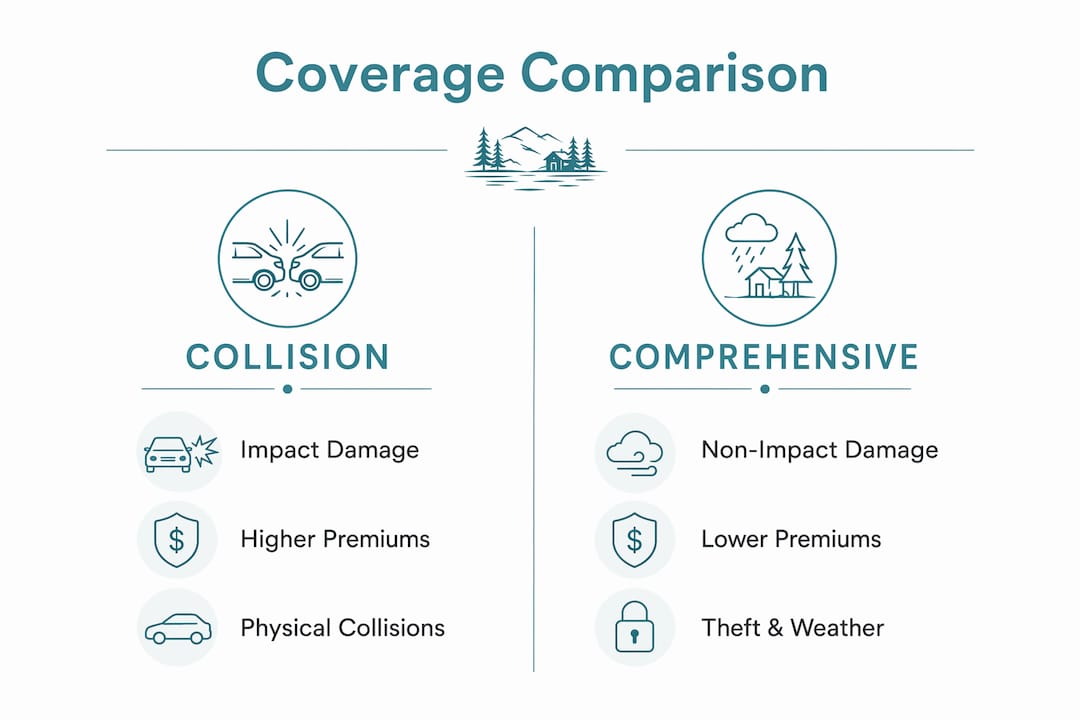
Collision pays for damage your car sustains from a crash or impact. Comprehensive pays for everything else: theft, weather, animals, vandalism. Most drivers with a loan or lease need both; if your car is paid off and worth less than a few thousand dollars, the math may favor dropping one or both.
Keep collision if you drive frequently, commute in heavy traffic, or couldn’t afford a repair bill out of pocket after an accident.
Keep comprehensive if you live in an area with high theft, hail, or deer-strike risk, or if your lender requires it until the loan is paid off.
Table of Contents
What does collision coverage actually pay for?
Collision coverage pays to repair or replace your vehicle when it makes physical contact with another car, an object, or the road surface itself. The trigger is always impact, regardless of who caused it.
Common collision claims include:
Rear-ending another car at a stoplight
Sideswiping a parked vehicle in a parking lot
Hitting a guardrail, telephone pole, or fence
Scraping a mailbox while pulling out of a driveway
Pothole damage that bends a rim or cracks a suspension component
A single-vehicle rollover
The payout works the same way across all of these: the insurer reimburses repair costs up to your vehicle’s actual cash value (ACV), minus your deductible. ACV is what your car is worth on the open market today, not what you paid for it or what it would cost to buy new. If repairs exceed ACV, the car is totaled and you receive the ACV amount minus the deductible.
Collision premiums run higher than comprehensive on average because collision claims are more frequent and costlier to settle. That frequency is exactly why deductible choice matters so much here.
Pro Tip: Set your collision deductible at the highest amount you could realistically pull together within 30 days. If $1,000 would wipe out your emergency fund, choose $500. The premium savings from a higher deductible rarely justify the financial stress of a payment you can’t make.
What does comprehensive coverage pay for?
Comprehensive covers damage that happens to your car without a collision being the cause. Think of it as the “everything else” bucket: theft, vandalism, fire, weather events, falling objects, and animal strikes all fall here.
Typical comprehensive claims:
A deer runs into your car on a rural highway
Hail dents your hood and roof
A tree limb falls on your parked car overnight
Your windshield cracks from a flying rock
Your car is stolen from a parking garage
Someone keys your door or smashes a window
Like collision, comprehensive pays up to ACV minus your deductible. The key difference is cost: Triple-I reports average annual premiums around $134 for comprehensive versus around $290 for collision. That gap reflects the lower frequency of comprehensive claims, even though individual events like theft or a total hail loss can be just as expensive.
Comprehensive is often the smarter coverage to keep on an older car precisely because it’s cheap relative to what it protects against. A stolen $8,000 car is a financial gut punch; paying $134 a year to cover that risk is a reasonable trade.
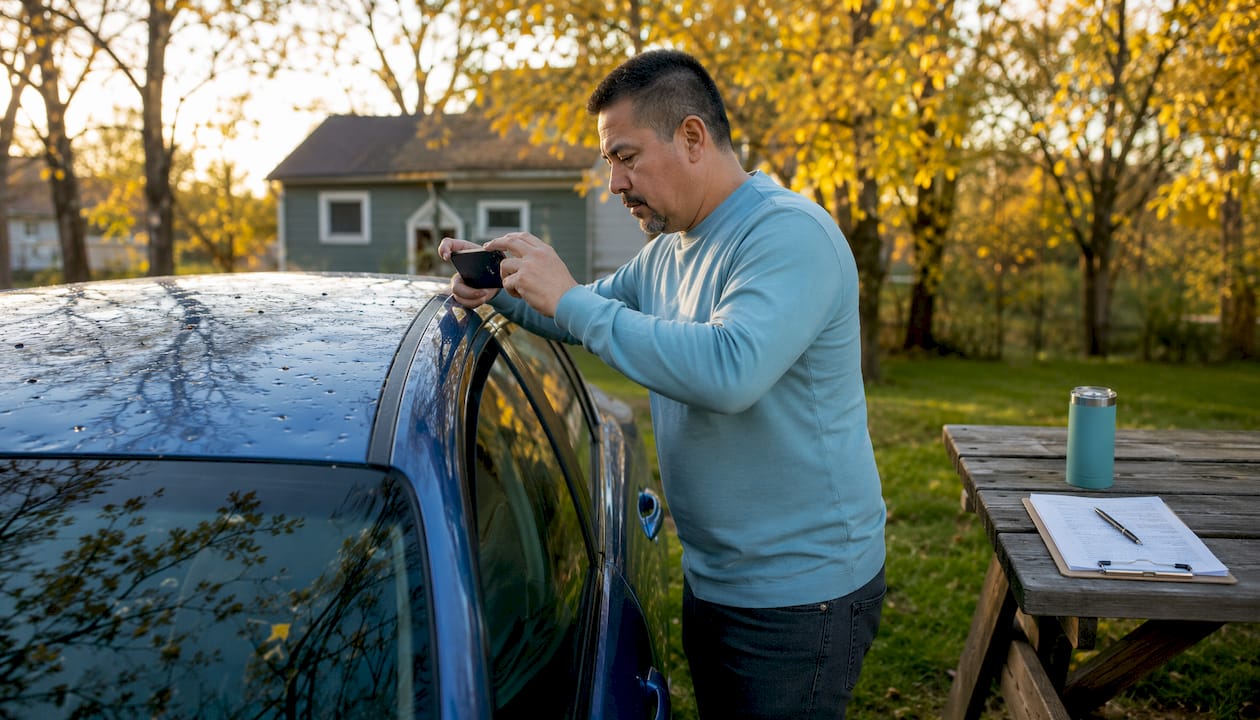
Pro Tip: Your comprehensive deductible should reflect what you can absorb immediately, since these losses tend to be sudden and unplanned. A stolen car or a hail storm doesn’t give you 30 days to prepare. If your savings are thin, keep the deductible low.
How do comprehensive and collision compare side by side?
The core distinction between the two coverages is the cause of the damage, not the repair cost or the dollar amount paid out. Both pay up to ACV minus your deductible; the only question is what triggered the loss.

Feature | Collision | Comprehensive |
What triggers it | Physical impact with another car, object, or road surface | Non-collision events: theft, weather, animals, fire, vandalism |
Required by state law | No (liability is required; collision is not) | No |
Required by lender/lease | Almost always, until loan is paid off | Almost always, until loan is paid off |
Average annual premium | ~$290 | ~$134 |
Deductible | Separate; you choose the amount | Separate; you choose the amount independently |
When it matters most | High-mileage drivers, newer or higher-value cars, urban commuters | Drivers in storm-prone, high-theft, or rural deer-strike areas |
Common examples | Rear-end, guardrail, parking-lot scrape, rollover | Deer strike, hail, theft, falling tree limb, vandalism |
A few things worth noting here. First, neither coverage is mandated by state law; every state requires liability, but collision and comprehensive are optional unless a lender demands them. Second, you set a separate deductible for each coverage independently, so you can carry a $500 collision deductible and a $250 comprehensive deductible on the same policy. Third, filing a collision claim, especially an at-fault one, can raise your future premiums. Post-accident rate increases vary by insurer and state, but at-fault accidents can push rates up significantly, which is one more reason to weigh deductible size carefully before filing small claims.
Is a $500 or $1,000 deductible the better choice?
The deductible is the amount you pay before the insurer covers the rest. Choose $500 and your premium is higher; choose $1,000 and you pocket the savings but absorb more risk per claim.
The math works like this: if raising your collision deductible from $500 to $1,000 saves you $120 a year in premium, you’d need to go more than four years without a collision claim to come out ahead. File a claim in year two, and you’ve paid an extra $500 out of pocket while saving only $240 in premium. That’s a net loss of $260.
The 10% rule offers a useful check on whether to carry the coverages at all: if your combined annual premium for collision plus comprehensive exceeds roughly 10% of your car’s ACV, maintaining both may not be cost-effective. On a car worth $5,000, that threshold is $500 per year. If you’re paying $700 combined, the numbers lean toward dropping one or both, assuming you could handle the loss.
Average annual premiums (Triple-I): Collision runs approximately $290 per year; comprehensive runs approximately $134 per year, for a combined average near $424 before any discounts or surcharges.
Rising premiums across the board make this calculation more pressing than it used to be. Understanding why insurance costs are climbing can help you decide whether a higher deductible or a coverage change makes more sense for your budget.
When are you actually required to carry these coverages?
Neither collision nor comprehensive is required by state law. Every state mandates liability coverage to protect other drivers, but what happens to your own car is legally your business. The mandate comes from lenders, not legislators.
If you finance or lease your vehicle, the loan or lease agreement almost certainly requires both collision and comprehensive until the balance is paid off. That requirement protects the lender’s financial interest in the car. Skip the coverage, and the lender can force-place insurance on your behalf, typically at a much higher rate and with less favorable terms for you.
Once the car is paid off, the decision is entirely yours. That’s when the 10% rule becomes the right starting point:
Look up your car’s current ACV (Kelley Blue Book and NADA Guides are reliable starting points).
Add up your annual collision and comprehensive premiums.
If that combined premium exceeds 10% of ACV, dropping one or both is worth considering.
Factor in your personal liquidity: could you replace the car out of pocket if it were totaled or stolen?
Dropping collision on a $4,000 car that you could replace without financial hardship is a reasonable call. Dropping comprehensive on that same car in a hail-prone state, where a single storm could total it, is a riskier move given how inexpensive comprehensive tends to be.
How to decide which coverage to carry: a practical checklist
Most drivers overthink this. Run through these five steps and the answer usually becomes clear.
Step 1: Find your car’s ACV. Check Kelley Blue Book or NADA Guides for a private-party value. That’s the ceiling on what any insurer will pay, regardless of what you owe on the loan.
Step 2: Apply the 10% rule. Add your annual collision and comprehensive premiums. If the total exceeds 10% of ACV, maintaining both is harder to justify on pure math. Use this as a starting point, not a hard rule.
Step 3: Test your liquidity. Could you pay your deductible today without stress? Could you replace the car entirely if it were totaled and you received nothing? If either answer is no, keep the coverage.
Step 4: Factor in your risk profile. High-mileage commuters have more collision exposure. Drivers in the upper Midwest or Southeast face real hail and storm risk. Anyone parking on a city street overnight has higher theft and vandalism exposure. Geography and driving patterns matter.
Step 5: Shop deductibles and carriers separately. Raising your collision deductible while keeping a lower comprehensive deductible is a legitimate strategy, since comprehensive events tend to be more sudden and less predictable. Getting side-by-side quotes across multiple carriers can surface meaningful price differences for the same coverage structure.
Pro Tip: An independent broker can run quotes from 20+ carriers at once and flag whether your lender’s requirements are already baked into your current policy. That single conversation often saves more than any deductible adjustment.
Is this a collision or comprehensive claim? Common scenarios
This is where most confusion happens. The rule is simple: if your car made contact with something while moving, it’s almost always collision. If something happened to your parked or stationary car, or an animal was involved, it’s almost always comprehensive.
You hit a mailbox while backing out: Collision. Your car made contact with an object.
A deer runs into your car on the highway: Comprehensive. Animal strikes are non-collision events regardless of speed or damage.
Hail dents your roof: Comprehensive. Weather damage falls outside collision triggers.
Someone vandalizes your car overnight: Comprehensive. Vandalism is a non-collision event.
Your car is stolen: Comprehensive. Theft is explicitly covered under comprehensive.
You’re rear-ended at a red light: Collision. The other driver’s liability may cover it, but if they’re uninsured or underinsured, your collision coverage steps in.
You hit a guardrail after a tire blowout: Collision. Contact with road infrastructure is a collision trigger.
A single-vehicle rollover: Collision. The vehicle contacted the road surface.
A tree limb falls on your parked car: Comprehensive. Falling objects are a named comprehensive peril.
One scenario that trips people up: if you swerve to avoid a deer and hit a tree, that’s collision, not comprehensive. The deer didn’t make contact with your car; the tree did. Filing under the wrong coverage at first notice can complicate the claim, so getting the trigger right from the start matters.
How to get coverage and what to do after a loss
Adding collision or comprehensive to an existing policy is straightforward. Call your insurer or broker, confirm your vehicle’s VIN and current ACV, choose your deductibles, and the coverage typically takes effect the same day. If you’re buying a car with a loan, the lender will specify minimum coverage requirements in the financing documents.
When damage occurs:
Document everything immediately. Photos of all damage, the scene, and any other vehicles or objects involved.
File a police report when the car is stolen, vandalized, or involved in a hit-and-run. Many insurers require it for those claim types.
Contact your insurer promptly. Most carriers have 24-hour claims lines and mobile apps for first notice of loss.
Get an estimate. The insurer will send an adjuster or direct you to an approved shop. You can get your own estimate as a reference point.
Understand the payout. You’ll receive ACV minus your deductible. If the car is totaled, the insurer takes the vehicle and pays you the ACV amount.
If you disagree with the insurer’s ACV assessment, you can negotiate with documentation: comparable listings, recent sales data, and any upgrades or low-mileage condition factors. For complex total-loss disputes, a public adjuster or attorney can help, though most straightforward claims don’t require that step.
Key Takeaways
Collision and comprehensive are complementary coverages, not substitutes: the right choice depends on your car’s value, your financial cushion, and your lender’s requirements.
Point | Details |
Collision vs. comprehensive trigger | Collision pays for impact damage; comprehensive pays for theft, weather, animals, and other non-collision events. |
Average annual cost | Collision averages ~$290/year; comprehensive averages ~$134/year, per Triple-I data. |
The 10% rule | If combined annual premiums exceed 10% of your car’s ACV, dropping coverage may make financial sense. |
Lender requirement | Financing or leasing almost always requires both coverages until the loan or lease is satisfied. |
Southlakemn advantage | Southlakemn shops 20+ carriers at no broker fee to find the right deductible and coverage structure for your vehicle and budget. |
What most drivers get wrong about these two coverages
The conventional advice is to treat comprehensive and collision as a package deal: either you have “full coverage” or you don’t. That framing misses the point entirely.
These are two separate coverages with separate deductibles, separate premium lines, and separate risk profiles. A driver in rural Minnesota with a paid-off 2015 pickup might have excellent reasons to keep comprehensive (hail, deer, theft) and drop collision entirely if the premium math doesn’t hold up. A city commuter with a newer car and a loan has the opposite situation: collision is the coverage doing the heavy lifting.
The other thing most articles gloss over: comprehensive is genuinely cheap for what it covers. Paying roughly $134 a year to protect against theft, a total hail loss, or a deer strike is one of the better insurance values available. Collision is the one worth scrutinizing more carefully as a car ages, because the premium doesn’t always drop as fast as the car’s value does.
The 10% rule is a starting point, not a verdict. Your personal liquidity, your driving environment, and your lender’s requirements all modify the answer. Run the numbers, then make the call.
How Southlakemn helps you get the right auto coverage
Shopping for the right deductible structure across collision and comprehensive is exactly where an independent broker earns its keep. Southlakemn connects drivers with 20+ top-rated carriers at no broker fee, running side-by-side comparisons so you can see exactly what each deductible choice costs across multiple insurers, not just one.

The agency averages $2,246 in savings per client and holds a 97.3% renewal rate, backed by over 337 five-star reviews. If you have a loan or lease, Southlakemn also coordinates directly with your lender to confirm coverage requirements are met from day one. No guesswork, no gaps.
Get a free, no-obligation quote at southlakemn.com and find out exactly what collision and comprehensive should cost for your specific vehicle, driving profile, and budget.
Sources and further reading
Insurance Information Institute (Triple-I): What is covered by collision and comprehensive auto insurance?
MoneyGeek: Comprehensive vs. Collision Car Insurance
CBS News: Comprehensive vs. collision auto insurance
State Farm: Collision vs. Comprehensive Insurance
Jacoby & Meyers: How Much Will My Insurance Go Up After an Accident?
Southlakemn: Why is the cost of insurance rising?
Recommended
Comments